BCSP Chapter 13: Thermal Stressors Explained – Heat Stress, Cold Stress & Control Strategies
Автор: QHSE Talks
Загружено: 2026-03-12
Просмотров: 32
Описание:
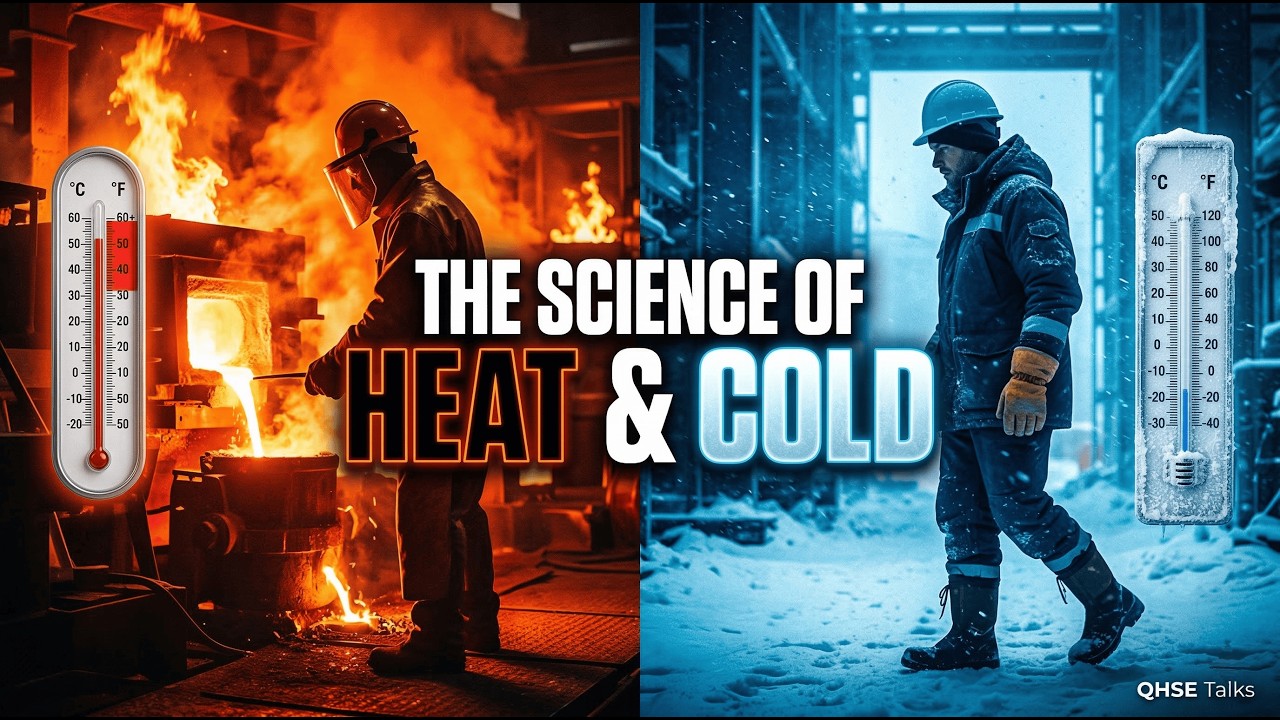
BCSP Chapter 13 focuses on one of the most critical topics in occupational health and industrial hygiene: thermal stressors. For safety professionals preparing for the ASP and CSP certification exams, understanding how the human body responds to extreme heat and cold is essential. This chapter provides the scientific principles, physiological responses, exposure evaluation methods, and control strategies needed to manage heat stress and cold stress in the workplace.
Thermal stress occurs when environmental conditions overwhelm the body’s natural thermoregulation mechanisms. In hot environments, workers may experience heat stress, which results from a combination of environmental heat, metabolic heat generated by physical activity, humidity, radiant heat, and air movement. When these factors exceed the body’s ability to dissipate heat, the body experiences heat strain, leading to a progression of heat-related illnesses.
Safety professionals must understand the physiological responses to heat exposure, including vasodilation, increased skin blood flow, and sweating for evaporative cooling. However, high humidity can reduce evaporation efficiency, increasing the risk of dangerous heat conditions. Workers exposed to heat hazards may develop several illnesses such as heat rash, heat cramps, heat syncope, heat exhaustion, and heat stroke. Among these, heat stroke is a life-threatening medical emergency that occurs when the body’s core temperature rises above approximately 104°F (40°C) and the central nervous system begins to fail.
To properly evaluate heat stress hazards, BCSP Chapter 13 introduces the Wet Bulb Globe Temperature (WBGT) index, which is the most widely used environmental heat stress indicator in occupational safety. WBGT accounts for humidity, radiant heat, air temperature, and air movement. Safety professionals must understand the two different WBGT equations used depending on environmental conditions: indoor environments without solar load and outdoor environments with direct sunlight.
In addition to environmental heat measurements, safety practitioners must evaluate metabolic heat production, which represents the heat generated by the human body during physical work. Tasks are categorized into workload levels such as light, moderate, heavy, and very heavy work based on metabolic energy expenditure. The time-weighted average metabolic rate equation is used to determine overall workload when workers perform multiple tasks during a shift. Combining metabolic rate with WBGT values allows safety professionals to determine appropriate work-rest cycles and prevent excessive body heat accumulation.
Another key concept covered in Chapter 13 is the human heat balance equation, which explains how the body maintains thermal equilibrium through radiation, convection, conduction, and evaporation. Understanding this heat balance is fundamental to designing effective engineering controls such as ventilation systems, shielding from radiant heat, and process insulation.
The chapter also emphasizes the hierarchy of controls for managing thermal stress. Engineering controls include ventilation, air conditioning, reflective shielding, and increased air velocity. Administrative controls include acclimatization programs, work-rest scheduling, hydration protocols, and monitoring environmental conditions. Acclimatization is particularly important, as the body typically requires 7–14 days to adapt to hot working environments. Workers are also encouraged to follow proper hydration practices, typically drinking 5–7 ounces of water every 15–20 minutes during hot work conditions.
While heat stress is a major occupational concern, BCSP Chapter 13 also addresses the opposite extreme: cold stress. Cold environments can cause the body to lose heat faster than it can produce it, resulting in dangerous conditions such as hypothermia, frostbite, chilblains, and immersion foot (trench foot). The chapter explains how wind significantly increases heat loss through convective cooling, which is why the Wind Chill Temperature equation is used to estimate how cold conditions feel to exposed skin.
The Wind Chill Index and modern Wind Chill Temperature formulas help safety professionals evaluate the severity of cold environments and determine the potential risk of frostbite. Proper cold-weather protection requires a three-layer clothing system, consisting of a moisture-wicking inner layer, an insulating middle layer, and a wind-resistant outer layer. Additional preventive measures include warm shelters, scheduled warm-up breaks, and monitoring workers for early symptoms of cold stress.
#BCSP #CSPExam #ASPSafety #ThermalStress #HeatStress #ColdStress #WBGT #WindChill #IndustrialHygiene #SafetyProfessional
Повторяем попытку...
Доступные форматы для скачивания:
Скачать видео
-
Информация по загрузке:




![Пожалуй, главное заблуждение об электричестве [Veritasium]](https://imager.clipsaver.ru/6Hv2GLtnf2c/max.jpg)





![Эффект Джанибекова [Veritasium]](https://imager.clipsaver.ru/N9HlQ-XVnFk/max.jpg)