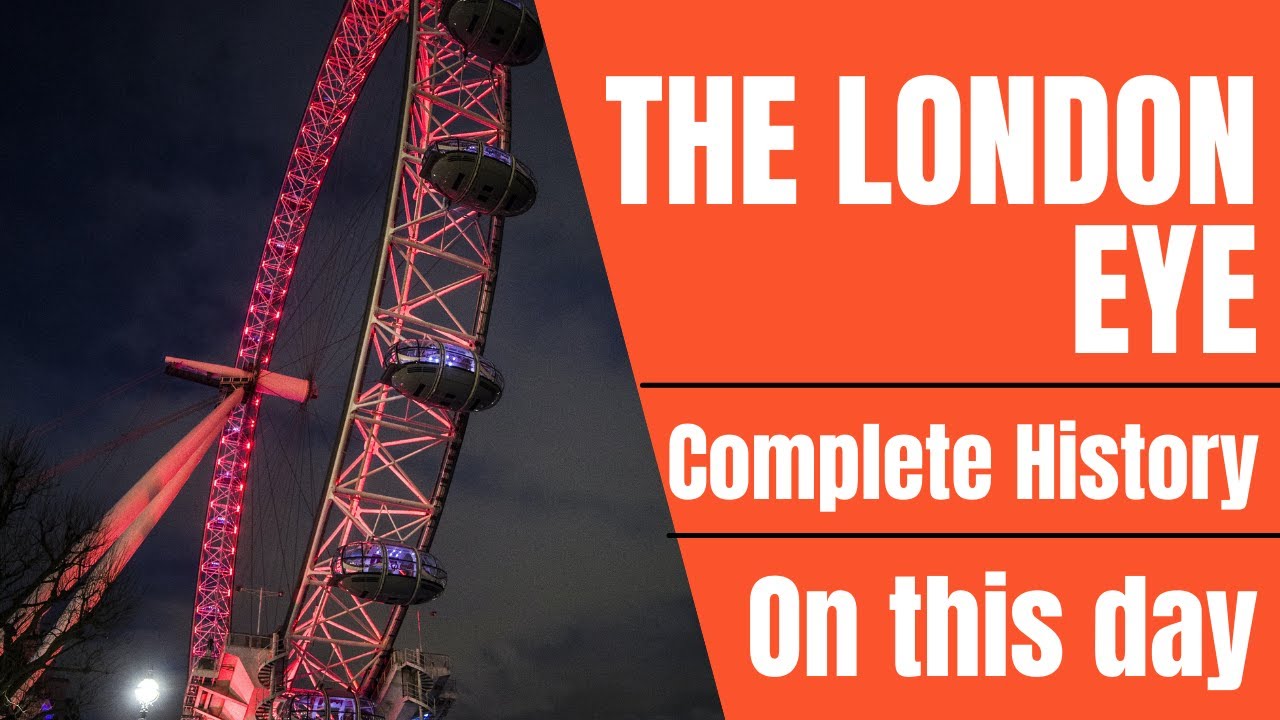
The London Eye - Complete History and facts - Opened on March 9, 2000 - On this day in History
Автор: On this Day
Загружено: 2021-02-20
Просмотров: 722
Описание:
The London Eye, or the Millennium Wheel, is a cantilevered observation wheel on the South Bank of the River Thames, in London. It is Europe's tallest cantilevered observation wheel, and is the most popular paid tourist attraction in the United Kingdom, with over 3 million visitors annually. It has made many appearances in popular culture.
#Education #History #OnThisDay
The structure is 135 metres tall, and the wheel has a diameter of 120 metres. When it opened to the public in 2000, it was the world's tallest Ferris wheel. Its height was surpassed by the, Star of Nanchang in 2006, in Singapore Flyer in 2008, and the High Roller
in Las Vegas, in 2014. Supported by an A-frame on one side only, unlike the taller Nanchang and Singapore wheels, the Eye is described by its operators as "the world's tallest cantilevered observation wheel".
The London Eye used to offer the highest public viewing point in London, until it was superseded by the 245-metre-high observation deck on the 72nd floor of The Shard, which opened to the public on 1 February 2013.
The London Eye, adjoins the western end of Jubilee Gardens, on the South Bank of the River Thames, between Westminster Bridge and Hungerford Bridge, beside County Hall, in the London Borough of Lambeth.
In March 2020, the London Eye celebrated its 20th birthday, by turning several of its pods into experiences themed, around London, in partnership with its sponsor lastminute.com. The special experiences, included a pub in a capsule, a west end theatre pod and a garden party with flower arrangements to represent the eight London Royal parks.
The London Eye was designed by the husband-and-wife team of Julia Barfield and David Marks of Marks Barfield Architects.
Mace was responsible for construction management, with Hollandia as the main steelwork contractor and Tilbury Douglas as the civil contractor. Consulting engineers Tony Gee & Partners designed the foundation works while Beckett Rankine designed the marine works.
Nathaniel Lichfield and Partners, assisted The Tussauds Group in obtaining planning and listed building consent to alter the wall on the South Bank of the Thames. They also examined and reported on the implications of a Section 106 agreement attached to the original contract, and also prepared planning and listed building consent applications for the permanent retention of the attraction, which involved the co-ordination of an Environmental Statement, and the production of a planning supporting statement detailing the reasons for its retention.
The rim of the Eye is supported by tensioned steel cables and resembles a huge spoked bicycle wheel. The lighting was re-done with LED lighting from Color Kinetics in December 2006, to allow digital control of the lights as opposed to the manual replacement of gels over fluorescent tubes.
The wheel was constructed in sections which were floated up the Thames on barges and assembled lying flat on piled platforms in the river. Once the wheel was complete it was lifted into an upright position by a strand jack system made by Enerpac. It was first raised at 2 degrees per hour until it reached 65 degrees, then left in that position for a week while engineers prepared for the second phase of the lift. The project was European with major components coming from six countries: the steel was supplied from the UK and fabricated in The Netherlands by the Dutch company Hollandia, the cables came from Italy, the bearings came from Germany (FAG/Schaeffler Group), the spindle and hub were cast in the Czech Republic, the capsules were made by Poma in France (and the glass for these came from Italy), and the electrical components from the UK.
The London Eye was formally opened by the Prime Minister Tony Blair, on 31 December 1999, but did not open to the paying public until 9 March 2000 because of a capsule clutch problem.
The London Eye was originally intended as a temporary attraction, with a five-year lease. In December 2001, operators submitted an application to Lambeth Council to give the London Eye permanent status, and the application was granted in July 2002.
On 5 June 2008 it was announced that 30 million people had ridden the London Eye since it opened.
The nearest London Underground station is Waterloo, although Charing Cross, Embankment, and Westminster are also within easy walking distance.
Connection with National Rail services is made at London Waterloo station and London Waterloo East station.
Повторяем попытку...
Доступные форматы для скачивания:
Скачать видео
-
Информация по загрузке:




![[4K] PARIS 2025 🇫🇷 1 Hour Aerial Drone Relaxation Film UHD | FRANCE](https://imager.clipsaver.ru/WHNNHAoaZD4/max.jpg)



![Эффект Джанибекова [Veritasium]](https://imager.clipsaver.ru/N9HlQ-XVnFk/max.jpg)