Why Were the Visby Soldiers Buried in Their Armor? Visby 1361
Автор: History Made Clear
Загружено: 2026-11-09
Просмотров: 22
Описание:
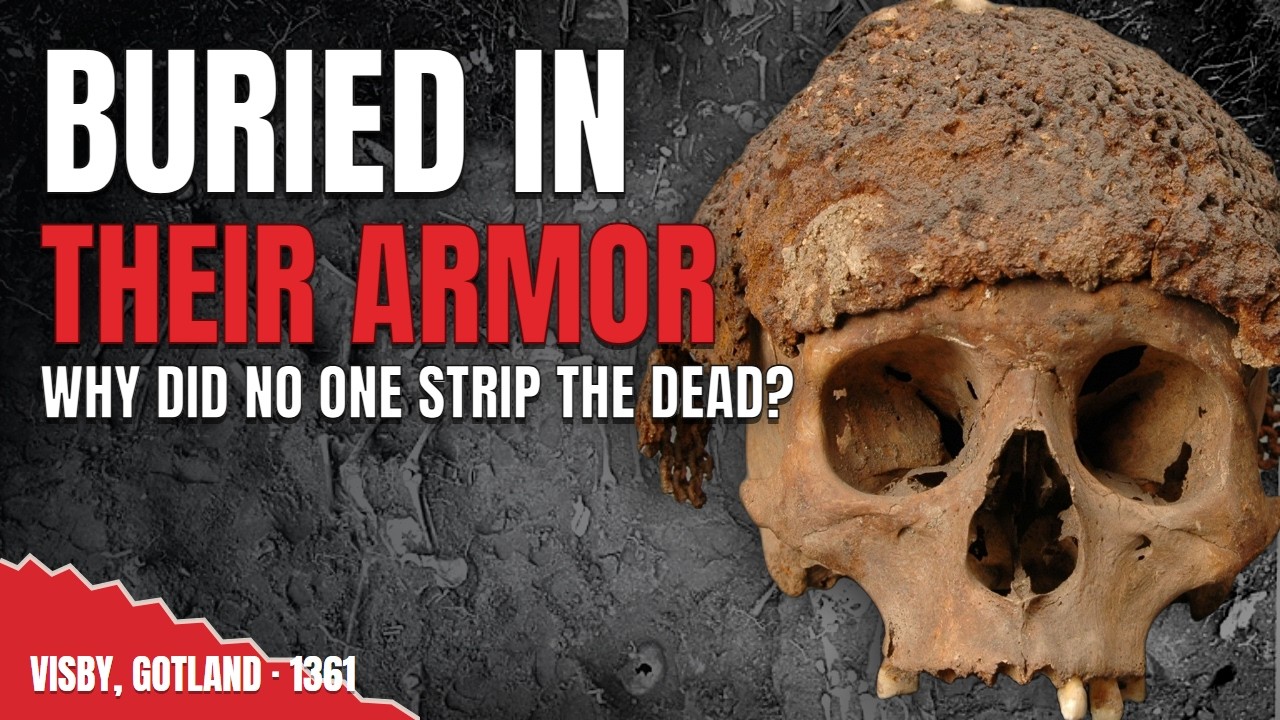
In 1905, workers digging outside the medieval wall of Visby, on the Swedish island of Gotland, opened a pit packed with 256 skeletons. Many still wore their mail hoods. Over the next 25 years archaeologists found at least 1,185 people in the Cross Meadow, the dead of one afternoon: 27 July 1361, when King Valdemar IV of Denmark destroyed Gotland's farmer army. On a medieval battlefield the dead were stripped of everything valuable. Here the weapons were taken, yet around 25 coats of plates and 185 mail hoods went into the ground with their owners. Why?
We follow the story from a Danish kingdom pawned to its creditors, through Valdemar's comeback and his invasion of the richest island in the Baltic, to the massacre at the wall. Then we open the graves: the four theories the Swedish History Museum puts forward, the clues the excavators found, and what the skeletons reveal about who fought, how they died and how the myths grew.
⏱ CHAPTERS
0:00 The graves outside the wall
2:35 Part 1: A Kingdom in Pawn
5:34 Part 2: Atterdag
9:56 Part 3: The Jewel of the Baltic
12:03 Part 4: Landing at Fröjel
15:12 Part 5: Massacre at the Wall
19:23 Part 6: Pits in the Cross Meadow
22:41 Part 7: Why Leave the Armour?
26:14 Part 8: What the Bones Say
31:00 Part 9: After the Slaughter
33:27 The Answer
📚 SOURCES
• Statens historiska museer (Swedish History Museum): exhibition "Medieval Massacre – the Battle of Gotland 1361" and research pages; Riksantikvarieämbetet (Swedish National Heritage Board), Mästerby 1361 battlefield report (2007)
• B. Thordeman, P. Nørlund, B. E. Ingelmark, Armour from the Battle of Wisby 1361 (1939); P. Åkeson, "De begravda vid Korsbetningen" (Arkeologi på Gotland 2, 2017); Forsom & Smith, Journal of Archaeological Science: Reports (2017); Curry & Foard, Journal of Conflict Archaeology (2016); T. Neijman & K. V. Jensen, The Battle of Visby 1361 and Its Contemporary Heritage (2025); G. Westholm, Visby 1361 (2007)
• Encyclopaedia Britannica; Aarhus University (danmarkshistorien); Deutsche Biographie
📷 Images: Wikimedia Commons and the Swedish History Museum open collection (public domain, CC0, CC BY, CC BY-SA). Swedish History Museum photos by Victoria Dabir, Jenny Nyberg, Jens Mohr, Thomas Neijman, Gabriel Hildebrand, Maria Neijman, Helena Rosengren, Lisa Hartzell – Historiska museet/SHM (CC BY 4.0). Other CC images: W.carter (CC BY 4.0); Rasmus Christiansen (1863-1940) (CC BY-SA 4.0); Mariusz Paździora (CC BY 3.0); Bonio (CC BY 2.5); Julius Jääskeläinen (CC BY 2.0); Anders Johnson (CC BY 3.0); Casandra Borg (CC BY-SA 4.0); Dguendel (CC BY 3.0); Tadeusz Hare (CC BY-SA 4.0); Danne77 (CC BY-SA 3.0); Gustaf Emil Pettersson (CC BY-SA 4.0); Bene Riobó (CC BY-SA 4.0); CarstenBN (CC BY 3.0); Erik Cleves Kristensen (CC BY 2.0); Herman Langland (CC BY-SA 4.0); Sven Rosborn (CC BY-SA 4.0); W.carter (CC BY-SA 4.0); Arild Vågen (CC BY-SA 4.0); RobKohl (CC BY-SA 4.0); VisbyStar (CC BY 4.0); Susanne Nilsson from Trelleborg, Sweden (CC BY-SA 2.0); Per Pettersson from Stockholm, Sweden (CC BY 2.0); En-cas-de-soleil (CC BY-SA 4.0). Paintings and reconstructions are labelled with their date. Maps: historical-basemaps (A. Ourednik, GPL-3.0), AWS Terrain Tiles. No AI images.
🔔 Subscribe for history told in full, from both sides.
#Visby #MedievalHistory #Archaeology
Повторяем попытку...
Доступные форматы для скачивания:
Скачать видео
-
Информация по загрузке: