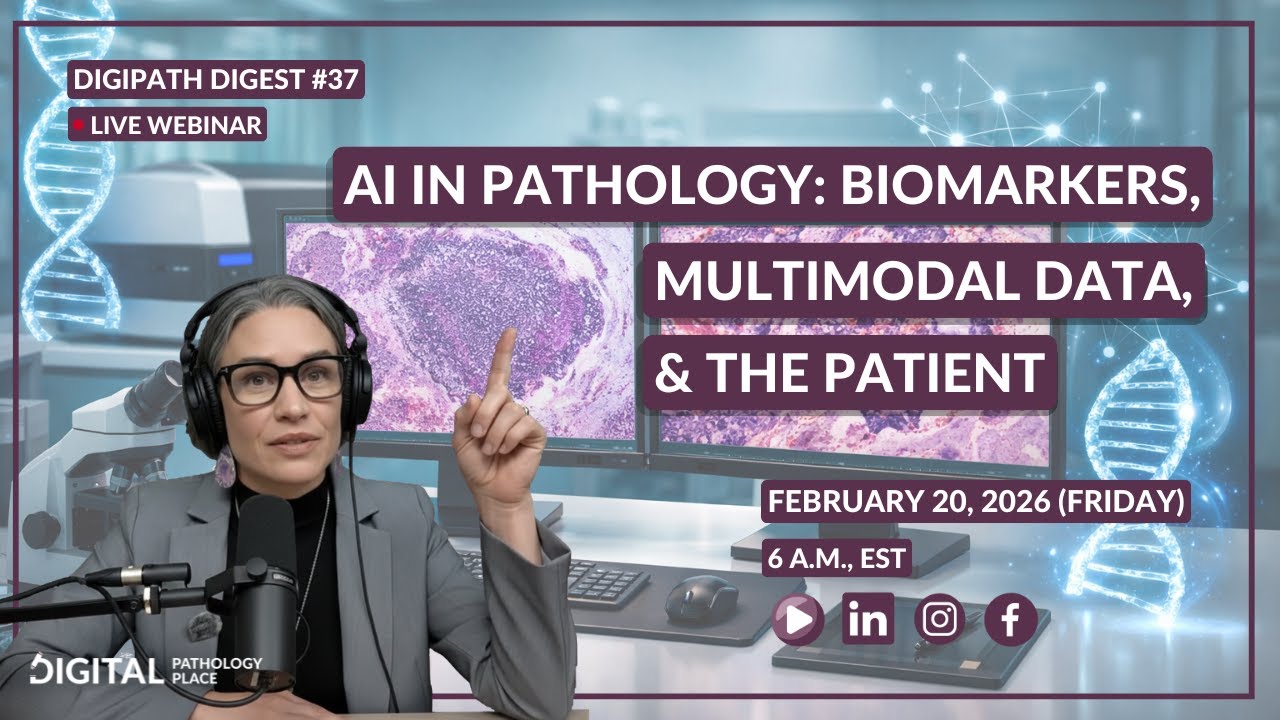
188: AI in Pathology: Biomarkers, Multimodal Data & the Patient
Автор: Dr. Aleks Digital Pathology & AI
Загружено: 2026-02-21
Просмотров: 23
Описание:
Send a text (https://www.buzzsprout.com/twilio/tex...)
Is AI in pathology actually improving diagnosis — or just adding complexity?
In DigiPath Digest #37, we reviewed four recent publications covering AI-based biomarker quantification in glioblastoma, real-world digital workflow integration in prostate cancer, multimodal AI combining histopathology and genomics, and patient perspectives on AI in cancer diagnostics.
This episode connects technical performance with something equally important: trust.
Episode Highlights
[00:02] Community & updates
Digital Pathology 101 free PDF, upcoming patient-focused book, and global attendance.
[04:07] AI-based image analysis in glioblastoma
AI showed strong consistency with pathologists when quantifying Ki-67, P53, and PHH3.
Significant biological correlations (Ki-67 ↔ PHH3, PHH3 ↔ P53) were detected by AI — not by manual assessment.
Takeaway: computational quantification improves precision.
[09:28] Real-world digital workflow + AI in prostate cancer (France)
AI-pathologist concordance:
• 93.2% (high probability cancer detection)
• 99.0% (low probability slides)
Gleason concordance: 76.6%
10% failure rate due to pre-analytical artifacts.
Takeaway: infrastructure and sample quality still matter.
[15:58] Multimodal AI (MARBIX framework)
Combines whole slide images + immunogenomic data in a shared latent space using binary “monograms.”
Performance in lung cancer: 85–89% vs 69–76% unimodal models.
Takeaway: integrated data improves case retrieval and similarity reasoning.
[22:13] AI-powered paper summary subscription introduced
Structured summaries for busy professionals who want more than abstracts.
[26:17] Patient roundtable on AI in pathology (Belgium)
Patients expect:
• Better accuracy
• Faster turnaround
• Stronger collaboration
Trust is high when:
• Algorithms use diverse datasets
• Pathologists retain final responsibility
Clinical validity mattered more than full algorithm transparency.
Privacy concerns focused more on insurer misuse than cloud transfer.
Key Takeaways
• AI improves biomarker precision in glioblastoma.
• Digital pathology implementation works — but pre-analytics can limit AI performance.
• Multimodal AI represents the next meaningful step in precision diagnostics.
• Patients are not afraid of AI — they want validation, oversight, and governance.
• Human–AI collaboration remains central.
If you’re working in digital pathology, computational pathology, or precision oncology, this episode connects evidence, implementation, and patient perspective.
Support the show (https://www.buzzsprout.com/410071/sup...)
Get the "Digital Pathology 101" FREE E-book and join us! (https://digitalpathology.club/digital...)
Повторяем попытку...
Доступные форматы для скачивания:
Скачать видео
-
Информация по загрузке: