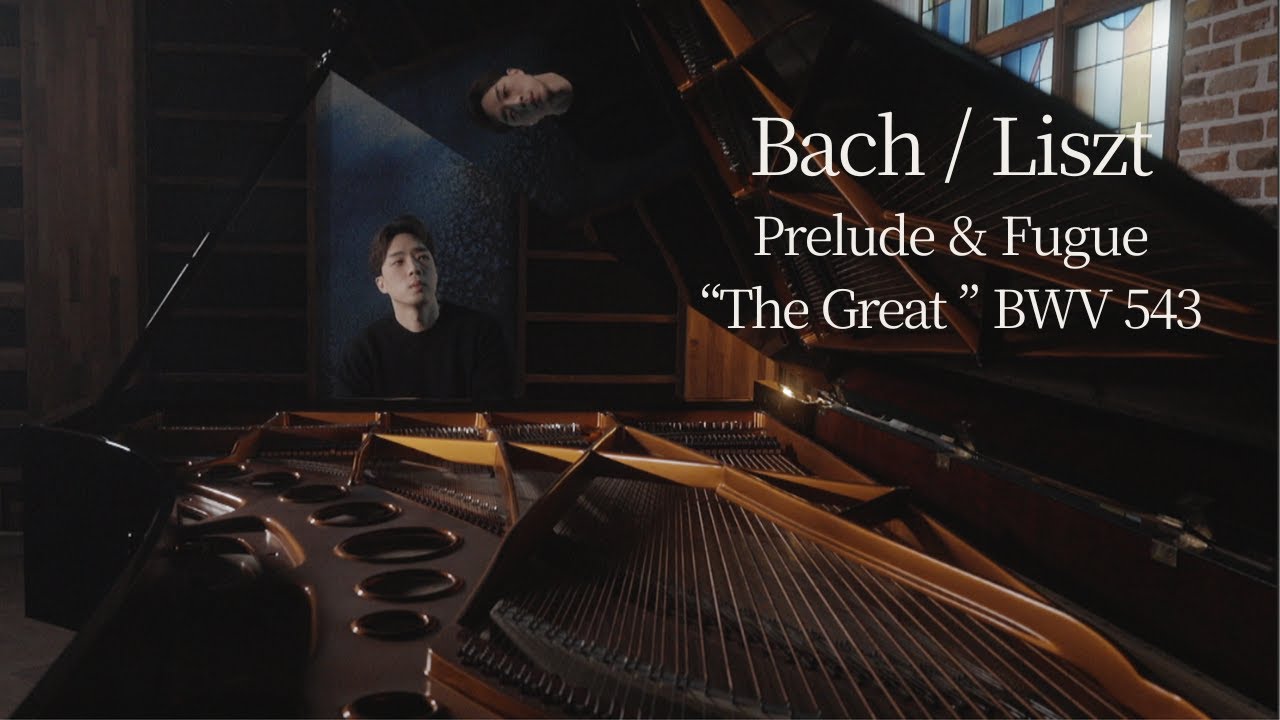
Bach / Liszt - Prelude & Fugue in A Minor, BWV. 543
Автор: Sehun Kim
Загружено: 2026-01-26
Просмотров: 1106
Описание:
#bach #classicalpiano #바흐 #피아노연주 #피아니스트
Sehun Kim plays
Bach / Liszt - Prelude & Fugue in A Minor, BWV. 543
Recorded in YAGI Studio (Seoul, South Korea)
www.yagi.co.kr
Interpretation -
Must Bach’s music really be played without rubato,
like a metronome, with minimal pedal,
emphasizing only structure and mathematical clarity?
This idea has long been accepted as an unquestionable truth.
Yet I have always felt a quiet doubt within it.
Was this truly Bach’s intention?
One only has to listen to Bach’s most famous work,
Toccata and Fugue in D minor, BWV 565,
to realize how misguided this belief is.
That music is not cold calculation,
but a vast breath and a storm of emotion.
Freedom hidden within rules,
and order reborn from that freedom-
this, I believe, is the true essence of Bach.
The tragedy lies in how incorrect ideas and education,
repeated over generations,
solidify into something accepted as truth.
BWV. 543 is a striking example of this phenomenon.
That is why I decided to record this piece-
to reveal once more the living vitality of Bach as I perceive it.
Although this work was originally written for the organ,
Liszt transferred it to the piano with remarkably little alteration.
He respected Bach’s structure,
changing nothing but the language through which it speaks.
For this reason, even when performed on the piano,
this piece remains wholly and unmistakably Bach.
The work is believed to have been composed during Bach’s years
at the Weimar court (1708–1713).
At that time, Bach was deeply absorbing
the vibrant rhythms and clear forward momentum
of Italian music, especially that of Vivaldi.
Those influences are clearly present here, yet many people believe it should be played so slowly - especially the Fugue.
The Prelude is written in the North German organ tradition
known as Stylus Phantasticus-
a style rooted in improvisation and free imagination,
with a distinctly toccata-like rhetoric.
What is fascinating is that every word used to describe
Stylus Phantasticus stands in direct opposition
to the image we commonly associate with “Bach.”
From the Prelude’s deep bass A, a resonance emerges-
like a shadow slowly revealing itself in dense fog.
Unsettling, yet powerfully present.
The sounds begin cautiously,
then grow increasingly violent,
intertwining and colliding
until they erupt as a single, overwhelming force.
It feels like destiny-
an inevitable current that cannot be resisted.
The Fugue begins in a gigue-like character (6/8 meter).
It reflects the Italianate momentum Bach absorbed from the Allegro movements of Vivaldi’s L’estro Armonico.
Bach transforms this sense of propulsion into the very motor of the fugue.
For this reason, the gigue should not be played too slowly.
Through the relentless continuation of the “hierarchical tail” (the chaining of voices),
static order is replaced by a sense of rotational energy.
It is no longer rule, but motion.
My goal was to allow every voice to sing-
to remain alive and expressive-
even within this immense storm of controlled chaos.
I discarded hundreds of takes,
and I have never experienced a recording process this demanding.
At last, all voices converge
into a brilliant explosion of cadenza and octaves-
a finale that feels like bursting light.
Yet the final chord is not a Picardy cadence.
It ends in minor,
returning to the very A (bass)
that opened the Prelude.
The tension remains unresolved.
And with that fateful tone, the work comes to an end.
Повторяем попытку...
Доступные форматы для скачивания:
Скачать видео
-
Информация по загрузке: