Circumference and arc length: Edexcel GCSE Maths Revision
Автор: Math Revision LM
Загружено: 2026-01-27
Просмотров: 6
Описание:
Beyond the Curve: The Surprising Logic Hidden Within the Humble Circle
Circles are perhaps the most common geometric shapes in our daily lives, found in everything from the wheels of a bicycle to the face of a clock or a slice of pizza. Yet, for many of us, measuring these rounded boundaries often feels like a memory test from school rather than the precision tool it actually is. Understanding the logic behind the curve allows us to define our world with remarkable accuracy, moving beyond guesswork to mathematical certainty.
One Perimeter, Two Paths to the Answer
In geometry, we use specific terminology to describe the boundaries of round objects. While we use the term "perimeter" for shapes with straight sides, a circle has its own dedicated name for this distance.
Circumference: The distance around a circle; its perimeter. Formula: A mathematical rule that links variables, by substituting the values that can be changed with words or letters, eg a² + b² = c². A formula contains an equals (=) sign.
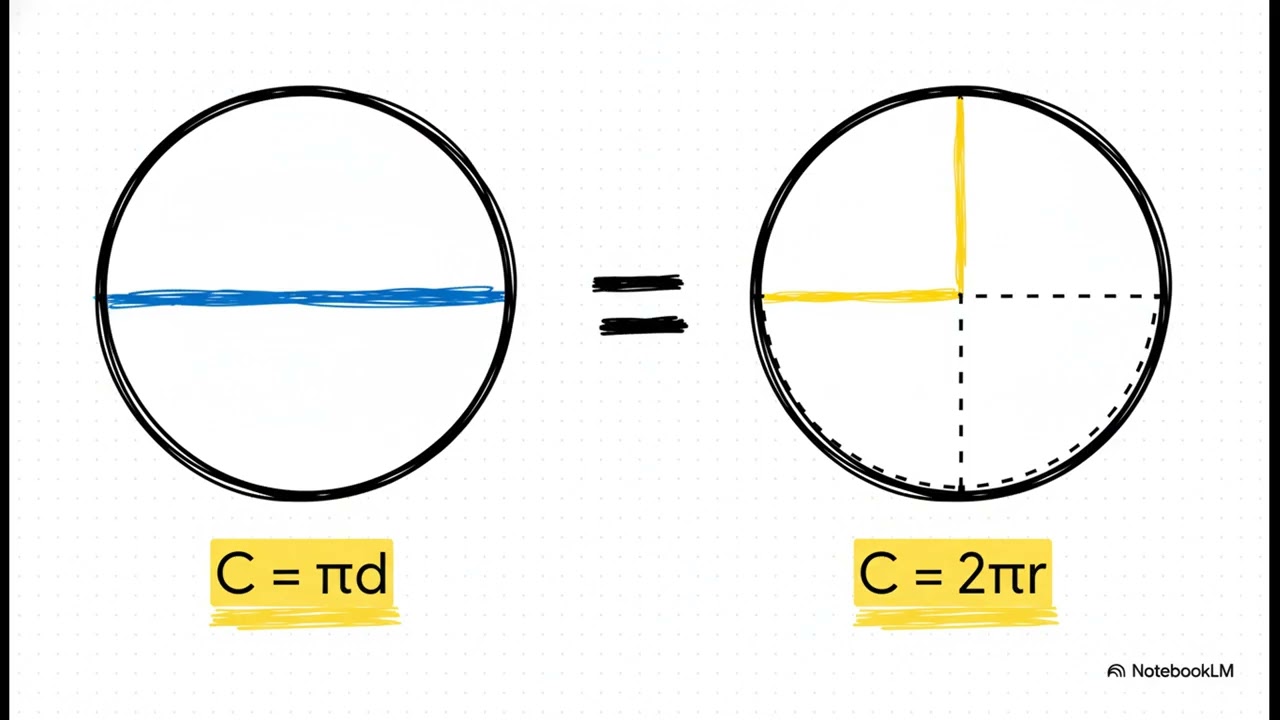
The beauty of circle geometry lies in its flexibility. Depending on which part of the circle you have measured, you can choose between two primary formulae to find the circumference:
C = πd: Use this when you know the diameter (the distance across the circle through the center).
C = 2πr: Use this when you know the radius (the distance from the center to the edge).
Because the diameter is exactly twice the length of the radius, these two paths always lead to the same destination. This isn't a redundant complication; it is a feature of mathematical flexibility that allows you to solve problems efficiently regardless of your starting measurement.
The Tangent’s "Invisible" Right Angle
While a circle is entirely curved, it interacts with straight lines in specific, predictable ways. One of the most important of these interactions involves the tangent.
A tangent is a straight line which touches the edge of a circle at a single point.
This interaction represents a fundamental rule of geometric precision: at the exact point where the tangent touches the circle, it is perpendicular to the radius. This means it creates a perfect 90° angle. This invisible relationship is a cornerstone of how engineering transforms curved designs into stable, straight-edged structures.
The "Straight Edge" Trap in Sector Perimeters
When we look at a "slice" of a circle, we are dealing with a Sector. Formally, this is a portion of a circle with a perimeter made up of two radii and an arc. It is easy to focus only on the curved edge, known as the arc length. Because an arc is a fraction of the total circle, its length is determined by the angle of the "slice."
Arc length formula: Arc length = θ ÷ 360 × 2πr
In this formula, the symbol θ (theta) represents the sector angle. However, there is a common "straight edge trap" when calculating the perimeter of the whole slice. While the arc length only covers the curved part, the perimeter of the entire sector must include the two straight radii that form the sides. To find the total perimeter, you must calculate the arc length and then add the lengths of those two straight edges.
Reversing the Logic (Working Backward)
Mathematics is rarely just about moving in one direction; it is about the relationship between variables. If you are given the circumference of a circle, you can use "inverse operations" to reveal the diameter or radius. Because the circumference is found by multiplying by π, the inverse is to divide by π.
Finding the Diameter from a Decimal Circumference:
Start with the circumference: 37.68 m.
Use the approximation of π = 3.14.
Divide the circumference by π: 37.68 ÷ 3.14.
Result: The diameter is 12 m.
Finding the Radius from a Circumference in "Terms of Pi":
Start with the circumference: 22π cm.
Divide by π to isolate the diameter: 22π ÷ π = 22 cm.
Divide the diameter by 2 to find the radius: 22 ÷ 2.
Result: The radius is 11 cm.
The Precision of "Terms of Pi"
When calculating circle measurements, you will often choose between using an approximation (like 3.14) or giving the answer "in terms of π" (such as 7π). As a math advocate, I encourage the latter when precision is key—leaving π in the answer is the most accurate method because it avoids rounding errors.
However, practical tasks often require decimal answers rounded to a specific degree of accuracy. To maintain mathematical literacy, we must be comfortable with two concepts:
1. Decimal Places (d.p.): This refers to the number of digits after the decimal point. For example, 0.275 has three decimal places. If we round 6.83715 to 2 d.p., it becomes 6.84.
2. Significant Figures (s.f.): These are the digits that give the most meaning to a number. The first significant figure is always the first non-zero digit.
Повторяем попытку...
Доступные форматы для скачивания:
Скачать видео
-
Информация по загрузке: