Voyage Data Recorder (VDR) - A Brief Description
Автор: Merchant Navy Knowledge
Загружено: 2022-07-22
Просмотров: 5797
Описание:
Voyage Data Recorder (VDR) on a Ship Explained.
#ships #bridgewatch #mariners #navy
Voyage Data Recorder (VDR) on a Ship Explained
The IMO defines the Voyage Data Recorder as a complete system, including any items required to interface with the sources of input signals, their processing and encoding, the final recording medium, the playback equipment, the power supply and dedicated reserve power source.
Akin to the ‘Black Box’ on airplanes, a Voyage Data Recorder is an equipment fitted onboard ships that record the various data on a ship which can be used for reconstruction of the voyage details and vital information during an accident investigation.
Information is stored in a secure and retrievable form, relating to the position, movement, physical status, command and control of a ship over the period and following an incident. This information is used during any subsequent safety investigation to identify the cause(s) of the incident. Aside from its usage in accident investigation, it can also be used for preventive maintenance, performance efficiency monitoring, heavy weather damage analysis, accident avoidance and training purposes to improve safety and reduce running costs.
Understanding VDR
As mentioned earlier, a VDR or voyage data recorder is an instrument safely installed on a ship to continuously record vital information related to the operation of a vessel. It contains a voice recording system for a period of at least last 12 hours (for VDRs installed post-July 2014, the period of the integrated details recorded is 48 hours as per the MSC Resolution 333.90). This recording is recovered and made use of for investigation in events of accidents in a compressed and digitised format.
A ship’s VDR is far superior to a black box of an aeroplane as it stores a variety of data and that too for not less than a period of 12 hours. The data records covering the last 12 hours are continuously overwritten by the latest data.
A VDR is capable of withstanding heavy weather, collisions, fires and pressure conditions even when a ship is at a depth of several meters in water.
How VDR works?
The VDR can be classified to contain following units,
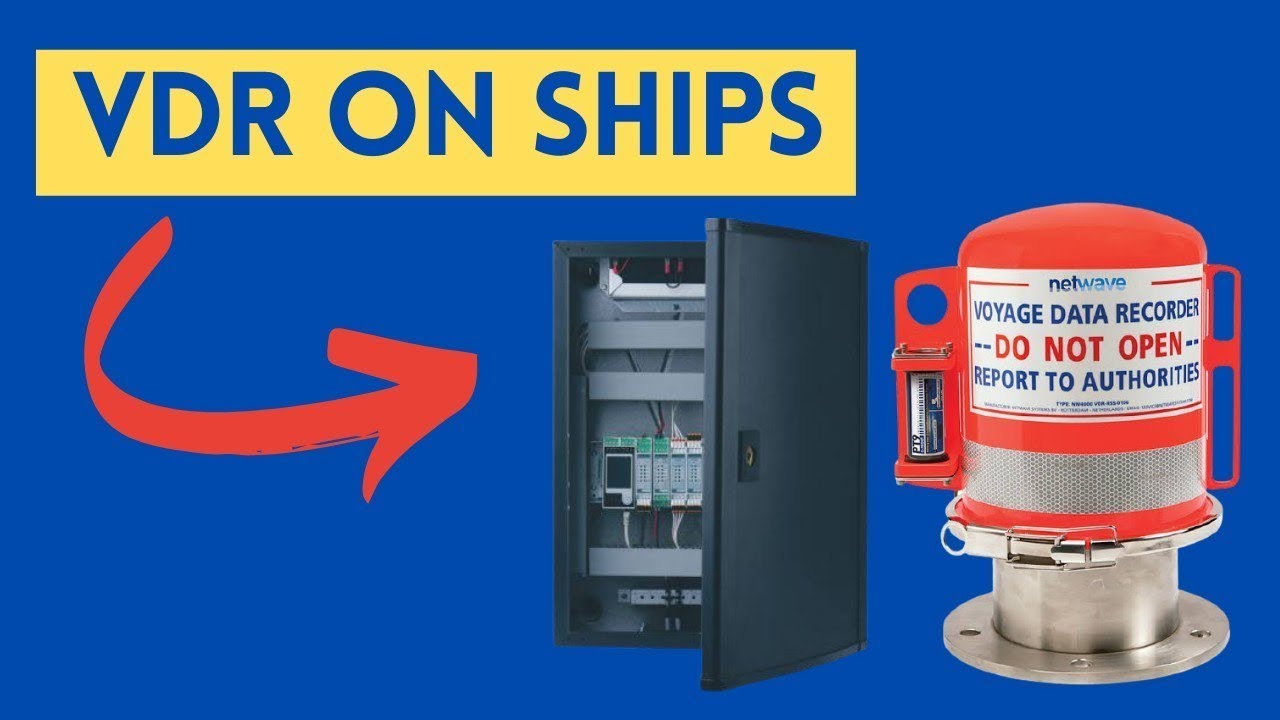
– the Data Collection Unit (DCU) (fitted on the bridge that pulls in data from all the integrated sources),
– a Data Recording Unit (DRU) (fitted on the monkey island that stores all of the data that is recorded via the unit within the wheelhouse) and microphones to record bridge audio. The DCU contains the Data Processor Unit, interface modules and backup batteries. It collects data from sensors as required by the IMO and IEC standards. The batteries supply power to the DCU to record bridge audio for 2 h in case of a main ship’s power failure. The flash memory in the DRU stores the data coming from the DCU. The data can be retrieved by using playback software for investigation after an incident. The DRU components are embodied in the protective capsule. The capsule ensures survival and recovery of the recorded data after an incident.
The flash memory in the DRU stores the data coming from the DCU. The data can be retrieved by using playback software for investigation after an incident. The DRU components are embodied in the protective capsule. The capsule ensures survival and recovery of the recorded data after an incident.
The DCU contains the Data Processor Unit, interface modules and backup batteries. It collects data from sensors as required by the IMO and IEC standards. The batteries supply power to the DCU to record bridge audio for 2 hrs in case of a main ship’s power failure. The flash memory in the DRU stores the data coming from the DCU. The data can be retrieved by using playback software for investigation after an incident. The DRU components are embodied in the protective capsule. The capsule ensures survival and recovery of the recorded data after an incident.
The data that is collected or pulled in from all the integrated sources is, as mentioned above, kept in the storage capsule and holds information for the 12 hours (or 48 hours) preceding it and continuously refreshed as the voyage progresses.
There is also a record button provided in the bridge unit so that after pushing button (say during starting of any incident like collision or grounding), the recorder will start recording a new set of information from that period of time.
The capsule mentioned above is a very sturdy unit, capable of withstanding shock and pressures associated with a marine mishap (collision, grounding, bad weather etc). It might be a float-free arrangement as with the HRU or attached with the EPIRB for simultaneous release.
The VDR at least must record the following:
Date and time (SVDR)
Ship’s position (SVDR)
Speed and heading (SVDR)
Bridge audio (SVDR)
Communication audio (radio) (SVDR)
Radar data (SVDR)
ECDIS data (SVDR)
Echo sounder
Main alarms
Rudder order and response
Hull opening (doors) status
Повторяем попытку...
Доступные форматы для скачивания:
Скачать видео
-
Информация по загрузке: