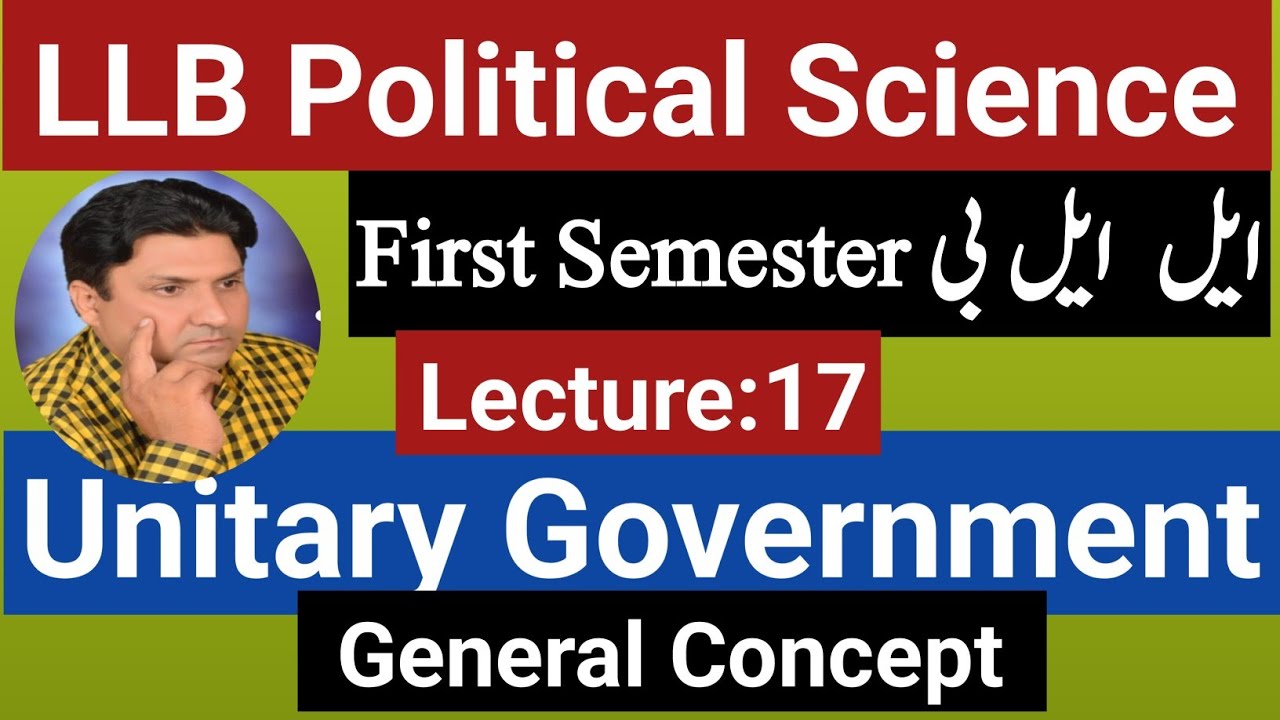
Unitary Government| LLB Political Science| LLB Semester 1| General Concept of Unitary Government|
Автор: Prof Jamil Baig
Загружено: 2026-02-09
Просмотров: 18
Описание:
In this video, we explain the general concept of a Unitary Government in an easy and exam-oriented way for LLB Semester 1 Political Science students.
A Unitary Government is a system in which all powers are vested in a single central authority. The central government is supreme and controls the entire country. Local or regional governments, if they exist, work under the authority of the center and exercise only those powers that are delegated to them.
In a unitary system, the central government makes laws and policies for the whole country. Administrative units like provinces or districts do not have independent constitutional status. The central authority can create, alter, or abolish these units whenever it wishes.
The main aim of a unitary government is to maintain national unity, uniform laws, and strong central administration. Decision-making is fast, administration is simple, and there is less conflict between different levels of government.
This system is suitable for small or culturally homogeneous countries, where people share similar language, culture, and traditions. However, one drawback is that local needs may be overlooked because decision-making remains centralized.
Countries such as the United Kingdom, France, Japan, and China follow a unitary system of government.
This video is helpful for LLB students, competitive exams, and general political science learners.
📌 Don’t forget to like, share, and subscribe for more LLB Political Science lectures.
Повторяем попытку...
Доступные форматы для скачивания:
Скачать видео
-
Информация по загрузке: