“
Автор: Plamadiso - Platforms, Markets & Digital Society
Загружено: 2025-10-16
Просмотров: 71
Описание:
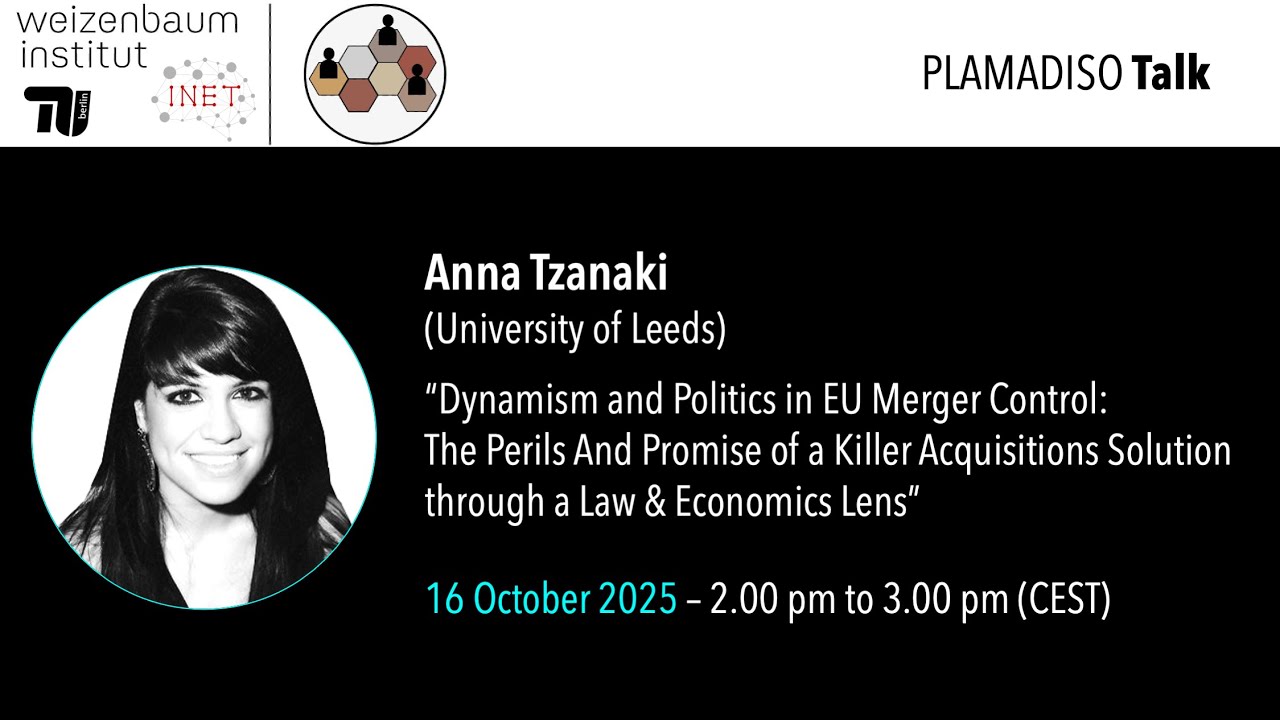
PLAMADISO Talk by Anna Tzanaki (University of Leeds) – 16 October 2025 || Organized by the Research Group “Digital Economy, Internet Ecosystem & Internet Policy” @Weizenbaum Institute for the Networked Society
Title
Dynamism and Politics in EU Merger Control: The Perils And Promise of a Killer Acquisitions Solution through a Law & Economics Lens
Abstract
For the last 35 years since its coming into being nothing seemed to shake the institutional setup of EU merger control. Notwithstanding their inherent limitations, turnover thresholds had been consciously chosen as the one and only jurisdictional criterion for EU merger review under the EUMR. The “clearcut” and “certain” threshold-based system of merger competence allocation was at the heart of the political bargain struck between the Commission and Member States that had been repeatedly skeptical of giving up part of their national powers for pan-European merger control to arise. Turnover thresholds had two key redeeming virtues: excluding jurisdictional competition between the Commission and Member States, with rare and narrow exceptions under a system of case referrals and being relatively simple and predictable in their application. As a side deal to that bargain, it was promised by the Commission that EU antitrust rules – previously instrumentalized to get Member States to agree on the enactment of the EUMR – were not to be used as basis for merger enforcement going forward. The result was an institutional setup much different to the now decentralized system of EU antitrust enforcement: transactions above the EUMR thresholds were subject to “centralized” mandatory ex ante review at EU level whereas below-threshold transactions were left to national merger control laws (if any).
With the rise of digitalization, that era of contained and certain EU merger enforcement seems long gone. “Killer acquisitions” exposed a major jurisdictional gap in EU merger control: acquisitions of small innovative startups fall below the EUMR’s turnover-based thresholds. As such, they are typically outside the Commission’s competence regardless of the potential cross-border nature of their geographic impact or the limited scope of applicable national merger control regimes. Eager for a quick and targeted fix, the Commission responded to the demand for more flexibility in EU merger control by unilaterally “repurposing” the Article 22 EUMR referral mechanism to catch any below-threshold killer mergers. Yet, the Commission’s creative solution to its jurisdictional deficit would not effectively address the “deterrence problem” and the “externality problem”, the main deficiencies of the EUMR thresholds, while it would de facto transform merger competence allocation between the EU and Member States into a “non-zero-sum” game, without amending the EUMR that would entail renegotiation of the original “zero-sum” bargain with Member States. Although the Commission’s attempt for unlimited jurisdictional expansion was struck down by the ECJ’s Illumina/Grail judgment, a narrower version of Article 22 EUMR based on national “call-in” powers still remains permissible. This paper shows that the repurposed Article 22 in its current form is neither an optimal nor sustainable solution and the search for further systemic reforms continues.
Short Bio
Anna Tzanaki is a Senior Lecturer in Law at the University of Leeds, and an Affiliate Fellow of the Stigler Center for the Study of the Economy and the State at the University of Chicago Booth School of Business. She serves as an Associate Editor of the Journal of Competition Law & Economics (Oxford) and Competition Policy International (Boston). Her research interests lie in the areas of EU and comparative competition law and policy, mergers and acquisitions, corporate governance and finance, law and economics, digital markets and new technologies. She holds a PhD from University College London (UCL) Faculty of Laws, an LLM from the University of Chicago Law School, and an LLB from the University of Athens Law School.
More about Anna Tzanaki:
Website: https://essl.leeds.ac.uk/law/staff/23...
Stay tuned for future events: https://plamadiso.weizenbaum-institut.de
Follow us on X: https://x.com/JWI_Digi_Econ
Follow us on LinkedIn: / plamadiso
Find all PLAMADISO Talks in our playlist: • Plamadiso Talks
The Weizenbaum Institute for the Networked Society: https://weizenbaum-institut.de/
Повторяем попытку...
Доступные форматы для скачивания:
Скачать видео
-
Информация по загрузке:


