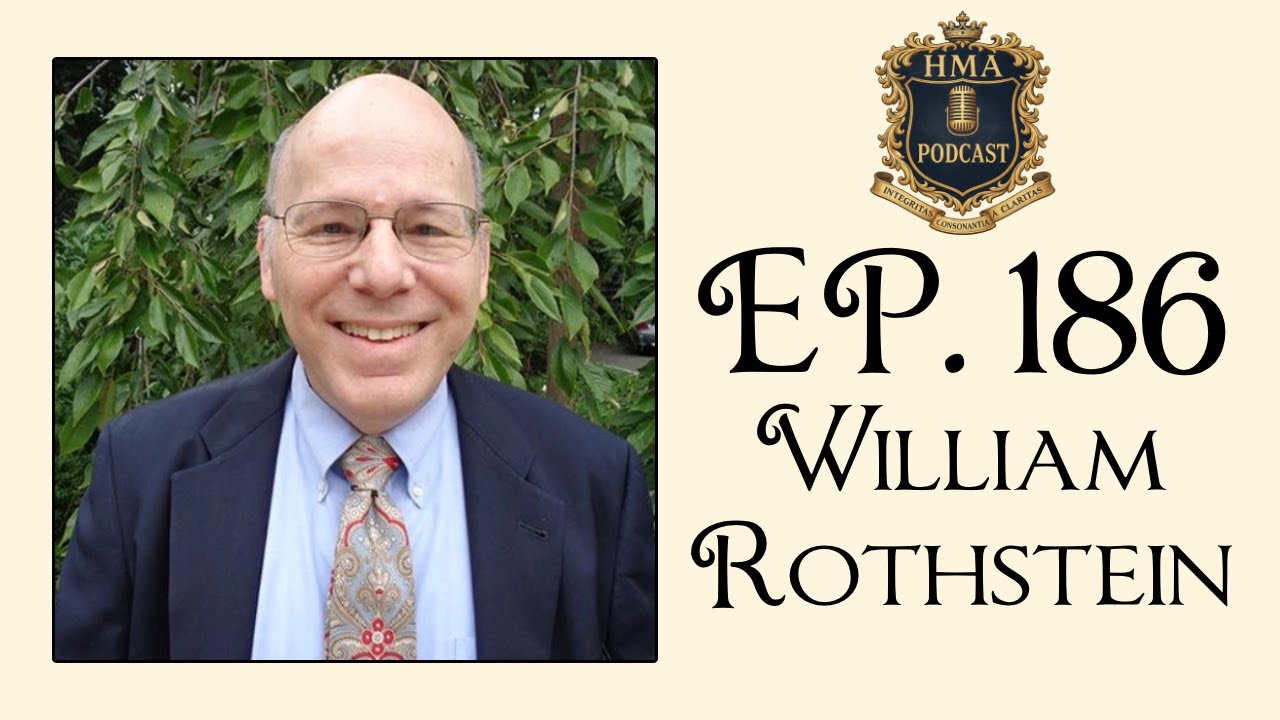
Ep. 186 | William Rothstein: Verdi, Rossini & the Italian “Usual Form” (1813–1859)
Автор: HMA Podcast
Загружено: 2025-12-25
Просмотров: 166
Описание:
🎥 Recorded using Ecamm Live — my favorite all-in-one Mac app for podcasting, recording, and live streaming.
👉 Try it here (affiliate link): https://bit.ly/4osrvBk
Interview Date: March 2024
Professor William Rothstein (Queens College & CUNY Graduate Center) joins the HMA Podcast to discuss his Oxford University Press book, The Musical Language of Italian Opera, 1813–1859.
We talk about Rothstein’s Germanic training (Schenker, Yale, decades of accompanying), the anti–Italian-opera prejudice inside North American music theory, and why he wrote this book to help theorists and scholars take Italian Romantic opera seriously.
Topics include:
• Italian opera’s distinct formal language (tempo d’attacco → adagio → tempo di mezzo → cabaletta)
• The melody–bass “outer-voice” focus rooted in partimento/solfeggio and thoroughbass
• How Meyerbeer shaped later Italian harmonic language and dramaturgy
• Why chamber music + accompanying (and never stopping) matters for pianists
• A fascinating deep-dive on Verdi’s “Anvil Chorus” and the possibility of Phrygian/modal thinking inside 19th-century opera
Chapters:
0:00 — Introduction: Rothstein & the OUP book
1:03 — From piano/composition to theory: NEC, Oster, Yale, accompanying
6:19 — Why write this book: fighting the “pro-German” bias in theory
9:26 — German nationalism & the theory canon (Schenker/Schoenberg/Hindemith)
14:38 — “What kind of theorist are you?” Schenker + thoroughbass + partimento links
18:00 — How long the book took + why focus on musical (not extra-musical) analysis
20:15 — Italian vs continental influence (Naples vs the North; Mozart/Haydn; Meyerbeer)
27:00 — Rossini: classical strain, forms, and what actually influenced him
34:42 — Did Italian opera influence German composers? (Vienna vs Berlin)
38:25 — Pianists & accompanying: what you miss without chamber/singers
41:05 — Sight-reading: audiation, volume, and the “don’t stop” rule
44:38 — Donizetti & Mercadante: Paris, Meyerbeer, and early “reform” impulses
49:40 — Bellini: “purity,” Paisiello lineage, and why Norma is special
52:18 — Verdi: Lavigna/Fenaroli lineage, Mozart study, phases, Paris, late style
59:43 — Core “musical language” of Italian opera: forms, melody–bass primacy
1:03:10 — Harmony & rhythm: third-relations, chromaticism, and Italian text-setting
1:07:48 — Verdi’s “Anvil Chorus”: why Rothstein hears modal/Phrygian logic
1:10:54 — Why the book ends at 1859 (pre-Wagner-in-Italy) + final message
Повторяем попытку...
Доступные форматы для скачивания:
Скачать видео
-
Информация по загрузке: