The Warlord's Ambition: Unlocking the Meaning of Cao Cao's "View of the Great Sea"
Автор: When China Spoke in Poetry
Загружено: 2026-02-05
Просмотров: 4
Описание:
Video Details & Quick Facts
• Poem Title: View of the Great Sea (观沧海 - Guān Cānghǎi)
• Author: Cao Cao (155–220 AD)
• Dynasty/Era: Late Eastern Han / Three Kingdoms Period
• Composition Year: 207 AD (12th Year of Jian'an)
• Location: Mount Jieshi (Modern-day Qinhuangdao, Hebei Province)
• Genre: Four-character ancient verse (Gushi) / Jian'an Literature
Main Video Description
Intro In this video, we dive deep into one of the earliest and most celebrated landscape poems in Chinese history: "View of the Great Sea" by the legendary warlord and poet, Cao Cao. Written in 207 AD, this poem is not just a description of the ocean—it is a window into the ambitious mind of a man determined to unify a fractured China.
Historical Context Cao Cao composed this masterpiece during his triumphant return from a northern campaign against the Wuhuan tribes. After achieving a decisive victory that consolidated his rear defenses, he ascended Mount Jieshi to gaze at the Bohai Sea. It was here, amidst the autumn winds, that he penned this work, which captures both the physical grandeur of the ocean and his own "grand aspirations".
Key Analysis Points Covered in the Video:
1. The Realistic Scenery (The "Charcoal Drawing") The first section of the poem is a grounded, realistic depiction of the view. Cao Cao describes the oscillating water, the towering islands, the overgrown vegetation, and the surging waves caused by the autumn wind.
• Critics note that these lines act like the outline of a painting or a "rough charcoal drawing," accurate and vivid without being cluttered with unnecessary detail.
• Despite the "desolate" autumn season (typically associated with sadness in Chinese poetry), Cao Cao’s depiction is full of life and majesty, showing trees and grass growing in abundance.
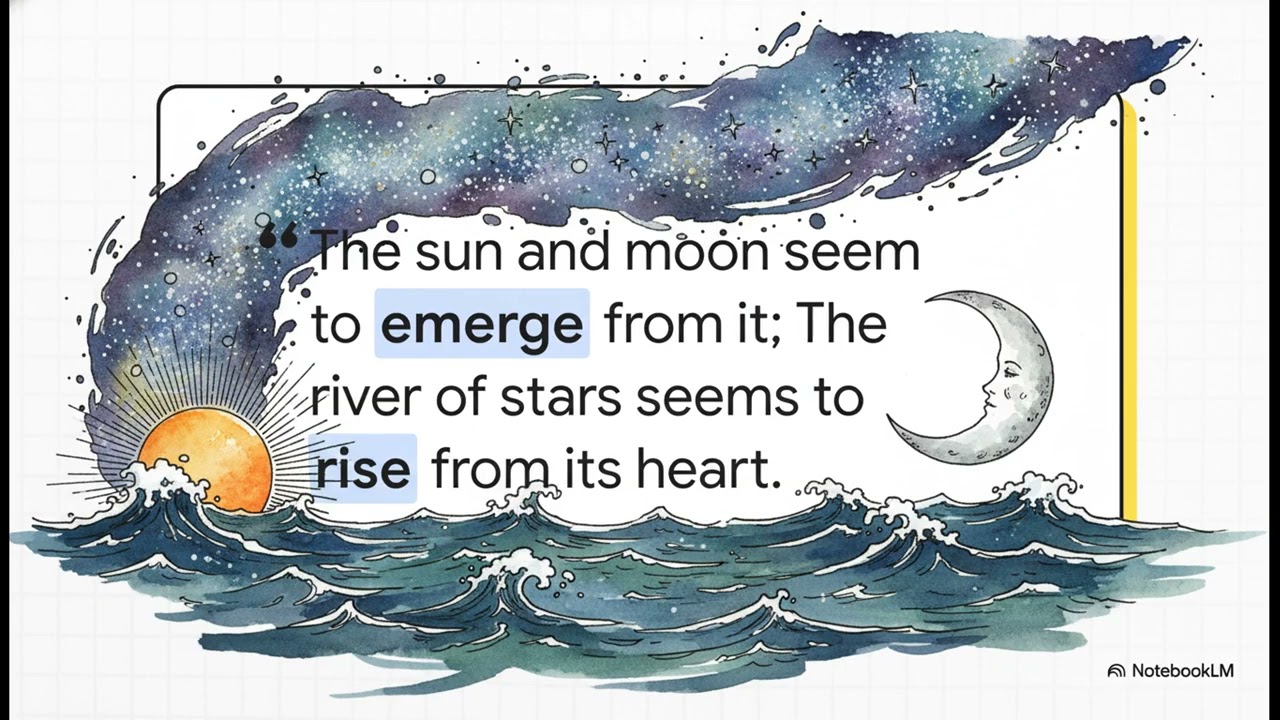
2. The Romantic Imagination (The Metaphor of Ambition) The poem shifts from reality to a bold, romantic imagination with the famous lines regarding the sun, moon, and the Milky Way (Starry Han).
• Cao Cao imagines the heavenly bodies rising and falling from within the ocean’s embrace.
• Symbolism: The vast ocean represents Cao Cao’s own chest and mind. Just as the sea contains the universe, he aspires to embrace and unify the entire world. This demonstrates his confidence and his thirst for accomplishment.
3. Artistic Style & The "Jian'an Bone" "View of the Great Sea" is a prime example of the "Jian'an wind" or "Jian'an bone" style—characterized by a tone that is tragic yet generous, solemn, and powerful. The poem achieves a perfect blend of emotion and scenery (qing jing jiao rong), where the ocean is given a dynamic, turbulent personality that mirrors the poet himself.
Note on the Ending You will notice the final lines: "Lucky indeed, to sing to express my will." Sources confirm these are standard musical phrases from the Yuefu style used to end the song and are not directly related to the poem's content.
Legacy This poem is considered the earliest masterpiece of Chinese landscape poetry. Its imagery of "swallowing the universe" even influenced modern poetry, such as Mao Zedong’s "Lang Tao Sha: Beidaihe".
Повторяем попытку...
Доступные форматы для скачивания:
Скачать видео
-
Информация по загрузке: