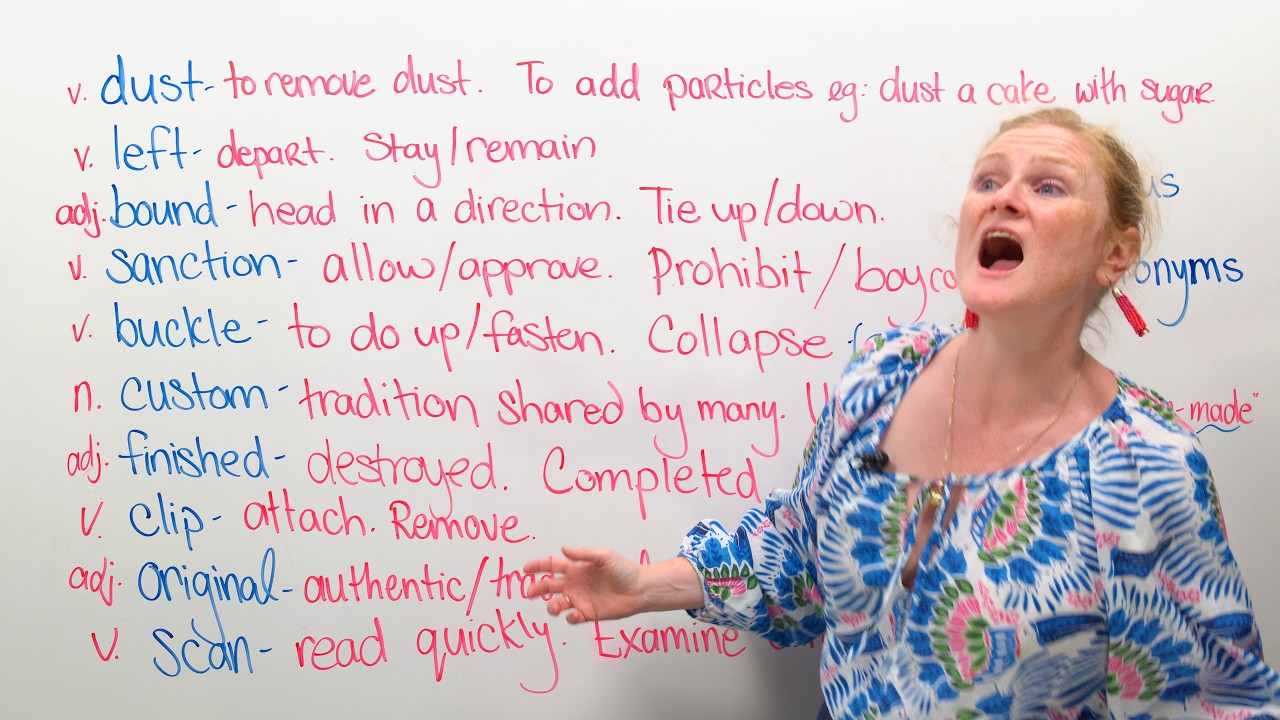
OLD SCHOOL Vocabulary...too formal!
Автор: Английский с Ронни · EngVid
Загружено: 2013-09-21
Просмотров: 1065004
Описание:
http://www.engvid.com/ I exited the building = very strange English! I shall teach you = very old-fashioned English! I joined the BBQ = WHAT??? Exit, shall, and join are all old words, and are considered too formal nowadays! Learn how to use more natural words and expressions! Don't forget to take the quiz: http://www.engvid.com/old-school-voca...
TRANSCRIPT
Hello, and welcome to my lesson. I hope you are happy. What? What's going on? Today, I'm going to teach you some words that you will say in English. They are definitely English words. You will use the words correctly in a beautiful, grammatically correct sentence, but they make me go, "What? That's weird. That's weird. "You speak like a grandmother or a grandfather." This lesson is called "Olde School" or -- uh-oh! "Too formal! What are you doing?" So one of the goals that I've always had since I started teaching ESL, or teaching English, is that textbook English and the way that a lot of people teach you how to speak... it's not "cool". You sound like you are reading a textbook. One of my goals in life is to make everyone that I teach sound natural, normal, and not like an old person even if you are an old person. That's cool. I want you to learn words that I and other normal -- normal? Not normal -- and natural English speakers would use. So "Olde School". "Ronnie, you've spelled "old school" wrong." Guess what? A long time ago, this is how they spelled "old", but they didn't say "oldie", they said "old". "Olde school" "Olde school" means it's old.
So let's look at the first one: "Telephone". We never, ever, ever, ever, ever say "telephone"; we say "phone" or "mobile" or "cell". "Telephone" is really, really, really old. Do you remember the really old telephones that you had to dial -- you stick your finger and you go [makes clicking sounds]? And if you made a mistake, you had to start again. I remember being a little Ronnie, and I had to dial my best friend's number, and it had three nines in it. [Shudders] "I made a mistake." So "telephone" -- old. Now we have these wonderful cell phones. You press a button, and your friend is right there -- "Hi", okay? Don't use the word "telephone"; it's strange.
The other one is: "Television". Do you have a television? I don't. I hate television. So much so that I don't even call it that; I call it a TV. Please call it a "TV", not a "television". "Television" is old, very old.
This word: "refrigerator" -- "Ronnie, there's a space here." Yeah. Ronnie has trouble spelling. And the reason why I have trouble spelling this word is we never, ever, ever say this word: "refrigerator". I'm tired by the time I get to this space here, so instead of saying "refrigerator", do you know what we say? "I'm hungry. I'm going to go to the fridge." and get a Coke or a drink. So normally, we shorten this, and we call it a "fridge", "fridge".
"Automobile", "auto". If you speak any of the Latin languages, you can understand "auto" means "self"; "mobile" means "move". "Look at me. I'm going in my self-move to the -- to the mall. Would you like a drive?" "No. I'll take the bus, thank you." So "automobile" and "auto", we do not use. We call it one of these [makes car noise] a "car". I have seen a textbook -- one or two in my day -- and it actually says "automobile". So I looked at the date: "Published 2010." Really? You put "automobile" in a textbook? Give your head a shake.
The next one is a modal verb. If you do not know what a modal verb is, go look in a grammar book. "Shall" is a modal verb. However, we never use this. The only time you will see this modal verb used is if you are reading rules of something. If you go to a public swimming pool, or if you go on the subway, all of the rules are written with this word. "You shall not spit in the pool. You shall not -- in the pool." Okay, I'm not going to do that. "You shall not run around the pool because you're going to die." "Shall" -- we always use "will" or negative "won't". This has... replaced our modal verb "shall". Please don't say this; it's weird. "You shall give me a dollar." What? "You will give me a dollar." "You're going to give me a dollar." Everyone give me a dollar.
The next one is an expression: "What a pity" or "What a shame!" Now, if you were -- let's see -- maybe a 70-year-old grandmother or grandfather living in England, you would say this all the time. My grandmother -- God rest her soul -- would say this, "What a pity. What a shame." She's from Scotland. She says this all the time, "What a pity. What a shame." We go, "That sucks." Okay? If something is bad, you can -- you can say that. You can say, "Wow. That sucks." or "That blows." Don't say this. You can even say, "That's bad." "What a pity" or "What a shame" -- it's way, way too old. Too old. Too old. Bye-bye.
"Pardon me!" Pardon me; I forgot the "S". "Pardon me" -- again, my grandmother says this all the time. Pardon me -- we say now: "Excuse me."
Повторяем попытку...

Доступные форматы для скачивания:
Скачать видео
-
Информация по загрузке: