Conditioning the Horse with a Heart Rate Monitor
Автор: Dawn Champion
Загружено: 2018-02-07
Просмотров: 2351
Описание:
Conditioning the Horse with a Heart Rate Monitor
For some reason, this is yet another contentious topic. I think the people who are against HR Monitors for conditioning are the ones who think that it will somehow replace common sense and "Knowing Your Horse". Nothing is further from the truth. The HR Monitor gives you one single extra piece of data - the Heart Rate. This is absolutely NO substitute for common sense and knowing your horse. In fact, both are required to be able to interpret the heart rate data accurately. It's different for each horse.
Why Use a HR Monitor?
1. Conditioning is basically carefully overworking the horse. The body is stressed and is forced to improve itself to adapt to this new level required of it. Push too far, too fast and you break your horse. Push too little, too slow and you don't get desired results - or take too long to get results. The HR Monitor gives you valuable data to custom tailor workouts to the perfect level each ride. Always pushing just enough to trigger improvements, yet not enough to greatly harm the horse.
2. Horses Lie.
a. Some horses are extremely stoic.
b. Some have impeccable work ethics, which make them push themselves past what is safe for them.
c. Some are lazy and act like they are dying after a 20 minute workout when they could do a ton more.
d. Some have hidden chronic issues that they've learnt to just accept - but an elevated HR will be a huge clue.
e. Some are so fearful of being left behind, that they will follow fitter horses to their detriment.
3. Respiratory rate and quality does not always match HR.
4. This may be a new horse to you and you don't know this horse's norms yet.
5. This may be a new workout for your horse so you don't know the norms yet.
6. You may just love data.
Choosing a HR Monitor
There are 3 main brands I know of. Polar, V-MAX and Garmin. I have the V-MAX and Garmin. V-MAX and Polar are more for HR data. Garmin is used by serious human athletes everywhere and give you a TON of data, plus a bunch of different ways of viewing and organizing it. I think all 3 are great, how you choose is by what your budget is and what kind of data you want.
Using the HR Monitor
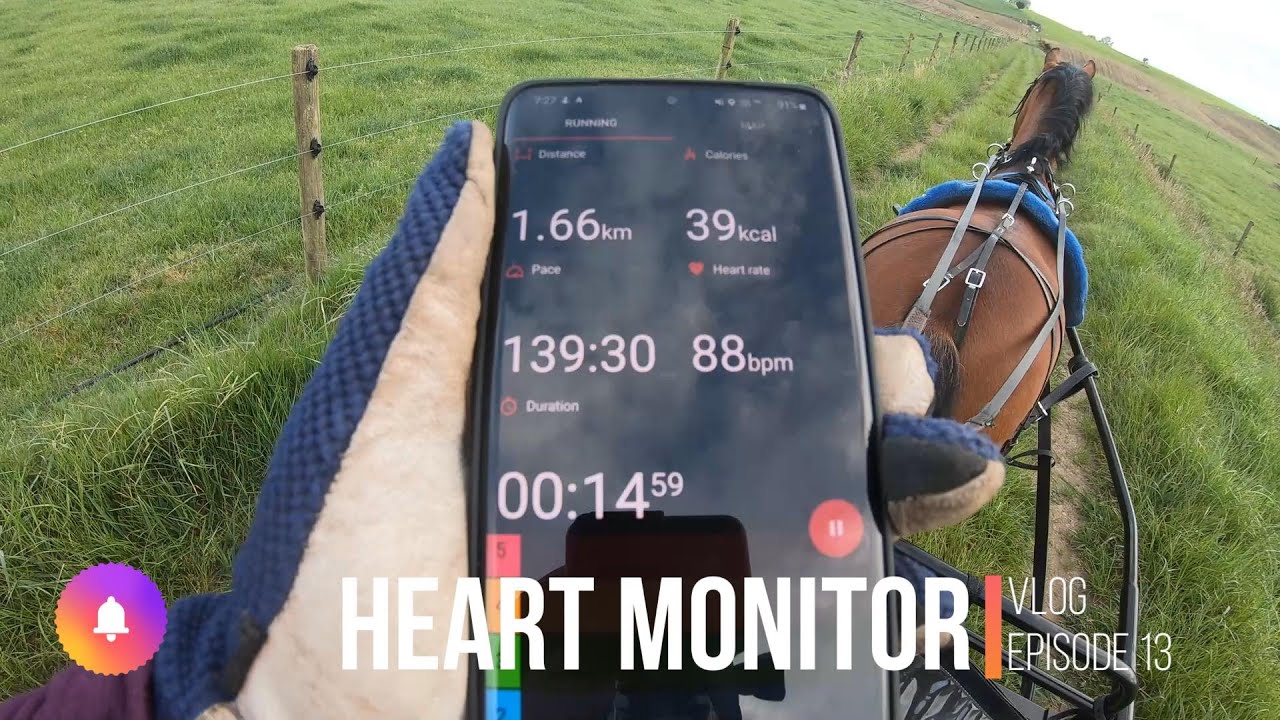
All these numbers are just examples - actual numbers will be individual for your horse. Basically, make note of Resting HR. Work the horse and watch what his working HR is for each gait - this is the number you will be improving. So say at first, your horse is able to trot at 10 mph for 15 minutes at 100 bpm. Then at 20 minutes it's up to 150 bpm. Then at 30 minutes it's up to 180 bpm. You will slowly condition him to where he can trot 10 mph for 60 minutes with a HR of 100 bpm. Recovery HR will tell you if the horse is exhausted or is ready for more challenging conditioning. If you run him and his HR is 200 bpm, then you stop and his HR drops back down to 55 within a minute, then that workout didn't tire him at all. He's good to go. If it takes him 2 hours to recover - he was pushed way too far and in danger of tying up. This should never happen if you are watching your numbers because HR over 170 bpm shouldn't be held longer than 15 min and you should be checking Recovery often. Recovering in 15 minutes is considered "good", but I am more conservative than that and will use 10 minutes or less. I aim for him to be recovered even before I can dismount...but within 10 minutes of dismounting is good for me too. In races, they typically give you 30 minutes. Of course, your time stops when your horse's HR reaches criteria (often 55 or 60 bpm) - so you want it to be down as soon as possible. You basically want to push and stress the body to teach the body how to handle it and recover from it faster. When the body gets stressed/pushed - it will figure out how to adapt to that level. Once it adapts, it becomes easy and there's no more adapting. Push harder, then the body is forced to adapt again. They key is to push for adaptation without pushing too far where you cause harm. Having that HR data - watching the Recovery Rate - really helps out in this case.
The tricky part is knowing how far to push. The body improved when harm is done - the key is making sure the harm done is such that the body will come back better and stronger and not break it down completely. Look at how muscles are built. They are built by carefully overworking them and creating microtrauma (micro tears) throughout. When you rest, the body repairs these tears, resulting in bigger, stronger muscles.
Now remember, muscles are the easiest things to build and it's just one part of fitness. You also need cardiovascular, respiratory, and skeletal health as well. Tendons/Ligaments are the slowest of these things to strengthen (think in terms of months), Bones also need to develop density. All of these need to be kept in mind when conditioning.
Повторяем попытку...

Доступные форматы для скачивания:
Скачать видео
-
Информация по загрузке: