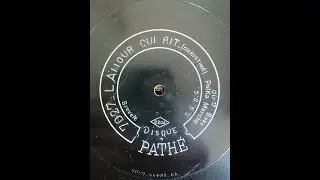
"Oh! Frenchy!" Joseph C. Smith's Orchestra (1918) Medley = Good-bye, Alexander & After You've Gone
Автор: Tim Gracyk
Загружено: 2022-12-26
Просмотров: 275
Описание:
"Oh! Frenchy!"
Joseph C. Smith's Orchestra
Victor 18511
1918
Songwriters are Sam Ehrlich, Con Conrad, Turner Layton, and Henry Creamer
Medley of these songs:
1) Oh! Frenchy!
2) Good-bye, Alexander
3) After You've Gone
Rosie Green was a village queen,
Who enlisted as a nurse
She waited for a chance
And left for France with an Ambulance,
Rosie Green met a chap named
Jean, a soldier from Paree,
When he said, “Parlevous my pet”
She said, “I will but not just yet,”
When he’d speak in French to her,
She’d answer lovingly,
“Oh!”
Frenchy,
Oh Frenchy, Frenchy,
Although your language is so new to me,
When you say, “Oui oiu, la la”
“We” means you and me, la la-
Oh! Frenchy, Oh Frenchy, Frenchy,
You’ve won my love with your bravery,
March on, March on, with any girl you see,
But when you la la la la la,
Oh, Frenchy save you la la la’s for me.
Oh! me
The band leader was born Joseph Cyrus Smith in 1883 in Sag Harbor, New York.
Joseph C. Smith's Orchestra was successful from 1917 to 1921, reaching its peak popularity around 1919-1920, with Victor issuing new Smith discs almost every month.
Smith's was the first "name" dance band to earn fame through records. He paved the way for Paul Whiteman, whose own success and innovations contributed to Smith's decline by 1921.
Before Smith's debut, dance records that sold well had been made by studio bands with generic names, such as the Victor Military Band, or by bands that already enjoyed fame as touring ensembles, such as Conway's Band. Jim Europe made dance records a few years before Smith, but Europe was invited to make records because he had already won fame as a band leader; moreover, Europe's records did not sell well.
Labels on many Smith records have the phrase "for dancing" or "dance music." It recorded fox trots, one-steps, and waltzes, a few featuring a vocal refrain contributed by a Victor studio singer. Although musicians varied, generally eight instruments were used, a combination of violin (Smith was a violinist), viola, piano, cello, trombone, cornet, drums.
Smith's Orchestra began recording for the Victor Talking Machine Company on September 25, 1916. From this session came "Songs of the Night" (the Victor Dance Orchestra is on the reverse side). It was issued in December 1916. Victor's monthly supplement calls the orchestra "a new organization...popular with New York dancers." "Money Blues" was also recorded at this session but was held for a few months, and that session's take of a Cole Porter song went unissued.
The orchestra was featured at New York's Plaza Hotel. It is unknown who the musicians were, but Hugo Frey was probably the pianist at the first session because Frey's composition "Money Blues" was recorded. Frey was a regular member of Smith's ensemble and its most important one aside from director Smith since Frey was a skilled composer as well as a talented pianist. On a few labels Frey is credited for his piano work.
Another sideman was Maurice Benavente, whose bass clarinet work is notable. Jack Wasserman played saxophone during at least some sessions. When Wasserman in 1924 recorded with Jack Shilkret's Orchestra, advertisements placed in trade journals by the Buescher Band Instrument Company described Wasserman as "formerly with Joseph C. Smith's Orchestra...He is rated one of the best players of the High Soprano Saxophone and rates with the very best players on three other sizes of Saxophone."
In previous years, dance records made by the Victor Military Band, Conway's Band, and Pryor's Band had a different sound. Smith's music must have struck many as fresh, original, different. Military bands gradually went out of fashion, and Smith's music--with violin and piano--became increasingly popular (Smith's predecessors on the Victor label include Europe's Society Orchestra and McKee's Orchestra).
Victor's June 1917 supplement states, "Smith's Orchestra has a quality of sound peculiar to itself, and one that is especially ingratiating with dancers."
A new era in dance music was born, the way paved for Paul Whiteman and His Ambassador Orchestra, the Isham Jones Orchestra, and others of the 1920s. After 1919 no new Victor Military Band titles were issued.
Smith's first Victor session had been in September 1916. His one Columbia session was 14 months later, so Smith probably had a one-year contract with Victor. Evidently nothing issued in that first year had been successful enough for Victor executives to care about Smith working for a rival company after the end of that year. He was not paid to remain exclusive to Victor.
At the end of Smith's first year, "Missouri Waltz" (35663), became very popular when finally issued in February 1918. Smith returned to Victor for a May 8, 1918, session and was thereafter exclusive to the company for four years.
Повторяем попытку...

Доступные форматы для скачивания:
Скачать видео
-
Информация по загрузке: