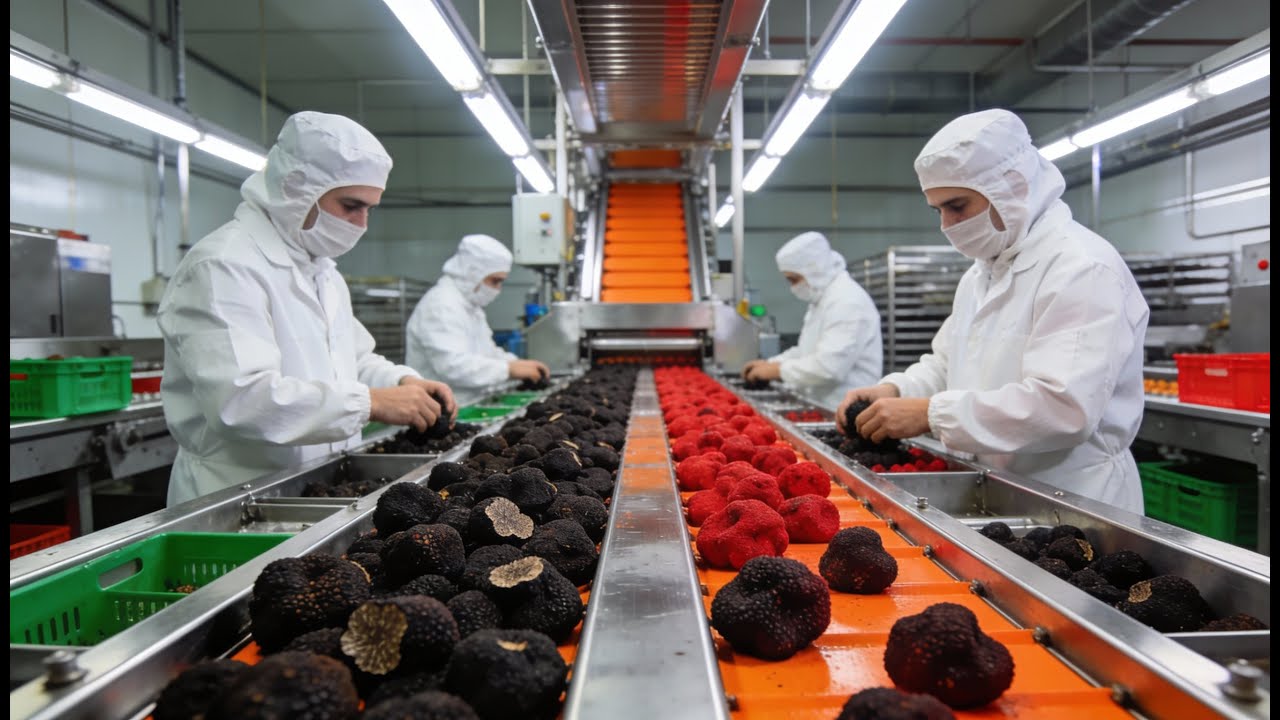
Inside the Black Truffle Facility – How Rare Fungi Become Million-Dollar Spices | Full Process
Автор: Inside the Food Industry
Загружено: 2026-01-12
Просмотров: 23
Описание:
What if I told you that buried beneath the soil of remote European forests grows a fungus so rare, so prized, that it sells for up to $3,000 PER POUND and has sparked underground theft rings, international smuggling operations, and even murders? Welcome to the SECRET world of black truffle cultivation—where agricultural science meets luxury commerce in facilities that guard their growing techniques like nuclear secrets. This isn't just a "how it's made" video—this is an UNPRECEDENTED inside look at the multi-million dollar black truffle industry, from mycorrhizal inoculation in sterile laboratories to the moment these "diamonds of the kitchen" reach Michelin-starred restaurants where chefs shave them onto $500 plates.
Black truffles (Tuber melanosporum), known as "Périgord truffles," represent one of the world's most mysterious and valuable agricultural products. Unlike mushrooms that can be grown in warehouses, truffles form symbiotic relationships with specific tree roots, require precise soil chemistry, take 5-10 YEARS to produce first harvests, and refuse to grow predictably even when all conditions seem perfect. For centuries, they could only be wild-harvested by trained dogs sniffing them out in French and Italian forests. But a revolution is underway—cutting-edge facilities have cracked the code to "farming" these fungi, transforming what was once pure luck into scientific precision worth hundreds of millions annually.
THE INOCULATION LABORATORY - Where Science Creates Mycorrhizal Magic: Our exclusive facility tour begins in sterile clean rooms where the entire process starts not with truffles, but with tree seedlings—specifically oak (Quercus ilex) and hazelnut (Corylus avellana) saplings. Technicians in full protective gear work under laminar flow hoods, carefully introducing truffle spores to young tree roots in a process called "mycorrhizal inoculation." This isn't simply planting spores—it requires creating symbiotic fungal networks where truffle mycelium wraps around and penetrates tree root cells in a mutually beneficial relationship. The truffle provides the tree with enhanced water and nutrient absorption; the tree provides the fungus with photosynthesized sugars. This delicate biological partnership took researchers 30+ years to master and remains proprietary technology worth millions. Each inoculated tree costs $50-150 and represents a 7-10 year investment before producing a single truffle.
THE NURSERY - Growing Tomorrow's Truffle Forests: After inoculation, saplings spend 1-2 years in specialized greenhouses where every variable is controlled: soil pH maintained precisely at 7.5-8.3 (truffles are extremely pH-sensitive), calcium carbonate levels monitored constantly, irrigation timed to mimic Mediterranean rainfall patterns, and root systems regularly tested to verify mycorrhizal colonization rates exceed 60%. Workers use microscopes to examine root tips, looking for the characteristic white fungal sheaths that indicate successful inoculation. Only trees meeting strict quality standards are sold to truffle farmers—rejection rates exceed 30%. This quality control is critical because planting non-colonized or poorly colonized trees means farmers waste years waiting for harvests that will never come.
#BlackTruffle #TruffleFarming #LuxuryFood #HowItsMade #Agriculture #TruffleHarvest #Mycology #FoodProduction #LuxuryIngredients #FarmToTable #GourmetFood #AgricultureInnovation #Fungi #TruffleIndustry #FoodScience
Повторяем попытку...
Доступные форматы для скачивания:
Скачать видео
-
Информация по загрузке:


