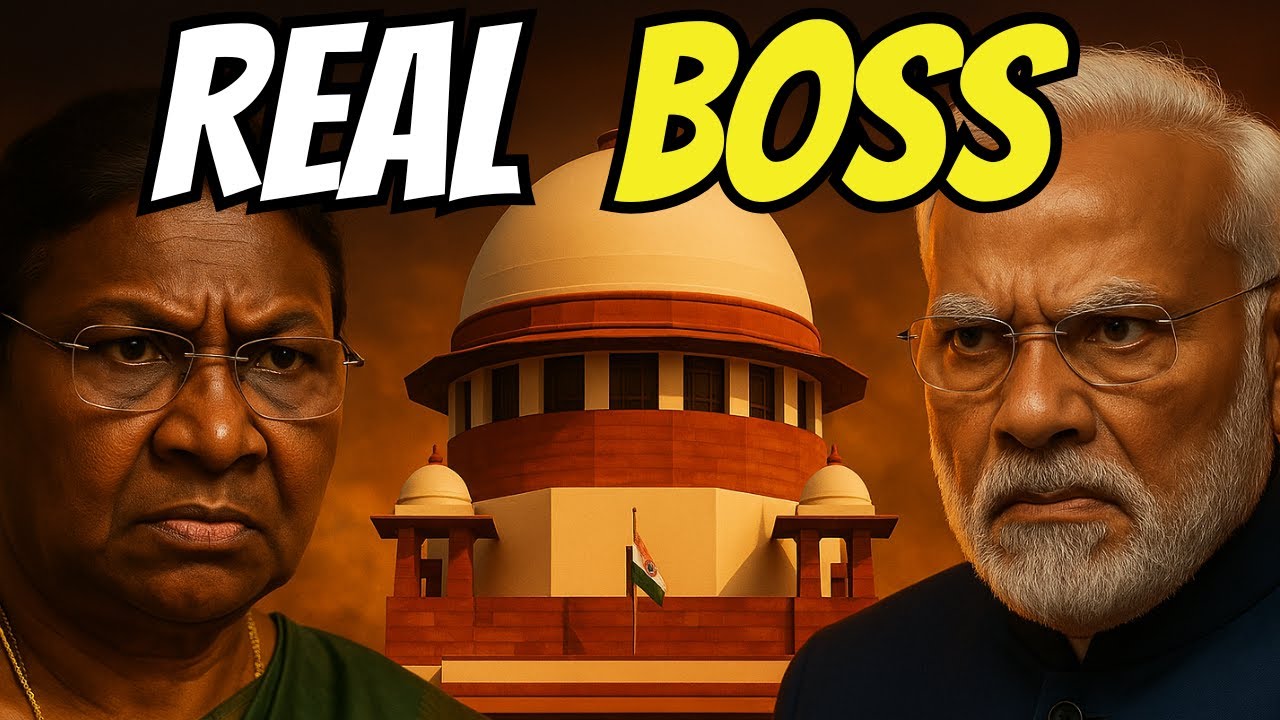
Who Rules India? | Supreme Court vs Government | Droupadi Murmu’s Article 143 Challenge
Автор: No Nonsense
Загружено: 2025-05-19
Просмотров: 85578
Описание:
Supreme Court vs Government | Droupadi Murmu’s Article 143 Challenge | Who Rules India?
In a rare and historic move, President Droupadi Murmu invoked Article 143 of the Indian Constitution, asking the Supreme Court to clarify whether it can impose timelines on the President and Governors for clearing state bills.
This came after the Supreme Court’s April 2025 verdict where it gave a 3-month deadline to constitutional heads. The result? A direct confrontation between the Judiciary and the Executive — and possibly a new chapter in the Supreme Court vs Government power struggle.
In this episode of No Nonsense, we dive deep into the real question:
Has the Supreme Court become more powerful than the elected government?
You’ll discover how:
🛡️ Article 32 gives the Court the power to protect your fundamental rights — instantly
⚖️ Article 136 allows it to override any High Court decision through Special Leave Petitions
📜 Article 141 ensures that its judgments bind all other courts — no debate, no exception
🧭 Article 142 lets the Court do “complete justice” — even if the law doesn’t say how
These aren’t just provisions. These are tools that have made the Supreme Court the final guardian of the Constitution — and in many ways, the last line of defense for Indian democracy.
But that’s only half the story.
The Parliament, under Articles 245, 246, and 368, has the power to make and amend laws — even the Constitution itself. It controls the budget, ministries, and even the salaries of judges. And yet, it too is bound by the Basic Structure Doctrine, first enforced in the legendary Kesavananda Bharati case (1973).
So what happens when these two pillars collide?
We explore every key moment:
Golaknath (1967) – where SC stopped Parliament from amending Fundamental Rights
Emergency (1975) – when SC backed the government, only to regret it later
NJAC (2015) – when Modi Govt’s attempt to control judicial appointments was shut down
Electoral Bonds (2024) – where the SC exposed political funding opacity
Tamil Nadu Bills (2024–25) – where SC bypassed Governors to protect legislative function
And now, Droupadi Murmu vs Supreme Court (2025) — a constitutional flashpoint under Article 143
The question now isn’t just about powers — it’s about boundaries.
Has the Court crossed into the Executive's domain?
Or is it simply doing what the Constitution asked it to — protecting the nation from overreach?
👉 That thin line between Judicial Activism and Judicial Overreach is now at the center of Indian politics.
From banning firecrackers to regulating election slogans, courts are increasingly seen as both saviors and regulators. Is that democracy… or domination?
🎯 Who really rules India?
Is it the elected Government, the Supreme Court, or the People?
The answer, like the Constitution says, lies in one phrase:
“We the People of India.”
Both the Government and the Court are subordinate to the Constitution, and the Constitution is a written contract by the People.
👉 The Supreme Court is powerful, but it is not the Boss.
👉 The Government is elected, but it is not absolute.
👉 The only real Boss — is the Constitution. And the People of India.
🔍 Topics Covered:
Supreme Court powers, Parliament authority, Judicial independence, Droupadi Murmu Article 143, Article 32, Article 136, Article 141, Article 142, Article 368, Kesavananda Bharati, Golaknath case, NJAC judgment, Emergency 1975, Electoral Bonds Supreme Court, Collegium system, Indian Constitution, Tamil Nadu governor bills, Judiciary vs Executive, Supreme Court deadlines
📌 If you believe that true power should rest with the Constitution and the People —
🔔 Subscribe to No Nonsense for sharp, research-based takes on law, politics, and national power.
#SupremeCourtVsGovernment
#DroupadiMurmu
#Article143
#JudicialOverreach
#IndianJudiciary
#KesavanandaBharati
#ElectoralBonds
#IndianConstitution
#SCJudgment
#CollegiumSystem
#NoNonsense
Повторяем попытку...
Доступные форматы для скачивания:
Скачать видео
-
Информация по загрузке: