Modeling a Harmonic Bond in LAMMPS | Session 3
Автор: NanoScaleModelling
Загружено: 2026-07-11
Просмотров: 34
Описание:
This is the third session in the molecular dynamics and LAMMPS series.
We use a two-atom system to see how bonds are represented in LAMMPS. We begin with harmonic and Morse potential-energy curves, then discuss what a force field actually contains: mathematical expressions, parameters, and the topology of the modeled system.
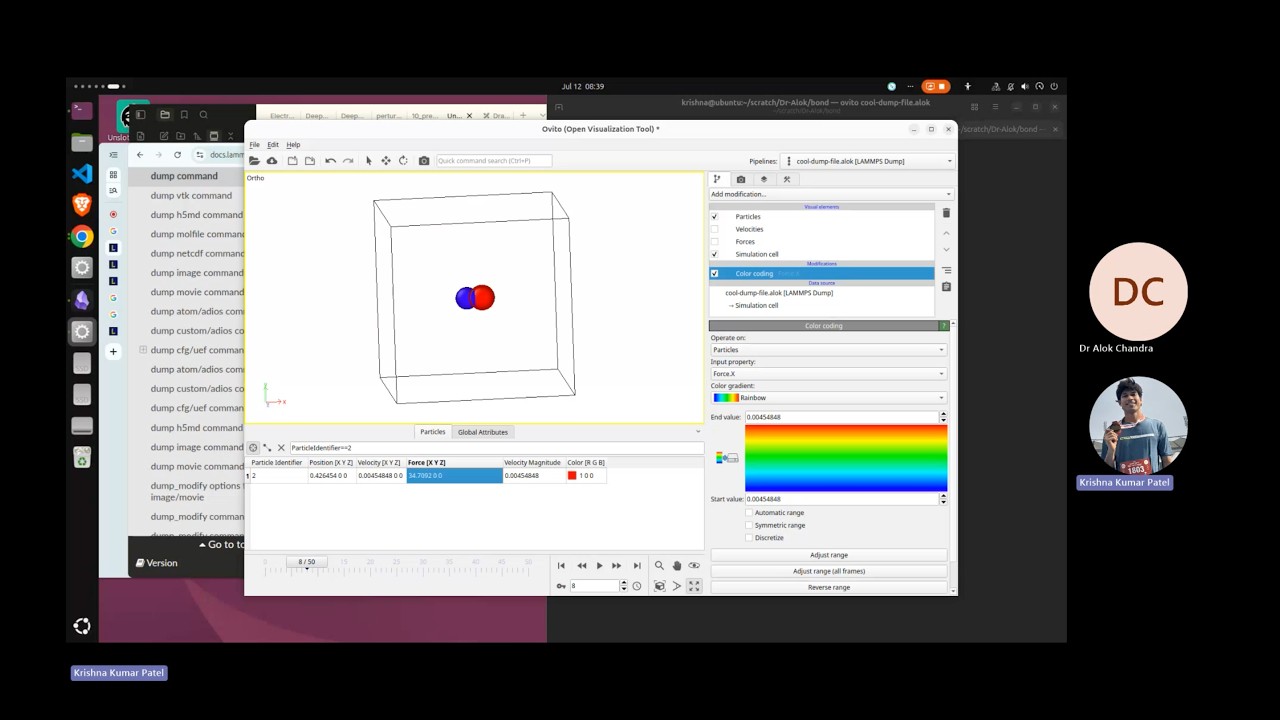
From there, we write a molecular LAMMPS data file by hand. The file contains two atoms and one bond. We read it into LAMMPS, assign a harmonic bond potential, run the system in the NVE ensemble, and write coordinates, velocities, and forces to a trajectory. In OVITO, we can then see the stretched bond pull the atoms together and watch potential energy turn into kinetic energy.
The discussion is mostly in English, with some Hindi along the way.
*Session files and notes*
GitHub repository: https://github.com/crisnapatel/nanosc...
Session 3 files: https://github.com/crisnapatel/nanosc...
*Main topics*
Harmonic and Morse bond potentials
Equilibrium bond length, force constants, and potential-energy curves
What a force field means in molecular simulation
`atom_style molecular` and bond topology
Structure of a molecular LAMMPS data file
`read_data`, `bond_style harmonic`, and `bond_coeff`
NVE, NVT, and NPT ensembles
Time averages, ensemble averages, and the ergodic hypothesis
Potential-to-kinetic energy conversion in a stretched bond
Thermodynamic output with `thermo` and `thermo_style`
Writing coordinates, velocities, and forces with `dump custom`
Inspecting motion and per-atom forces in OVITO
Bonded and non-bonded interactions
*Chapters*
```text
00:00 Recap and plan for the two-atom bond model
03:31 Harmonic and Morse bond potentials
04:50 Reading potential-energy curves
06:55 Can a Morse potential represent bond dissociation?
09:34 What a force field means
11:04 Creating the bond-model directory
13:31 Why we use `atom_style molecular`
15:58 Reading a molecular data file with `read_data`
18:53 Atom, bond, and angle counts in a data file
22:24 Writing atoms in molecular format
23:34 Structure of a LAMMPS molecular data file
27:52 Checking the LAMMPS documentation and file formats
31:16 Defining the box and debugging the data file
34:07 Opening the initial molecule in OVITO
35:35 What LAMMPS needs to run molecular dynamics
35:47 NVE, NVT, and NPT ensembles
40:45 Time averages, ensemble averages, and ergodicity
43:11 Choosing NVE for the isolated two-atom system
44:06 Integrating motion with `fix nve`
47:38 Why the atoms move without assigned initial velocities
48:37 Selecting `bond_style harmonic`
51:30 Setting the force constant and equilibrium bond length
52:34 Running the first bonded simulation
55:04 How force converts potential energy into kinetic energy
56:24 Customizing thermodynamic output
59:26 Writing a trajectory with `dump custom`
1:00:49 Saving selected groups and per-atom properties
1:05:18 Opening the trajectory in OVITO
1:06:26 Inspecting per-atom force components
1:07:59 Next steps: angles, water, and non-bonded interactions
```
In the next session, we can extend the same idea to three atoms. A simple water-like molecule will let us add two bond terms and one angle term, then watch the molecule bend toward its preferred geometry.
*Nanoscale Modeling* covers molecular dynamics, LAMMPS, atomistic simulation, computational materials science, and the Linux/HPC workflows behind them.
#MolecularDynamics #LAMMPS #OVITO #ForceField #ComputationalMaterialsScience #NanoscaleModeling
Повторяем попытку...
Доступные форматы для скачивания:
Скачать видео
-
Информация по загрузке: