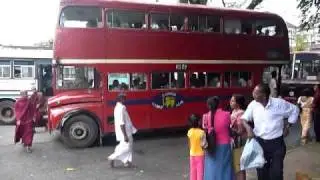
Sri Lanka,ශ්රී ලංකා,Ceylon,Kandy,AEC Routemaster Double-Decker Bus (02)
Автор: NickVenture1
Загружено: 2010-12-28
Просмотров: 8024
Описание:
I ran into this bus while walking through Kandy, the main town uphill in central Sri Lanka. Description: Double-Decker Bus, AEC Routemaster, Manufacturer: Associated Equipment Company, Specifications: Length 27 ft 6 in (8.38 m), 30 ft 0 in (9.14 m), Width 8 ft (2.44 m)
Height: 14 ft 4½ in (4.38 m), Floor type Step-entrance, Doors: 1 door, Weight:7.35 long tons (7.47 t), Chassis Integral, with front and rear subframes
Engine(s): AEC AV590 9.6 L or Leyland O.600 9.8 L, 6-cylinder diesel
Power output 115 hp (86 kW) (AEC AV590), Transmission AEC 4-speed automatic/semi-automatic.
The Routemaster bus was developed during the years 1947--1956 by a team directed by A. A. M. Durrant and Colin Curtis, with vehicle styling by Douglas Scott. The design brief was to produce a vehicle that was lighter (hence more fuel efficient), easier to operate and to be maintained by the existing maintenance practices at the recently opened Aldenham Works. The resulting vehicle could carry 64 seated passengers despite weighing three-quarters of a ton less than the previous RT which could carry 56 seated passengers. The first task on delivery to service was to replace London's trolleybuses, which had themselves replaced trams, in London and to commence replacement of the older types of diesel motor bus. The Routemaster was primarily intended for London use, being designed by London Transport and constructed at the AEC Works in Southall, Middlesex with assembly at bodybuilder Park Royal Vehicles, a subsidiary company of AEC.
It was an innovative design compared with previous buses and used lightweight aluminium and techniques developed in aircraft production during World War II.[3] As well as a novel weight-saving integral design, the Routemaster also introduced (for the first time on a bus) independent front suspension, power steering, a fully automatic gearbox and power-hydraulic braking.[4] This surprised some early drivers who found the chassis unexpectedly light and nimble compared to older designs, especially as depicted on film on tests at the Chiswick Works "skid pan". Footage of Routemaster RM200 (VLT 200) undergoing the skid test at Chiswick was included in the 1971 film On the Buses.[5]
The Routemaster design was a departure from the traditional chassis/body construction method. With London Transport being the primary customer, the option to use different bodybuilders was less important. The design was one of the first "integral" buses,[4] with the bus being a combination of an "A" steel sub-frame (including engine, steering, front suspension), a rear "B" steel sub-frame (carrying rear axle and suspension), connected by the aluminium body.[1] The gear box was mounted on the underside of the body structure with shafts linking the engine to the back axle. (Wikipedia)
Повторяем попытку...

Доступные форматы для скачивания:
Скачать видео
-
Информация по загрузке: