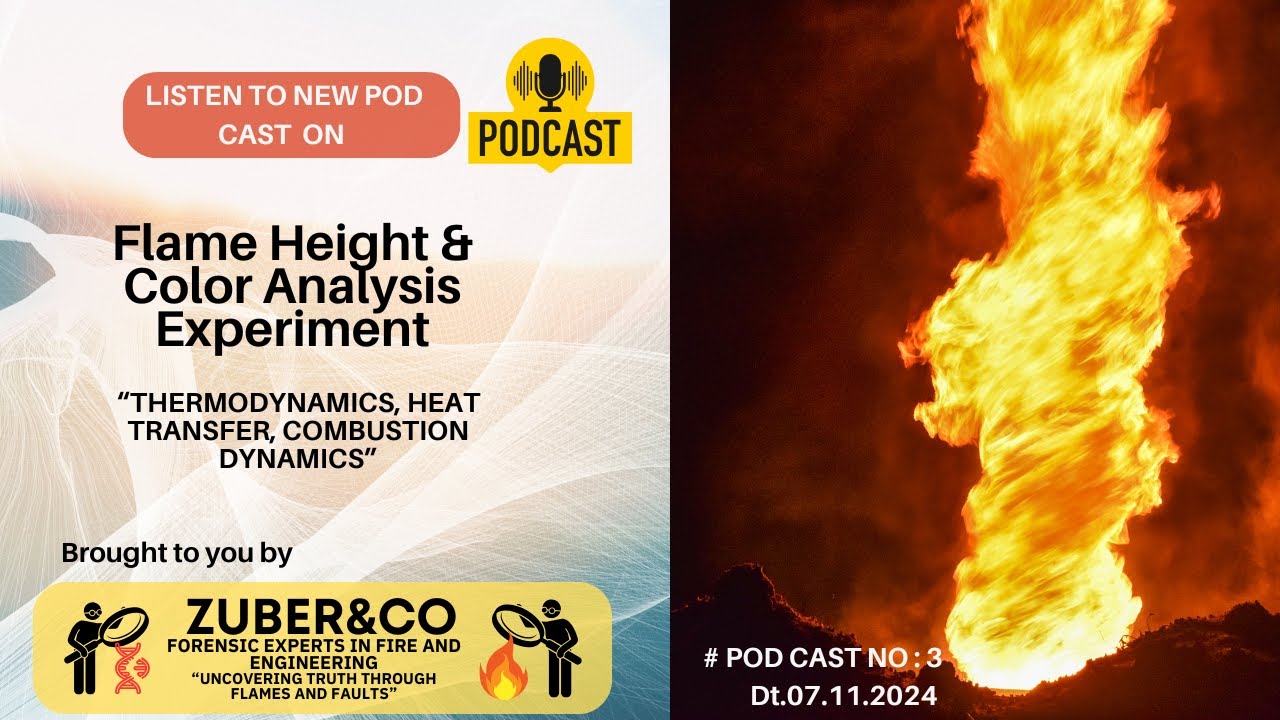
Analyzing Flame Height & Color: A Thermodynamics Experiment: FIRE FORENSIC EXPERIMENT
Автор: Zuber Ali Khan
Загружено: 2024-11-09
Просмотров: 79
Описание:
Title: Measuring Flame Height and Color: A Practical Experiment in Thermodynamics and Combustion Dynamics 🔥
Description:
In this video, we dive into an experiment designed to measure the height and color of flames produced by a combustible liquid in a controlled environment. Using principles from thermodynamics and heat transfer, this experiment provides a practical approach to understanding combustion dynamics and flame behavior. Whether you’re a student, fire forensic investigator, or just interested in the science of fire, this experiment reveals the fascinating interplay between fuel, oxygen, and heat.
🔬 Experiment Overview: Our primary objective is to observe and analyze the flame height, color variations, and heat transfer mechanisms when a specific quantity of combustible liquid is ignited. By applying the First and Second Laws of Thermodynamics and examining heat transfer methods (conduction, convection, and radiation), we gain insights into how energy is transferred and transformed during combustion.
🔥 Key Concepts Covered:
Combustion Dynamics: How fuel vaporizes, mixes with air, and sustains a flame.
Thermodynamic Laws: Understanding energy conservation, entropy, and enthalpy of combustion.
Heat Transfer Mechanisms: The roles of conduction, convection, and radiation in flame behavior.
Flame Color Analysis: Using color to estimate temperature zones and combustion efficiency.
🛠️ Experimental Setup: The setup involves a heat-resistant container with a specific quantity of liquid fuel, safety gear, and measuring tools to record flame height and temperature. We also capture the flame color and analyze the correlation between flame color and temperature, using concepts from Planck’s Law and Wien’s Displacement Law.
📊 Observations and Measurements:
Flame Height: Linked to fuel vaporization rate and oxygen availability.
Flame Color: Blue flames indicate complete combustion, while yellow/orange flames suggest incomplete combustion.
Temperature Gradients: Observed using a thermal imaging camera to verify theoretical predictions based on enthalpy.
⚙️ Practical Applications: This experiment isn’t just about observing flames! Understanding flame behavior has critical applications:
Fire Forensics: Helps experts identify combustion characteristics to determine the origin and cause of real-world fires.
Safety Standards: Highlights the need for proper handling and storage of combustible liquids.
Heat Transfer Engineering: Informs the design of efficient heating systems and safety protocols in industrial applications.
💡 Why Watch This Video? This video combines scientific theory with practical experimentation to explore the fascinating dynamics of fire. By breaking down complex concepts in thermodynamics and combustion, we aim to make science accessible and engaging for viewers at all levels. Ideal for students, forensic professionals, and fire safety enthusiasts!
📌 Chapters: 0:00 Introduction to the Experiment
1:15 Materials and Setup
2:30 Ignition and Observation
4:05 Flame Height and Color Analysis
6:45 Thermodynamic and Heat Transfer Principles
8:20 Practical Applications in Fire Forensics and Safety
🔔 Subscribe for More Science Experiments & Forensic Insights!
Повторяем попытку...
Доступные форматы для скачивания:
Скачать видео
-
Информация по загрузке:
![What is a Plasma? Is it the 4th State of Matter? - [5]](https://image.4k-video.ru/id-video/WVYJQucn2yU)