Shifting boards | Bulk carrier | Cargo operations | Merchant navy knowledge
Автор: Merchant Navy Knowledge
Загружено: 2023-04-03
Просмотров: 9472
Описание:
SHIFTING BOARDS FOR SHIPS" HOLDS Filed Feb. 1s,v 195e 2 sheets-sheet' i I InvO/'ztor {v4/5,57@ /174y BH ocx. 2o, 1959" g, MAY 2,909,139
SHIFTING BOARDS FOR SHIPS HOLDS FIG. 4
United States Patent O i ree SHIFTING BOARDS FOR SHIPS HOLDS Ernest Cyril May, Liverpool, England, assignor to M.E.P.
Company Limited, Liverpool, England, a British com- Pally Application February 13, 1956, Serial No. 565,214
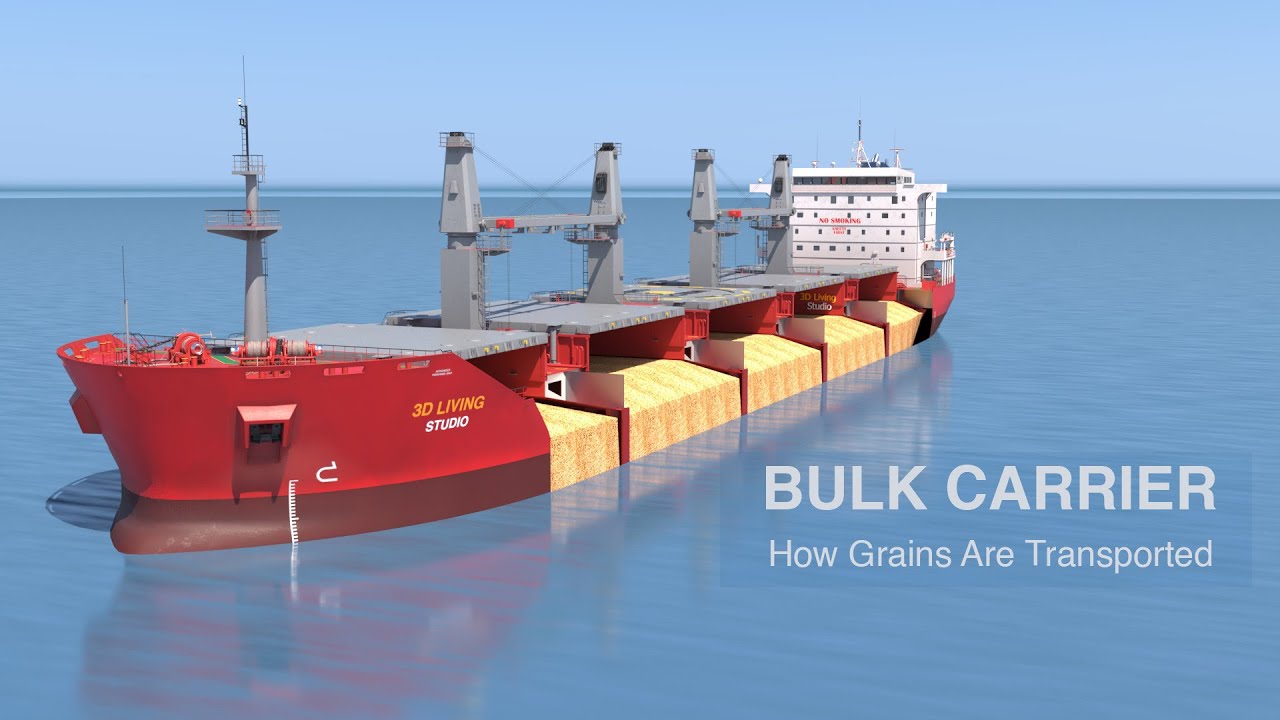
' 4 claims. (cl. 114-75) This invention is for improvements in or relating to means for supporting or carrying shifting boards or the like in a ships hold. Shifting boards are a well known accessory used in a ships hold so as to control :or limit the movement of bulk cargoes such as grain which if left uncontrolled might impair the stability of the vessel. In general, a centre shifting board running in a fore-andaft direction along the centre line of the ship is provided.
The present invention is particularly concerned with improvements in the uprights or like members between and by which the shifting boards are carried and supported. Heretofore it has been the practice to have these uprights or the like extending from top to bottom of the holds. In practice, however, even with a full bulk cargo it is unnecessary for the shifting boards to extend more than a third or a half the depth of the hold from the coaming. On the other hand, with a part bulk cargo shifting boards may be required which extend up say a third or half the depth of the hold from the tank top or floor. One object of the present invention is to meet these two alternative requirements whilst saving considerably in the size, weight and cost of the uprights.
According to the present invention there is provided in or for use in a ships hold a member for carrying shifting boards, centre line grain divisions or the like, which is substantially less in length than the depth of the hold and has means at one of its ends by which it can be secured to a hatch beam so as to be suspended therefrom or alternatively to the hold floor or tank tops so as to project up therefrom.
According to a further feature of the present invention there is provided a ships hold having a series of members of substantially less length than the depth of the hold and suspended from the hatch beams or projecting up from the hold oor or tank tops and supporting or adapted to support between them shifting boards or centre line grain diw'sions or the like.
According to a still further feature of the present invention rthere is provided in or for use in a ships hold a hatch beam or the like having a member depending from it and of substantially less depth than the hold over which the hatch beam is to be fitted, and adapted to serve as a support for a shifting board or the like.
Conveniently the members for supporting and carrying the shifting boards or the like are of channel or of double channel section, the end or ends of the shifting boards tting into the channel or channels.
One specific embodiment of a shifting board structure in accordance with the present invention will now be described, by way of example, with reference to the accompanying drawing wherein:
The rupright shown in the drawing comprises an l-section rolled steel joist 10 along the opposite edges of the flanges of which are welded at bars l1. These bars project outwardly so as to form channels 12 along the flanges of the upright, these channels extending for the full depth of the upright. Located at one end of each channel is an inverted U-shaped stop 13 (see Figures 2 and 3) which is bolted in position so that it can readily be removed for a purpose hereinafter to be described. A-lso at this end of the upright are outwardly projecting lugs or snugs 14 formed by a plate which is continuous through the web of the joist and is welded thereto. These lugs have holes 15 near their ends for the attachment of `a stay wire 16 which can extend from the upright to the side of the ships hold in the 'usual way.
Welded to the other end of the upright are two brackets 17 which project in opposite directions from theweb of the joist. Each bracket comprises a plate 18 of right triangular form having a flange 19 along its'upper' edge, a flange 20 Welded along its hypotenuse and a stiffener plate 21 (see Figures 3 and 4) welded in position and extending between the latter flange and the upper flange of the bracket. The upper flange has a series of spaced holes 22 along it for a purpose to be hereinafter described. The brackets just described are secured -to the upright so that the upper horizontal flange 19 of one projects in one direction whilst the corresponding flange of the other projects in the opposite direction.
Повторяем попытку...

Доступные форматы для скачивания:
Скачать видео
-
Информация по загрузке: