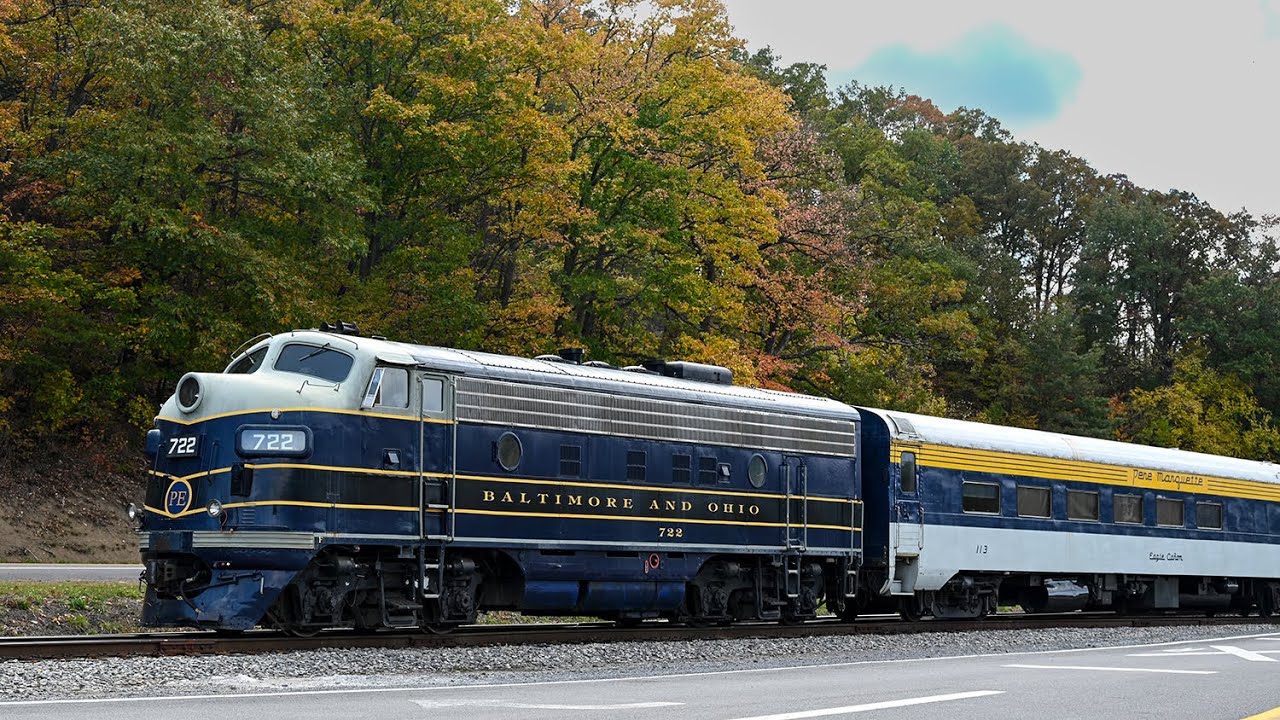
F Units on the Potomac Eagle, Romney, West Virginia!
Автор: Yard Limit
Загружено: 2022-12-30
Просмотров: 1188
Описание:
The South Branch Valley Railroad has been a vital part of the valley from Green Spring to Petersburg for well over 100 years. The South Branch Valley Railroad (SBVR) comprises a 52.4-mile route from Petersburg to Green Spring where it links to the CSX mainline connecting Cumberland, MD to Martinsburg, WV. The SBVR generally parallels the South Branch of the Potomac River – from which the railroad takes its name. It is owned and operated by the West Virginia State Rail Authority (SRA).
This system was sold to the Moorefield and Virginia Railroad Company in 1911 with the purchaser assuming a mortgage existing against the line in the amount of $700,000. William Cornwell and Eugene Ailes, son-in-law of Governor Cornwell, were officers of the grantor company. In November 1913 the Moorefield and Virginia Company transferred the system to the Baltimore and Ohio Railroad Company. Passenger service was abandoned on the line sometime around 1928.
In the mid-1970s, the line was abandoned by the B&O. It was taken over by the State of West Virginia on October 11, 1978, as government officials became concerned over the harm that would come to existing industry and the prospects of driving away new business along the line. Track rehabilitation began on the 52-mile stretch, but the famous flood of 1985 knocked out four bridges and left 13 miles of track with heavy damage and 23 miles with moderate damage. It was reported that in some stretches in the Trough that rail and ties hung in mid-air with all traces of road bed gone beneath them.
In late 1989 the Romney Business and Professional Organization began a successful effort to bring a tourist train to the area. Spurred on by a state commissioned report showing the line had great potential, the group worked tirelessly to get the excursion up and running. The spring of 1991 saw the first Potomac Eagle pull out of Romney.
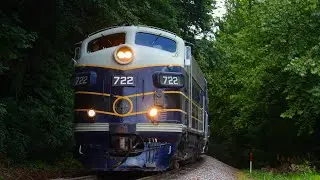
The Potomac Eagle #722 locomotive has a long and storied past. The F-7 was built in 1952 for the Bessemer and Lake Erie Railroad by Electro Motive Division of General Mothers in La Grange, Illinois.. It was part of the first wave of new diesel locomotives to replace steam engines. After approximately 25 years of general service hauling coal, coke and iron ore between the Great Lakes and Pittsburgh, the unit became part of a small program that would extend the unit’s useful life on a Class 1 carrier. The unit was retrofitted for special remote control operation involving the B&LE’s dock facility in Conneaut, Ohio.
Years later, while looking for a door to fit a former CSX 116 as part of a grant project to restore a locomotive for the C&O Historical Society, David Corbitt, then-president of the Potomac Eagle Scenic Railroad, and Charlie Sayre, retired CSX locomotive engineer, discovered an F-7 locomotive in a Youngstown, Ohio salvage yard. Corbitt was in one part of the salvage yard looking for a door while Sayre was looking in another area. Sayre spotted the 1952 locomotive and urged Corbitt to take a look.
A short time later a deal was struck for the locomotive with LTE Rail Services, owners of the F-7. Potomac Eagle Scenic Railroad employees worked with LTE’s staff to make the repairs. Lettering for the Potomac Eagle’s name was performed and a target date of September 1, 2002, was set for the locomotive to arrive at Wappocomo Station in Romney. On August 30 Potomac Eagle’s restored #722 arrived at the CSX yards in Cumberland, Md. and on August 31 it was turned around and moved to Green Spring, W. Va. Potomac Eagle engineer Craig Yokum moved the locomotive to Wappocomo Station on September 1. #722 remained in the Potomac Eagle paint scheme until 2010 when it was repainted into B&O livery.
Thank you for watching our video and please subscribe to the channel!
Повторяем попытку...
Доступные форматы для скачивания:
Скачать видео
-
Информация по загрузке: