Why did Arjuna Grieve? - Consciousness Conversations on "Mahabharata" - Sangeetha Men
Автор: Consciousness Conversations
Загружено: 2025-10-26
Просмотров: 664
Описание:
We now turn to Arjuna, not just as a warrior, but as a symbol of inner conflict that fundamental transforms to eventual clarity. I reserved the discussion on Arjuna towards the end of the Mahabharata series, not only because his narrative brings light to the darker emotional terrains we have already explored, but also because his transformation invites us to pause, reflect, and even, perhaps, smile, because something continues to shift inwardly as his struggle unfolds in front of us.
Unlike Dhritaraashtra’s resignation or Duryodhana’s envy, Arjuna’s crisis is deeply ethical and to some extent his inner conflicts with his attempts for self-integration. It arises not from external threat or comparison, but from an intense moral and philosophical confrontation within himself.
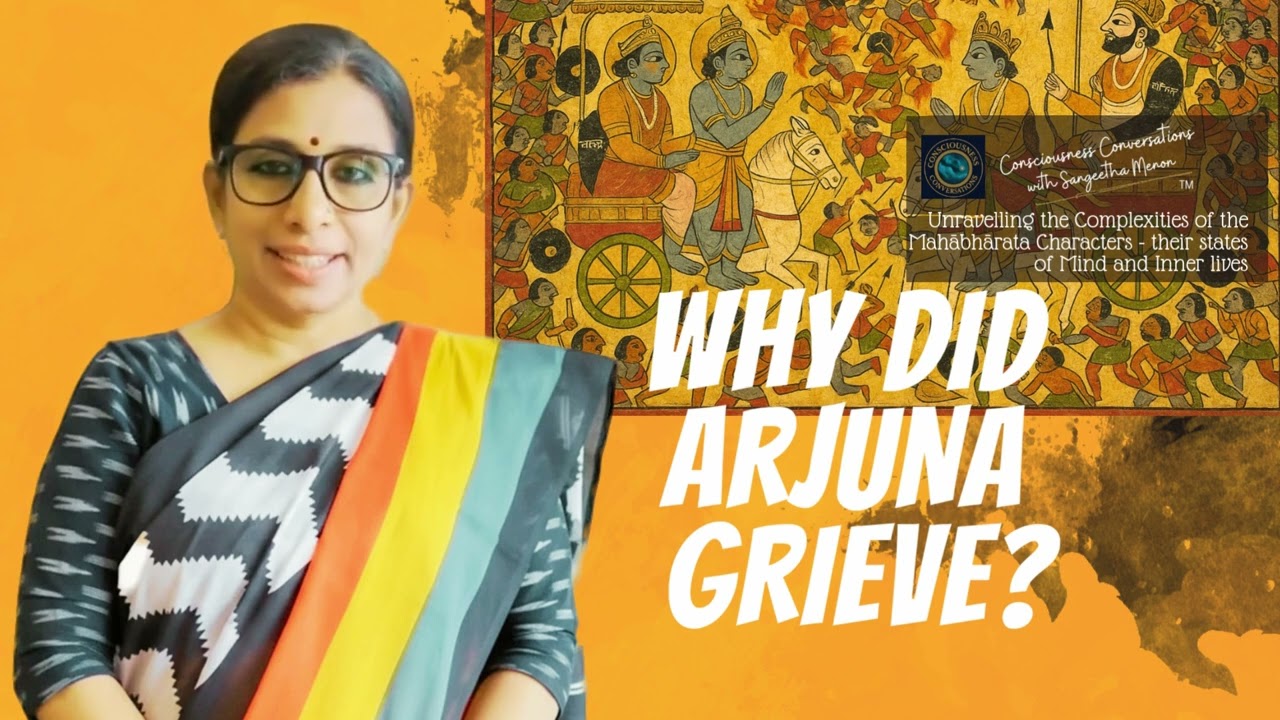
At the edge of the Kurukshetra battlefield, Arjuna asks Krishna to place his chariot between the two armies. What he sees overwhelms him, not enemies, but kin, teachers, elders, and beloved companions. He is struck by a sudden reversal of perception: these are not targets, but relationships, threads of his very identity.
“How can I fight those to whom I owe my life? If I win, what joy remains? If I kill, what kind of self survives?” He gets overwhelmed by these intense questions and collapses on to the floor of the chariot.
Arjuna’s worldview, built around duty, honor, and righteousness, begins to crumble. He lays down his bow and declares that he will not fight. What follows is the beginning of the Bhagavad Geetha, where Krishna steps in, not just as a charioteer, but as a voice of inner discernment and a Guru.
After listening to the long winding narratives of Arjuna dripping with grief, Krishna’s first words are direct: “Do not grieve".
This is not a dismissal of Arjuna's emotions. Rather, Krishna points Arjuna toward a deeper metaphysical understanding of his self. The Geetha teaches that grief, when left unexamined, leads to paralysis. But grief, when seen through, can open the door to insight about oneself and the other.
Krishna reminds Arjuna that he is more than a warrior, more than a cousin, more than a student, more than a nephew, more than a role. He is, in essence, the witness consciousness, the one who acts, but is not entangled in action; who grieves, but is not destroyed by grief. Krishna creates a radical shift in Arjuna's perspective on his self and the acts initiated.
Arjuna is not told to abandon his duty, but to approach it without clinging to outcome, without ego, without despair. In doing so, he discovers a form of engagement that is inwardly free and outwardly precise.
The contrast with Duryodhana is sharp, here. Duryodhana’s desire consumes him, whereas Arjuna’s self-inquiry leads him to clarity both about himself and the decisions on the acts he has to perform. His crisis is a turning point, not an end in itself.
Arjuna’s struggle at no point is resolved through renunciation of his agency and ownership, but through the reorientation of his perspectives on his self, and the relation between his self and the rest of the world. A enlightened causal reorientation.
Subsequently the same battlefield becomes a site not of confusion and trepidation, but of clarity and decisive determination.
And what is insightful is that even after the extensive dialogue what Krishna asks Arjuna is to make his own choice and accordingly decide his actions. The dialogue between Arjuna and Krishna is a discourse on freedom that goes with enlightenment.
Повторяем попытку...
Доступные форматы для скачивания:
Скачать видео
-
Информация по загрузке: