Alexandre Guilmant Symphony No. 2 for Organ and Orchestra
Автор: Chamber Orchestra of the Springs
Загружено: 2018-09-27
Просмотров: 10529
Описание:
Deke Polifka, organist
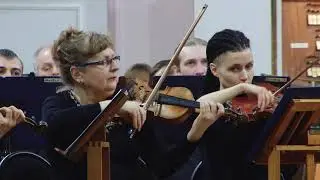
Chamber Orchestra of the Springs
Thomas Wilson, Music Director
September 9, 2018
First United Methodist Church
Video Engineer Michael Lascuola
Program Notes Mark Arnest
#Guilmant
Overview: Felix Alexandre Guilmant
Born March 12, 1837, Boulogne-sur-Mer, France; died March 29, 1911, Meudon, France
Work Composed: 1907
Why It Matters: A majestic late work by a rarely performed Romantic composer.
Until he was 34, Felix-Alexandre Guilmant seemed destined to follow his father’s steps as small-town organist in the northern French seaport of Boulogne-sur-Mer. But he had ambition, and that year he got the job as organist at La Trinite Church in Paris. This brought his talents to a much wider circle of attention, and from there his career blossomed. He became an organ superstar, performing all over Europe and making three tours of the United States. He published prolifically, with nearly all his pieces involving organ or harmonium.
Some of you may recall the Chamber Orchestra of the Springs’s 2016 performances of Guilmant’s first Organ Symphony. In that piece, Guilmant’s second time combining organ with orchestra, his approach was fairly conservative. He tended to alternate the two, heeding Hector Berlioz’s famous advice: “Both the organ and the orchestra are kings; or rather, one is the emperor and the other the pope. Their tasks are different; their interests are too vast and too divergent to be mixed together.”
But by the time Guilmant composed his second organ symphony, he’d had an additional thirty-seven years of experience. The result is an organ part that’s much more integrated into the overall texture. Guilmant still dramatically contrasts the orchestra and the organ; but he had also absorbed Richard Strauss’s advice that the organ “is really nothing but a wind instrument,” and he frequently blends it with the orchestra.
The organ part in Jongen’s symphony is so big as to verge on being an organ concerto; in contrast, this is very much a symphony in which the organ is one of the instruments. Guilmant lets the organ be silent for long sections.
The symphony exists in two versions, which appear to have been created at the same, or nearly the same, time: the first for organ alone, published as his Eighth Organ Sonata; and this symphony, both bearing the same opus number. It’s one of his final compositions.
Stylistically, the piece belongs to the late nineteenth century. In contrast to Jongen, there’s no evidence that Guilmant was even aware that Debussy existed. That’s not to suggest that the symphony lacks originality, however. Guilmant was very much influenced by Saint-Saens, one of whose most pronounced traits was his interest in musical form; and Guilmant’s approach to form in this piece is always interesting and even thought-provoking.
This is evident early in the first movement. The piece begins with a lengthy slow introduction, which leads to a grandiose climax; the following main theme begins like a fugue, but doesn’t continue long in this vein, though the counterpoint continues to be busy. As is typical in Romantic sonata forms, the second theme is more lyrical – but, unusually, it’s also closely connected to the theme of the introduction. Guilmant continues to exploit the contrasting character of these themes throughout the movement.
The tender second movement begins with a wistful melody for organ solo. Guilmant’s mastery of colors is evident here: At the theme’s repeat, he doubles the organ’s left hand – but only the left hand – with the cellos, giving this inner voice a special radiance. And he gives the final statement of the theme to the clarinet, emphasizing the natural connection between the organ and the woodwinds.
The genial third movement contains echoes of Schumann. Its form is slightly unusual, with two trios instead of the usual one. The organ barely appears in this movement, supplying only a few bass notes in the second trio.
The organ returns to begin the fourth movement, which is in an unusual two-part form. The organ solo is slow, warm, and dark. The orchestra joins in with chromatic harmony reminiscent of César Franck. The second half of the movement begins with a horn call leading to a dramatic crescendo, after which the first movement’s suggestion of a fugue now becomes full-blown.
The first section of this fugue is purely orchestral. The organ then introduces a second fugue, which Guilmant combines with the first as the piece rushes to a triumphant conclusion.
Повторяем попытку...

Доступные форматы для скачивания:
Скачать видео
-
Информация по загрузке: