Bi-Metal Temperature sensor working principle!
Автор: Raj Kanabar
Загружено: 2024-02-27
Просмотров: 15049
Описание:
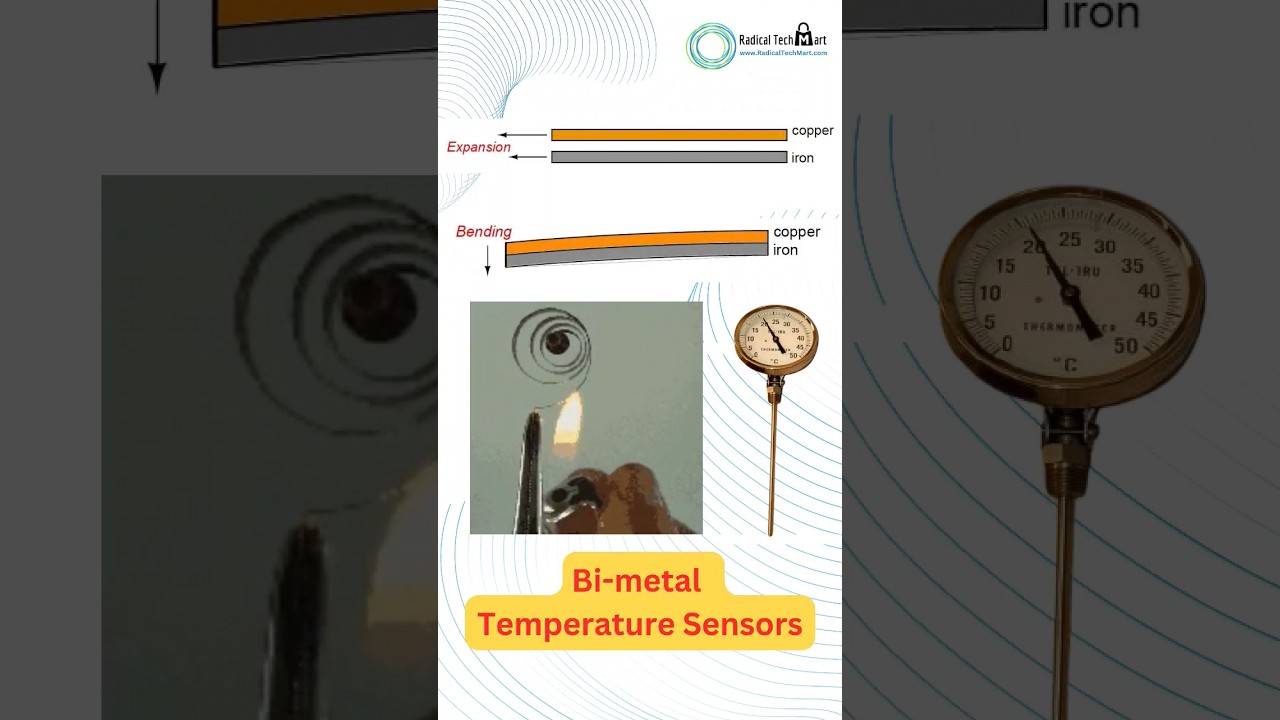
Bi-metal temperature sensors are commonly used in thermostats and other temperature control devices. They work based on the principle of differential expansion of two different metals when subjected to temperature changes. Here's how they work:
1. **Construction**: A bi-metal temperature sensor consists of two strips of different metals bonded together. These metals have different coefficients of thermal expansion, meaning they expand and contract at different rates when heated or cooled.
2. **Curvature**: When the bi-metal strip is exposed to a temperature change, the two metals expand or contract at different rates, causing the strip to bend or straighten. This bending or straightening is known as the "curvature" of the bi-metal strip.
3. **Switching Mechanism**: The bi-metal strip is typically connected to a mechanical switch or contact. When the temperature changes and the bi-metal strip bends or straightens, it causes the switch or contact to open or close.
4. **Temperature Control**: In a thermostat, for example, the bi-metal strip is connected to a temperature control mechanism. When the temperature rises above a certain set point, the bi-metal strip bends, causing the switch to open and turn off the heating element. When the temperature falls below the set point, the bi-metal strip straightens, causing the switch to close and turn on the heating element.
5. **Accuracy and Calibration**: The accuracy of a bi-metal temperature sensor depends on the materials used, the thickness of the metals, and the design of the sensor. Calibration is often required to ensure accurate temperature control.
Bi-metal temperature sensors are simple, reliable, and cost-effective devices used in a wide range of applications, from household thermostats to industrial temperature control systems.
Повторяем попытку...
Доступные форматы для скачивания:
Скачать видео
-
Информация по загрузке:


