Before You Put LVP on Your Stairs, Watch This
Автор: Nick - Platte + Pine
Загружено: 2026-01-02
Просмотров: 955
Описание:
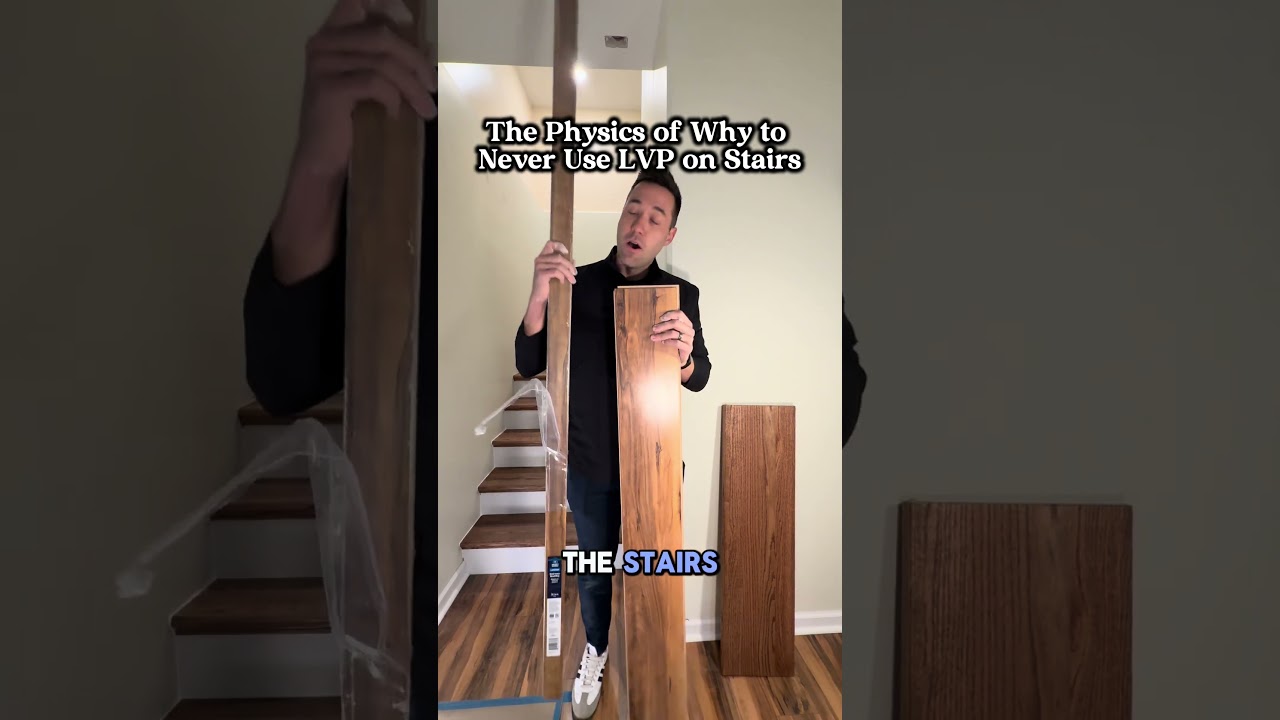
Most people don’t realize that stairs are one of the most punishing places in your home for flooring. Every single step concentrates your full body weight onto the very front edge of the tread. That repeated point-load is brutal over time, especially when the system was never designed for it.
With LVP, you’re typically laying floating planks across the tread and then gluing or nailing a separate bullnose onto the edge. That creates a weak point where gravity, shear force, and foot traffic are all working against the connection. Eventually, no matter how well it’s installed, you start to see movement, separation, or failure at that nose.
On top of that, LVP simply isn’t as wear-resistant on stairs as people expect. The thin wear layer gets hit constantly in the same exact spots, so you tend to see scuffing, edge breakdown, and visual wear much sooner than you would on a flat floor.
That’s why we recommend solid hardwood tread covers instead. It’s one continuous piece of wood from back to front, so the load is distributed properly, there’s no mechanical weak point at the edge, and the material itself is built to be refinished and last decades. We stain and seal them to match the LVP as closely as possible, but the performance is in a completely different league.
If you want stairs that still look good and feel solid in 10, 20, or 30 years, hardwood is the smarter choice.
Повторяем попытку...
Доступные форматы для скачивания:
Скачать видео
-
Информация по загрузке: