Parihaka-3D seismic time slices
Автор: StarkReality
Загружено: 2023-02-24
Просмотров: 190
Описание:
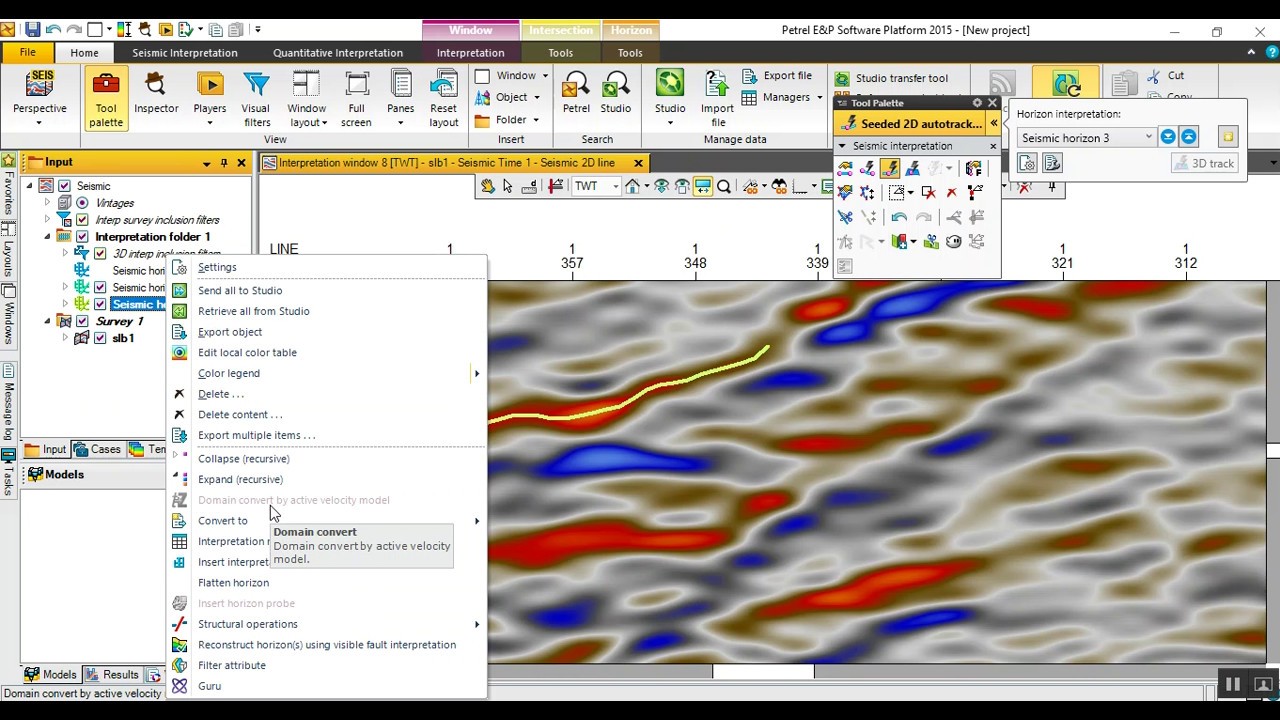
This video pans through conventional time slices from the New Zealand Parihaka-3D seismic full stack volume. It is from a set of 5 videos generated to illustrate the application of the Stark Reality “Surface Segments” plugin. This plugin generates data volumes useful for interpreting and extracting geological information from 3D seismic data volumes prior to starting the interpretation process. The other videos in the set can be found in the "Surface Segments" playlist on the @starkreality7077 YouTube channel.
Strike and dip direction of seismic events can be inferred from videos of time slices. However, quantitative strike and dip information cannot be extracted from a single conventional time slice. This is because the discretely-sampled continuous seismic wave-field has both temporal and spatial variations of amplitude and waveform. Conventionally, a seismic horizon must be interpreted to extract quantitative strike and dip information or amplitude variations along a horizon. However, these types of information are available (over a cycle-width limited time range) from a single time slice through a “Surface Segment” volume, as illustrated by the other videos in the set.
“Surface Segments” either display the amplitude or arrival time attributes of specific types of events within in a limited time window. This time window is less than one local period. The available types of events are peaks, local peaks, troughs, local troughs and zero crossings. “Surface Segments” are generated on a trace by trace basis, using at most three vertically adjacent data samples to determine if the desired event type is present within the two to three samples. If the type of event is not present, the output sample is set to a “no event” value. If it is present, then the output is set to either represent the seismic amplitude (or some other attribute) or arrival time. The found events are then copied to vertically adjacent time samples. As a result, any spatial continuity exhibited in a time slice from the output Surface Segment volume is due to the data itself and not something that is implied or forced by the attribute generation algorithm.
“Amplitude Surface Segments” illustrate the local variation in amplitude of the type of horizons. Their width indicates the dip magnitude and their “no event” boundaries follow the local strike. “Time Surface Segments” contain portions of the time contour maps of the event types, and therefore also show details of the dip direction and dip magnitude, along with the strike information.
Stark Reality wrote the commercial OpendTect plugin used to generate the Surface Segments displayed in these videos. This plugin should be available from the online OpendTect Pro store by the time this video is published. (https://prostore.dgbes.com/plugins/). The Stark Reality implementation is an expansion of the “Surface Slice” method described by Stark (1991): “Surface slices:” Interpretation using surface segments instead of line segments (https://doi.org/10.1190/1.1888952), Stark(1996): Surface slice generation and interpretation: A review (https://doi.org/10.1190/1.1437369) and Stark (2005): Surface slices as a stratigraphic interpretation tool (https://doi.org/10.1190/1.1887542).
The seismic data used for this video was obtained as a free download from https://wiki.seg.org/wiki/Open_data. The New Zealand Petroleum and Minerals ( http://www.nzpam.govt.nz ) are acknowledged as providing the data used as input to generated these figures.
The number centered at the bottom of each frame indicates the arrival time of the displayed time slice.
Повторяем попытку...

Доступные форматы для скачивания:
Скачать видео
-
Информация по загрузке: