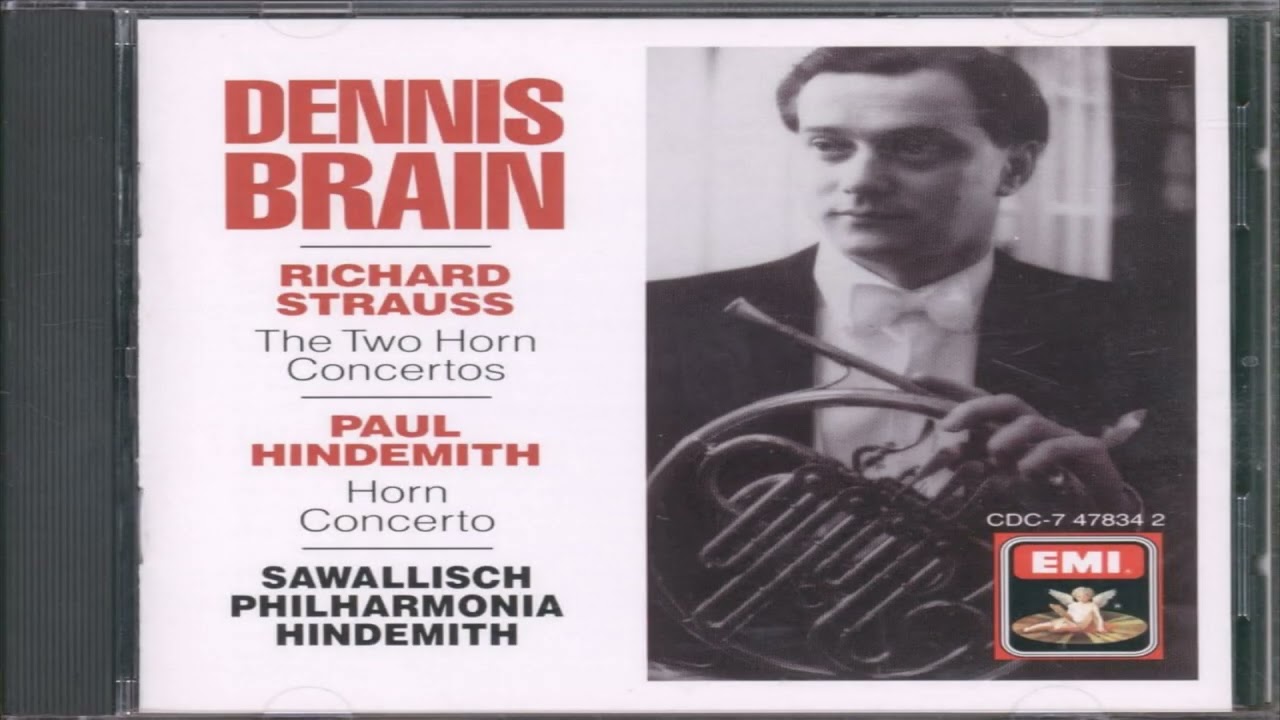
Dennis Brain - Richard Strauss - Horn Concerto #2 In E Flat, AV 132
Автор: BigFeetBigSocksTV
Загружено: 2024-08-07
Просмотров: 194
Описание:
Dennis Brain - Richard Strauss - Horn Concerto #2 In E Flat, AV 132
Wolfgang Sawallisch - Conductor
Philharmonia Orchestra
Strauss (R) - Horn Concerto #2 In E Flat, AV 132 - 1. Allegro - 0:00
Strauss (R) - Horn Concerto #2 In E Flat, AV 132 - 2. Andante Con Moto - 7:48
Strauss (R )- Horn Concerto #2 In E Flat, AV 132 - 3. Rondo. Allegro Molto - 13:07
Dennis Brain (17 May 1921 – 1 September 1957) was a British horn player. From a musical family – his father and grandfather were horn players – he attended the Royal Academy of Music in London. During the Second World War he served in the Royal Air Force, playing in its band and orchestra. After the war, he was the principal horn of the Philharmonia and Royal Philharmonic orchestras, and played in chamber ensembles.
Among the works written for Brain is Benjamin Britten's Serenade for Tenor, Horn and Strings (1944). Other composers who wrote for him include Malcolm Arnold, Lennox Berkeley, Alan Bush, Gordon Jacob, Humphrey Searle and Mátyás Seiber.
Brain was killed in a car crash at the age of 36.
By 1945, Brain, at 24 years of age, was the most sought-after horn player in England. His father injured himself in a fall, and retired from the BBC Symphony Orchestra, although he remained professor at the RAM until his death ten years later. After the war, Legge and Sir Thomas Beecham founded the Philharmonia and the Royal Philharmonic orchestras, respectively. Brain was principal horn in both, playing for Beecham alongside the woodwind players dubbed "the Royal Family" – Jack Brymer (clarinet), Gwydion Brooke (bassoon), Terence MacDonagh (oboe), and Gerald Jackson (flute). Later, he found that he did not have enough time to fill both positions and resigned from the Royal Philharmonic.
On 1 September 1957, at the age of 36, Brain was killed driving home to London after performing the Tchaikovsky Symphony No. 6, Pathetique with the Philharmonia under Eugene Ormandy at the Edinburgh Festival. He had driven his Triumph TR2 sports car off the road and into a tree on the A1 road opposite the north gate of the De Havilland Aircraft factory at Hatfield.
Brain was interred at Hampstead Cemetery in London. His headstone is engraved with a passage from the "Declamation" section of Hindemith's Horn Concerto:
My call transforms
The hall to autumn-tinted groves
What is into what
Has been...
One of Brain's favorite horns (by Alexander of Mainz: a single B-flat horn with an F extension as a tuning slide) was badly damaged in his fatal crash. It has since been restored by Paxman Brothers of London and is on public display in the York Gate Collections at the RAM.
Richard Strauss composed his Horn Concerto No. 2 in E-flat major, (TrV 283) whilst living in Vienna in 1942. The work was premiered in 1943 at the Salzburg Festival and was recorded in 1944, both with solo horn Gottfried von Freiberg. The score was published by Boosey & Hawkes of London in 1950. It was taken up and popularized by the British horn player Dennis Brain. It has since become the most performed and recorded horn concerto of the 20th century.
The premiere of Strauss's opera Capriccio was on 28 October 1942. Strauss wrote "My life's work has been concluded with Capriccio. Whatever notes I scribble down now have no bearing on musical history." A couple of days later he drove to Vienna where he was to stay for over 6 months. The horn concerto seems to have been written very quickly: his note book indicates that the draft was finished on 11 November, and the final score two weeks later on the 28th (he added a note at the end "In the beautiful house at Vienna"). The autograph score indicates that it is dedicated "To the memory of my father", although this did not make it into the published version. The speed of composition may reflect that it had been on his mind for sometime, as the principal horn player at Munich, Professor Josef Suttner, had asked him years before to write a second concerto. Strauss also mentioned the second concerto in a program list written in 1941.
Повторяем попытку...
Доступные форматы для скачивания:
Скачать видео
-
Информация по загрузке: