How to Measure Very Low Current with Tolicore Picoammeters
Автор: Tolicore Corp.
Загружено: 2025-06-01
Просмотров: 627
Описание:
How to Measure Femtoamperes on Your Coffee Table: Measure Very Low Current Using a Tolicore Picoammeter
Situation:
Detecting femtoampere-level current changes might be challenging, which is why knowing how to measure low current properly is so important.
Have you ever waved your hand over your typical picoammeter and saw the spikes that rendered your signal unusable?
Or had to press the start button and then quickly step back a few feet just to avoid disturbing the measurement?
We know exactly how that feels.
And yes… a good instrument is not enough to measure low level current change reliably. A good setup is also required.
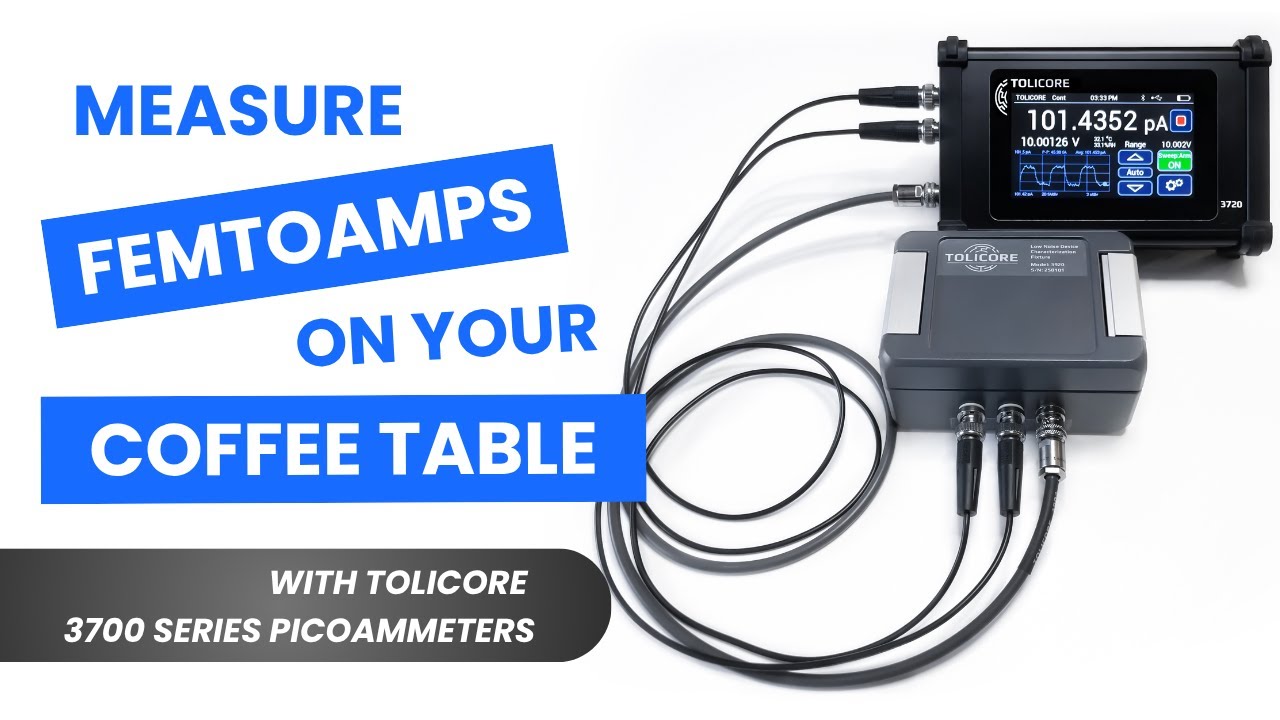
But don’t worry—pairing a Tolicore picoammeter with a Tolicore low noise device characterization fixture and low noise cabling allows you to see those femtoamperes right on your coffee table!
Design: Building an Instrument for Reliable Low Current Measurement
The Tolicore Model 3720 was designed to help you detect the lowest current changes in the real world.
We packed some critical features that help you minimize interference and noise, and see very low level current signals:
• Very low noise current sensing amplifier design
• High quality triax current input
• Isolated analog front-end
• Isolated voltage source
• Battery-powered system (to remove AC line connection)
• Bluetooth® interface (to remove noisy computer connection)
• Low noise device characterization fixture
• Low noise triax cable with a semiconducting layer
Setup: How to Measure Low Current with the Tolicore 3720
The setup is very simple.
• Tolicore Model 3720 Picoammeter / Voltage source
• Tolicore Model 3920 Low Noise Device Characterization Fixture
• Tolicore Model 3903 Low Noise Triax Cable
• Two BNC cables
And we plugged in a 100 Gohm resistor into the fixture.
Signals: Detecting Femtoampere-Level Currents Without Interference
On the Model 3720, we set up the voltage source to generate a repeated 4 mV peak-to-peak pulse signal with the base at 10.002 V.
The signal was applied to a 100 Gohm resistor that was placed into the socket on the board inside the Tolicore 3920 Low Noise Device Characterization Fixture.
The current generated was measured with the 3720 picoammeter.
First, we left the fixture open and waved a hand over the setup. Yes, our hand can easily generate a few picoamperes of interference!
So... our expected 40 fA signal is lost indeed!
Then we closed the fixture cover and waited to acquire a new signal. Now we can easily see our 40 fA peak-to-peak signal. And that is 0.04% at a 100 pA baseline with a good signal-to-noise ratio!
At the 100 pA baseline signal, our peak-to-peak noise seems to be on the order of 10 fA, which is equivalent to less than 2 fA RMS value.
And, that isn't even at the most sensitive speed acquisition settings and without any filters applied!
We even waved our hand over the setup… still good signal!
The Bottom Line: Measuring Low Level Current Reliably
With the Tolicore picoammeter and standard test kit, you can easily see femtoamperes with a high impedance source—all while sipping coffee next to your setup, worry-free!
Visit us at https://tolicore.com to learn more about Tolicore instruments.
Повторяем попытку...
Доступные форматы для скачивания:
Скачать видео
-
Информация по загрузке: