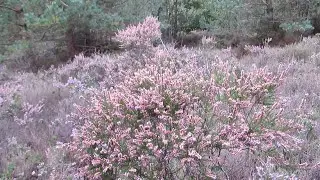
Calluna vulgaris - (Common Heather)
Автор: Herbarium Werdler
Загружено: 2018-08-12
Просмотров: 11886
Описание:
Latin name: Calluna vulgaris
Family name: Ericaceae
Naming by country:
Chinese: 帚石楠
Deutsch: Besenheide / Heidekraut
English: Common heather / Ling / Heather
Francais: Béruée / Brande / Bruyère commune / Bucane / Fausse Bruyère / Grosse Brande / Péterolle / Bruyère callune
Nederlands: Struikhei
Portuguese: Urze / Queiró
World:
Calluna is native to Europe, Iceland, the Faroe Islands, and the Azores. It has been introduced into many other places worldwide with suitable climates, including North America, Australia, New Zealand and the Falkland Islands. Calluna vulgaris was introduced to New Zealand and has become an invasive weed in some areas, notably the Tongariro National Park on the North Island and the Wilderness Reserve (Te Anau) on the South Island, overgrowing native plants. Heather beetles have been released to stop the heather, with preliminary trials successful to date.
Location:
Sunny and in moderate shade
Soil:
Acidic soil
Height:
20 - 50 cm (7.9 - 19.7 in)
Rarely to 1 meter (39 in) and taller
Flowers:
The flowers emerge in late summer; in wild plants these are normally mauve. They are terminal in racemes with sepal-like bracts at the base with a superior ovary, the fruit a capsule. Different cultivars have flower colours ranging from white, through pink and a wide range of purples, and including reds. The flowering season with different cultivars extends from late July to November in the northern hemisphere. The flowers may turn brown but still remain on the plants over winter, and this can lead to interesting decorative effects.
Leaves:
Calluna vulgaris has small scale-leaves (less than 2–3 mm long) borne in opposite and decussate pairs.
Garden:
Calluna vulgaris is a very popular ornamental plant in gardens and for landscaping, in lime-free areas where it will thrive, but has defeated many a gardener on less acid soil.
Food:
Heather honey is a highly valued product in moorland and heathland areas, with many beehives being moved there in late summer. Not always as valued as it is today, it was dismissed as mel improbum by Dioscurides. Heather honey has a characteristic strong taste, and an unusual texture, for it is thixotropic, being a jelly until stirred, when it becomes a syrup like other honey, but then sets again to a jelly. This makes the extraction of the honey from the comb difficult, and it is therefore often sold as comb honey.
Medicine:
Calluna vulgaris herb has been used in the traditional Austrian medicine internally as tea for treatment of disorders of the kidneys and urinary tract
Animals:
Heather is an important food source for various sheep and deer which can graze the tips of the plants when snow covers low-growing vegetation. Willow Grouse and Red Grouse feed on the young shoots and seeds of this plant. Both adult and larva of the Heather Beetle Lochmaea suturalis feed on it, and can cause extensive mortality in some instances. The larvae of a number of Lepidoptera species also feed on the plant, notably the small emperor moth Saturnia pavonia.
Chemicals:
The shoots of Calluna vulgaris contain the phenolic compounds chlorogenic acid, its 3-O-glucoside, 3-O-galactoside and 3-O-arabinoside.
-------------------------------------
Follow Herdarium Werdler on:
Google Plus: https://plus.google.com/b/11434544296...
Twitter: / hw_herbarium
YouTube: / @herbariumwerdler
-------------------------------------
Music:
Dixxy - Smile
-------------------------------------
Sources:
https://en.wikipedia.org/wiki/Calluna
https://www.gbif.org/species/2882482
Повторяем попытку...

Доступные форматы для скачивания:
Скачать видео
-
Информация по загрузке: