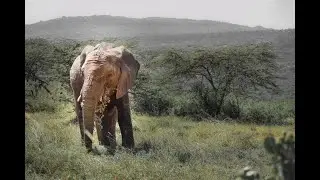
Impala in the Wild
Автор: Natural Cuties
Загружено: 2015-06-13
Просмотров: 12211
Описание:
The impala (Aepyceros melampus) is a medium-sized African antelope.
The impala inhabits savanna grasslands and woodlands in close proximity to water sources. It is a mixed forager, whose diet consists of grasses, forbs, monocots, dicots and foliage. It switches between grazing and browsing depending on the season and habitat. Water is an essential requirement. Impala are fast runners and are known for their leaping ability, reaching heights up to 3 m (9.8 ft). They communicate using a variety of unique visual and vocal cues. There are three distinct social groups during the wet season: the female herds, the bachelor herds and the territorial males. The mating season is the three-week-long period toward the end of the wet season in May. A single fawn is born after a gestational period of about six to seven months. The fawn remains with its mother for four to six months, after which it joins juvenile groups.
The impala is native to Angola, Botswana, Kenya, Malawi, Mozambique, Namibia, Rwanda, South Africa, Swaziland, Tanzania, Uganda, Zambia and Zimbabwe. Regionally extinct in Burundi, it has been introduced in two protected areas of Gabon.
mpala are diurnal, most active shortly after dawn and before dusk. They spend the night feeding and resting. They use various kinds of unique visual, olfactory and auditory communication, most notably laying scent-trails and giving loud roars. The roaring process consists of one to three loud snorts with mouth closed, followed by two to ten deep grunts with an open mouth, lifted chin and upraised tail. The most characteristic movement of the impala is its unique leap. When alarmed, they run at very high speeds and jump to heights of 3 m (9.8 ft), over bushes and even other impala, covering distances of up to 10 m (33 ft). The impala has an average lifespan of about 15 years in the wild, and nearly 17 years in captivity.
Impala are important prey animals for several carnivores, including lions, leopards, cheetahs, Cape hunting dogs, spotted hyenas, crocodiles and pythons. An alert and wary animal, the impala turns motionless on sensing danger. It will scan the vicinity with its eyes to spot the predator, and rotate its ears to catch any tell-tale sounds. It stares at and moves its head to get a better view of any object it can not identify. The female who leads a file of impala on the way to drink often stops and surveys the surroundings for danger, while the rest stand relaxed. Unlike other antelopes, who run away in the open when disturbed, the impala tries to hide itself in dense vegetation in case of any alarm.
The social behaviour of the impala is influenced by the seasons. While their home ranges are heavily fortified in the wet season, they often overlap in the dry season. The southern impala are much likely to intermix in the dry season, while the eastern impala are territorial during this period. Three distinct social groups are formed in the wet season: the territorial males, bachelor herds and female herds.These groups continually break up into smaller herds and reunite. About a third of the adult males hold individual territories, which range from 0.2–0.9 km2 (2,200,000–9,700,000 sq ft) in size and may change according to the season. The males demarcate their territories with urine and faeces and defend them against any other male intruders. A study of impala in the Serengeti National Park showed that in 94% of the males, territoriality was observed only for a duration of less than four months. During the mating season males prefer small, easily defended territories, and will sometimes reclaim their old ones from previous mating seasons. These territorial males may or may not have breeding females in their territories. The male will try to control any female herds passing through his territory by herding them towards the centre, and will also chase away any bachelor males or juveniles who accompany them.
The bachelor herds comprise non-territorial adult as well as juvenile males, and can have about 30 members. Individuals maintain distances of 2.5–3 m (8.2–9.8 ft) from one another. Young and old males may interact, but middle-aged males usually avoid one another. The female herds consist of 15-100 individuals, comprising females and their young (including young males below four years). The females form clans, and inhabit home ranges 80–180 hectares (200–440 acres; 0.31–0.69 sq mi) in size. There is no distinct leader of the female herd, though animals aged five years or more may move independently. Membership in both bachelor and female herds is variable.
#zebraplainsmoments #zebraplainscollection #Wildlife
Повторяем попытку...

Доступные форматы для скачивания:
Скачать видео
-
Информация по загрузке: