Brain Bully Thinking is Success Stopper Thinking
Автор: Giulio
Загружено: 2026-03-19
Просмотров: 2
Описание:
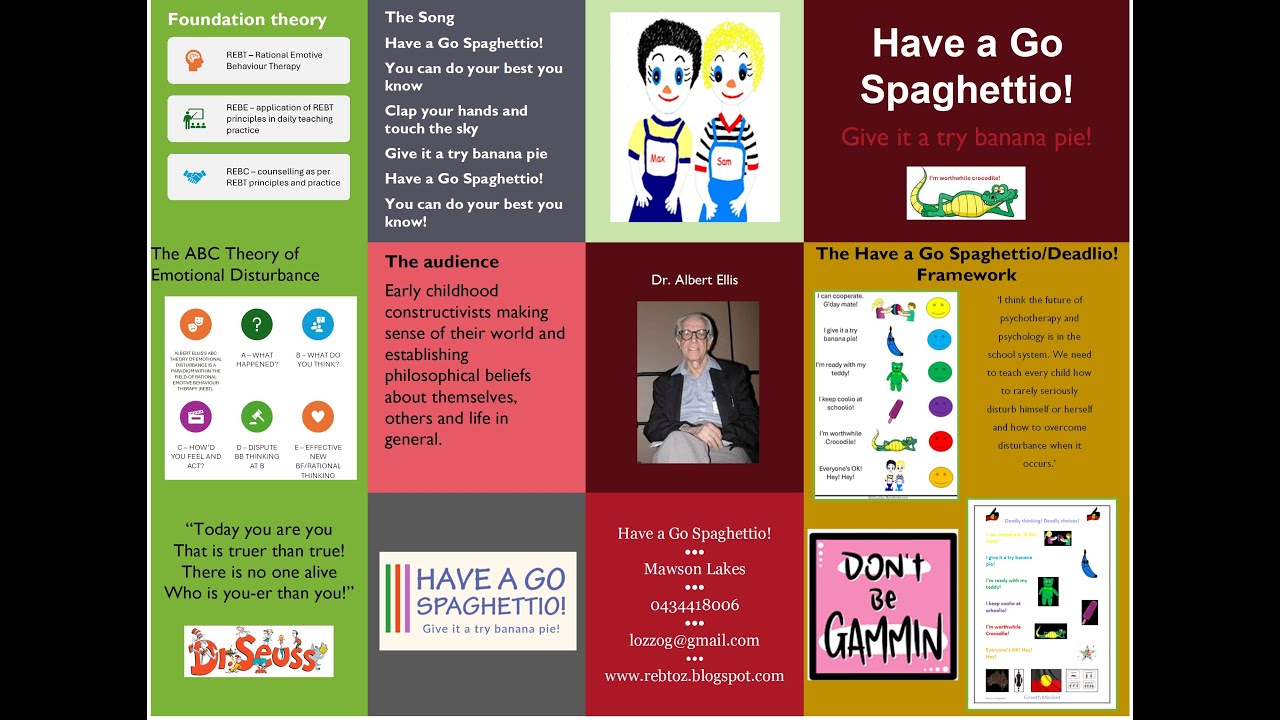
In this presentation we revisit Brain Bully (BB) thinking. Have a Go Spaghettio! teaches children that thinking and feeling and behaving are connected. Brain Bully thinking makes Brain Bully feelings and Brain Bully behaviours. E.g., if something is seen as a catastrophe, yet evidence may suggest otherwise, feelings will be heightened, more acute, and behavioural choices might not be the best ones! This is where BB thinking is driving BB feelings and making BB choices. Can you relate to this scenario perchance?
The problem is that the evidence may challenge errant ideas and perceptions of self, others and happenings but does the young child have the wherewithal, or the insight needed to question and challenge what it is they are thinking and why they feel as they do?
At this stage of the child's development, they don’t have the capacity to do this. It is beyond their capability to think about their thinking. So, we start to provide the tools that will help them to meta cognise later when they reach formal operations stage.
Here are a couple of relevant quotes.
‘We move in the direction of our most dominant thoughts.’
‘What you think you become.’ Buddha’s teachings in the Dhammapada, which emphasize that the mind shapes reality, defines character, and determines destiny.
This is what is referred to as the Law of Dominant Thought which is a useful thought to have in mind. What thoughts or beliefs are our young early childhood constructivists developing? Which will dominate, BB or BF thinking?
Constructivism is a learning theory and philosophical viewpoint asserting that individuals actively construct knowledge, meaning, and reality through personal experience, social interaction, and reflection.
Construct, make, fabricate all suggest building, putting together bits and pieces to make a bigger picture of how we see others, ourselves and how we think the world works.
If the ‘map’ we are constructing approximates how the world works, the ‘territory’, we are more likely to manage our reaction, emotional and behavioural, to what’s happening in a reasonable way.
Jean Piaget’s constructivism is a theory positing that learners actively construct knowledge rather than passively absorbing information, building understanding through experiences, exploration, and mental adaptation to their environment. Piaget emphasized that cognitive development occurs through stages where individuals adapt to new information via assimilation and accommodation, moving from simple to complex thinking.
The wall is something that’s constructed or built, made of brick components and each contribute to its strength and durability. It has a foundation also that helps maintain the integrity of the structure. How might that relate to the idea of the unconditional self that REBT maintains is a healthy, Brain Friend/Success Hele[pr belief construction.
If we were to colour some bricks grey to represent those things we would like to improve, or acknowledge as being some kind of personal deficit, and consider them in the context of all bricks, bright coloured and duller we may appreciate that we are a composite of many bricks that make us who we are. We are our strengths and our weaknesses and if we accept this, we arrive at accepting our selves without condition, unconditional self-acceptance.
The problem is when we focus on a particular thing we don’t like about ourselves, and we miss the forest for a particular tree, the tree then becomes the forest. The grey brick becomes the wall. The bad thing about us becomes us.
Even if a brick is broken, the wall maintains its essential strength and integrity.
The wheel, like the wall, gets its strength from its component parts, the spokes. If one wobbly spoke becomes the bike in our minds i.e., the spoke is bad, the bikes bad, then we might as well throw it away, because we’ve decided its useless. One loose spoke is not the bike, one cracked brick is not the wall, one weed is not the garden, a word (dumb, stupid, cute, kind) is not us, ‘the map is not the territory’ as General Semantics tells us.
Unconditional Self Acceptance is when we find our own dodgy brick or a wobbly spoke, we know/decide it doesn’t/can’t define our ‘self’ i.e., the whole wall or the entire bike!
There are three main must beliefs that hold us back that Albert Ellis says contrives against our well being:
I must …
You must …
It must …
Albert Ellis’ REBT incorporates the thinking of the Stoic Philosophers, who said that what happens isn’t solely responsible for our feelings and actions, our perception of what happens has a role so it’s H + P = FAE i.e., happening plus perception equals feeling and actions experienced . If we call H ‘A’, and P ‘B’ and FA ‘C’ we have Albert Ellis’ ABC Theory of Emotional Disturbance counselling/teaching paradigm.
Have a Go Spaghettio! Give It a Try Banana Pie!
Повторяем попытку...

Доступные форматы для скачивания:
Скачать видео
-
Информация по загрузке: