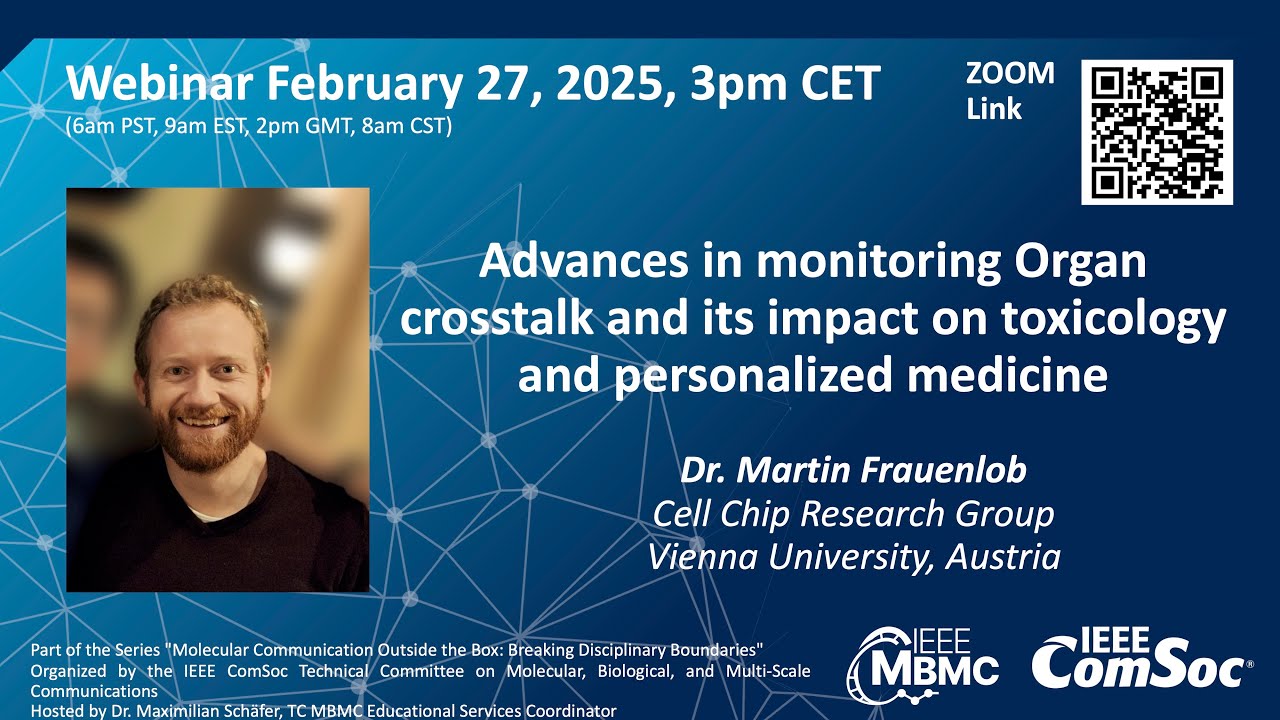
Advances in monitoring Organcrosstalk and its impact on toxicologyand personalized medicine
Автор: IEEE ComSoc MBMC-TC
Загружено: 2025-03-18
Просмотров: 54
Описание:
This is the talk by Priv.-Doz. Dr. Yolanda Salinas (Johannes Kepler University Linz, Austria) under the interdisciplinary seminar series "Molecular Communication Outside the Box: Breaking Disciplinary Boundaries" of IEEE ComSoc's Technical Committee on MBMC.
Abstract: The development of organ-on-a-chip (OOC) models is transforming toxicology and pharmacology by offering physiologically relevant platforms that emulate organ-specific microenvironments and their dynamic interactions. These microfluidic systems integrate human cell types within controlled settings, allowing for precise replication of organ function and inter-organ crosstalk, crucial for understanding systemic responses to drugs and toxins. Organ crosstalk, such as the interaction between the midbrain and the blood-brain barrier (BBB), has gained interest due to its role in neurodegenerative diseases like Parkinson's disease, where dopaminergic neuronal degeneration disrupts the integrity of the BBB. Furthermore, these interactions significantly influence the neurotoxicity profiles of pharmacological agents, underscoring the need for models that capture their complexity. With technological advances in microfluidics, including real-time impedance measurements, oxygen sensing, and modular chip designs, it is possible to enhance the precision and scalability of OOC systems. These advancements collectively highlight the potential of OOC technologies which paths the way to live analysis of organ crosstalk and systemic responses.
Biography: Martin Frauenlob the research group leader within the Cell Chip research group at Vienna University, with 10 years of expertise in biomedical engineering and microfluidics. His primary focus lies in 3D cell culture, biomaterial synthesis, and microphysiological systems. In 2019, he attained his PhD in transdisciplinary Life Science from Hokkaido University, where his research focused on the interaction between human cancer stem cells and tough hydrogels. Following his doctoral studies, Martin was working on the interface between industrial and academic science with a Postdoctoral position at the Institute Pasteur in Paris. There, he engaged multiple projects at the biomaterials and microfluidics core facility, notably contributing to the development an endothelial-muscle interface for investigating immune cell responses to adjuvanted vaccines.
Molecular Communication Outside the Box: Breaking Disciplinary Boundaries - YouTube Playlist:
• Molecular Communication Outside the Box: B...
IEEE ComSoc's Technical Committee on MBMC website: https://mbmc.committees.comsoc.org
IEEE ComSoc's Technical Committee on MBMC on LinkedIn: / 14247935
Повторяем попытку...
Доступные форматы для скачивания:
Скачать видео
-
Информация по загрузке: