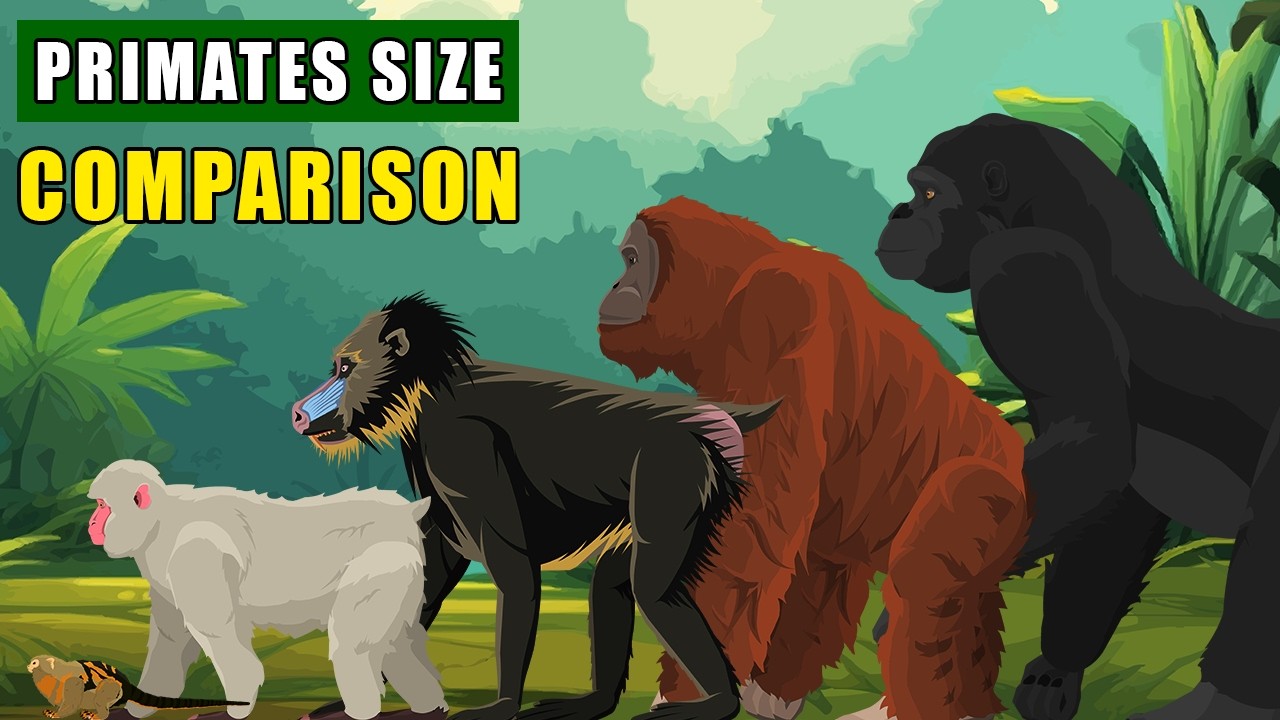
Primates Family Size Comparison: From Pygmy Marmoset to Gorilla
Автор: Exard Wild Flash
Загружено: 2026-03-19
Просмотров: 4162
Описание:
From the tiniest monkey that fits in your hand…
To the largest and most powerful ape on Earth…
How big can primates really get?
In this Wild Flash episode, we compare the body size of the primate family — revealing how evolution shapes height, strength, and survival across forests, mountains, and jungles.
📊 Primate Size Ranking + Quick Explanation:
🐒 Pygmy Marmoset — 10 cm
The smallest primate. Extremely light and agile, built for life on thin branches.
🐒 Squirrel Monkey — 16 cm
Small and fast. Uses speed and group movement to survive predators.
🦧 Gibbon — 20 cm
Long arms dominate its body. Built for swinging rather than large body size.
🐒 Emperor Tamarin — 25 cm
Small but social. Uses coordination and awareness more than size.
🕷️ Spider Monkey — 25 cm
Lightweight with long limbs. Designed for balance and tree movement.
🐒 Capuchin Monkey — 35 cm
Compact and intelligent. Balanced size allows both climbing and tool use.
🐵 Japanese Macaque (Snow Monkey) — 40 cm
Stockier build. Adapted to colder climates with stronger body mass.
🐒 Macaque Monkey — 45 cm
Versatile and adaptable. Medium size supports both climbing and ground movement.
🐵 Proboscis Monkey — 50 cm
Larger body with unique features. Built for riverine and forest environments.
🐒 Baboon — 60 cm
Ground-dwelling and muscular. Size supports strength and dominance.
🦍 Gelada — 60 cm
Similar size to baboons but more specialized for highland grasslands.
🦍 Mandrill — 70 cm
Large and powerful. One of the biggest monkeys with strong physical presence.
🦧 Bonobo — 75 cm
Lean but strong. Uses intelligence and social behavior more than aggression.
🦧 Chimpanzee — 85 cm
Highly muscular. Combines intelligence with strong physical capability.
🦧 Orangutan — 90 cm
Massive upper body. Built for powerful climbing and slow movement.
🦍 Gorilla — 110 cm
The largest primate. Enormous size and strength dominate all others.
🌍 MACRO-SYNTHESIS
The primate family shows a clear scale progression from agility to dominance.
The Frame: From tiny branch specialists to massive ground-dwelling giants.
The Power: Size increases with muscle mass and physical strength.
The Strategy: Small primates rely on speed and evasion, while larger primates depend on strength and presence.
As size increases, survival shifts from avoiding danger to controlling it.
🧨 FINAL CONCLUSION
Placed side by side, the contrast is dramatic.
The smallest primates survive by staying hidden and fast.
The largest primates dominate through sheer physical power.
At the top, the gorilla stands as the ultimate giant — the peak of size and strength in the primate world.
⚠️ FINAL BIOLOGICAL DISCLAIMER
All sizes are simplified averages for comparison purposes.
Actual height varies depending on posture, species variation, sex, and environment.
🎯 INTENDED AUDIENCE
General Audiences (13+)
Wildlife enthusiasts, animal comparison fans, and viewers interested in biological scaling.
⚖️ EDUCATIONAL & CONTENT DISCLAIMER
This content is created for educational and entertainment purposes only.
It does not encourage interaction with wildlife.
Primates are intelligent and sometimes powerful animals that should be respected in their natural habitats.
Credit:
Ovani Sound - Pirate Set Sail
#WildFlash #Primates #SizeComparison
#AnimalSize #Gorilla #Monkey #WildlifeFacts
Повторяем попытку...
Доступные форматы для скачивания:
Скачать видео
-
Информация по загрузке: