Il Volto Santo e il menestrello The Holy Face the fiddler: da Lucca a Monte s. Martino @manortiz46az
Автор: Luigi Manfredi
Загружено: 2018-11-12
Просмотров: 122
Описание:
Volto Santo di Lucca e menestrello
Lucca, Cattedrale di san Martino
The Holy Face and the legend of the fiddler
Saint Martin’s Church, Lucca
Lucca, Cattedrale di san Martino
Monte san Martino (Marche, Italy)
Chiesa Madonna delle Grazie
A legend of a fiddler devotee of the statue receiving a shoe in precious metal, with a number of variants in the story, is first recorded from the 12th century. Typically the statue allows the shoe to drop, or kicks it over to the fiddler (despite, in some versions, a nail through it). The fiddler may be a poor pilgrim, or a devotee who is rewarded for frequently playing in front of the statue; or he may only take up the fiddle after his good luck. The slipper may be filled with gold coins, and the slipper may be returned by the fiddler and the gift repeated. The fiddler may be tried for theft of the slipper, but escape condemnation. The legend also became part of the cult of Wilgefortis, the alter ego of the Holy Face
Images showing the legend normally feature the fiddler playing below the statue, which is placed (as apparently in reality) just over an altar. The statue seems to be wearing actual clothes - like other much venerated statues, it seems to have been dressed in "festive clothes", at least some of the time. On the altar are the slipper, and a chalice below one of the statue's feet. This also reflects the medieval arrangement, where such a "chalice" was placed to receive offerings. In fact it was fixed and lacked a bottom, and led to a tube that carried offerings to a strongbox below the altar.*
Friesen Ilse E., The Female Crucifix: Images of St. Wilgefortis Since the Middle Ages. (Waterloo, Ontario:Laurier University Press) 2001, 35-40
https://wikivisually.com/wiki/Holy_Fa...
La ciabatta d'oro ed il giullare
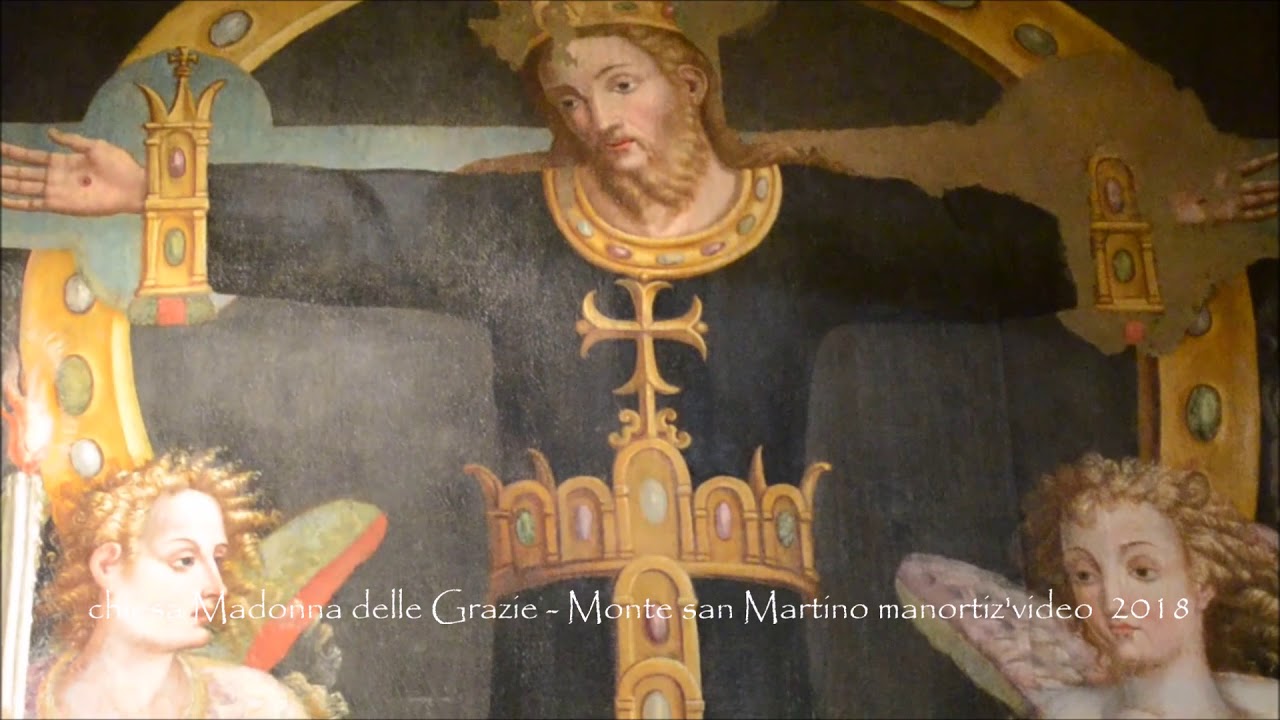
Nella Cattedrale di san Martino di Luca si venera una statua lignea di Cristo detta del "Volto Santo" (cercare sul web per approfondire tutta la storia) . A Monte san Martino, nella chiesa appena fuori il Borgo di santa Maria delle Grazie c'è un dipinto che riproduce la statua lignea venerata a Lucca: aldilà di tutto simbolismo presente, è interessante notare come il Cristo è raffigurato con un piede appoggiato su di un calice: per quale motivo?
eccolo:
"Si narra che un giullare molto povero e fedele al Volto Santo, si recasse a pregare intensamente per le sue miserie offrendo in segno di devozione l'unica cosa che possedeva, la sua arte giullaresca, e volteggiando così nel luogo sacro presso il crocifisso destò l'ira dei prelati e dei devoti. Il Volto Santo, agghindato di ori nella corona e nella veste, lasciò cadere una delle preziosissime ciabatte dorate (la destra) in segno di apprezzamento per il suo gesto puro e dargli la possibilità di far fronte alle proprie miserie. Quando l'uomo prese la preziosa ciabatta, fu acciuffato e gli fu intimato di restituire quello che appariva come il frutto di un furto. Nessuno credette al racconto miracoloso narrato dal povero, il quale fu incarcerato. Ma ogni tentativo di ricollocare la ciabatta dorata al piede del crocifisso fu inutile: essa continuava ad essere "rifiutata" dal piede della reliquia, come se fosse un dono ormai fatto al povero, ingiustamente incarcerato, avvalorando la versione del miracoloso dono sostenuta dall'uomo. Così il povero fu creduto e rilasciato e gli fu fatta una generosa donazione in denaro da parte della Chiesa a patto che rinunciasse alla santa ciabatta, che il povero accettò di buon grado. Ancora oggi la ciabatta d'oro del Volto Santo non è fissata al piede del crocifisso, ma è semplicemente appoggiata e sorretta da un calice dorato, come se il piede del crocifisso continuasse a rifiutarla".
(Wikipedia)
Повторяем попытку...
Доступные форматы для скачивания:
Скачать видео
-
Информация по загрузке: