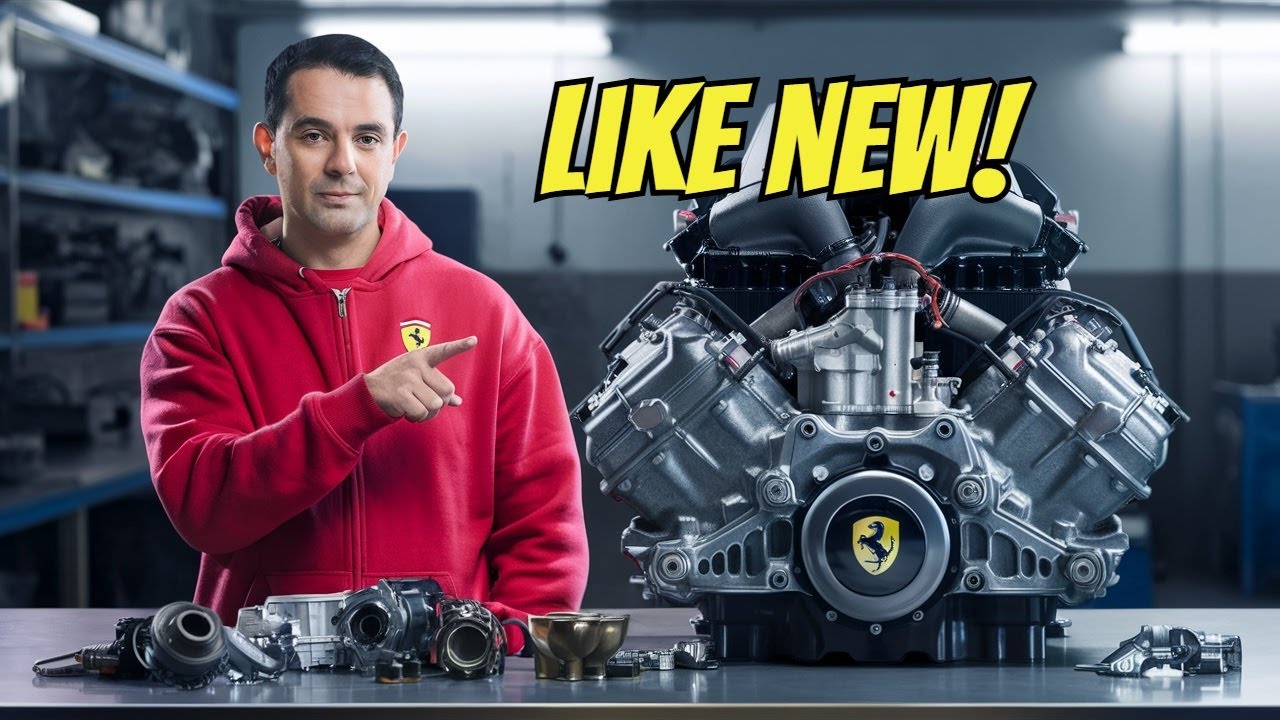
FERRARI REBUILD — PART 2
Автор: Apex Revival
Загружено: 2026-01-06
Просмотров: 18
Описание:
Tearing It Down, Finding the Truth
⸻
When a Ferrari comes apart,
you don’t rush the process.
Part one was about assessment —
what we could see,
what we could confirm,
and what we suspected.
Part two is where the truth actually comes out.
Because once the car is disassembled,
there’s no hiding anything.
⸻
STARTING WITH CONTROLLED DISASSEMBLY
Every fastener removed on this car is intentional.
Ferraris aren’t built like normal cars.
Many components serve multiple purposes —
structural, mechanical, and acoustic.
That means disassembly isn’t about speed.
It’s about sequence.
Interior components come out first.
Seats.
Trim panels.
Carpets.
Not because they’re in the way,
but because they tell a story.
Wear marks show how the car was used.
Heat marks show where stress lived.
Nothing here is ignored.
Everything is documented.
⸻
THE FIRST REAL SIGNS OF DAMAGE
Once the interior is stripped,
we start seeing the first indicators that weren’t visible before.
Minor misalignment.
Subtle deformation.
Mounting points that don’t sit perfectly flat.
This is the kind of damage that doesn’t look dramatic —
but matters the most.
Ferraris operate on extremely tight tolerances.
When something is off by millimeters,
the car feels wrong at speed.
And “feels wrong” is unacceptable.
⸻
SUSPENSION AND SUBFRAME INSPECTION
Next comes the suspension and subframe.
This is where rebuild costs escalate quickly.
Suspension components are removed and inspected individually.
No assumptions.
No “close enough.”
Bushings are checked for compression fatigue.
Control arms are measured, not eyeballed.
Mounting points are inspected for micro-cracks.
On a Ferrari, a slightly bent component isn’t usable.
It’s replaced.
Because replacing one part is cheaper
than chasing handling issues later.
⸻
ENGINE AND DRIVETRAIN — NO SHORTCUTS HERE
The engine isn’t removed because it’s broken.
It’s removed because verification matters.
Once out, the engine is inspected externally first.
Oil residue patterns.
Heat discoloration.
Mount integrity.
Then the supporting systems are checked:
Cooling lines.
Ancillaries.
Sensors.
Nothing here is about adding performance.
This rebuild is about restoring balance and reliability.
Ferrari engines are engineered to work as a system.
Changing one thing without understanding the whole
creates problems down the line.
That’s how expensive mistakes happen.
⸻
BODY PANELS AND STRUCTURAL TRUTH
With mechanical systems out of the way,
the body finally gets the attention it deserves.
Ferrari panels are thin by design.
Lightweight.
Shaped for airflow and stiffness.
That also means they don’t forgive poor repair work.
Each panel is removed and checked off the car.
Edges.
Mounting tabs.
Hidden stress points.
If a panel has been previously repaired incorrectly,
it shows immediately.
And unfortunately,
this car had evidence of past work that wasn’t done to factory standard.
That’s where rebuilds become restorations.
⸻
WHY PREVIOUS REPAIRS COST MORE LATER
Improper repairs don’t just fail —
they create new problems.
Incorrect adhesives.
Improper fasteners.
Panel tension where there shouldn’t be any.
Fixing bad work costs more than fixing original damage.
This is why Ferrari rebuilds are expensive.
You’re not just repairing the car —
you’re undoing mistakes.
And Ferrari tolerances don’t allow compromises.
⸻
PREPARING FOR CORRECTION, NOT COSMETICS
At this stage, nothing goes back on the car yet.
That’s intentional.
Before reassembly begins,
everything that needs correction is addressed in isolation.
Metalwork is corrected gradually.
No forced shaping.
No aggressive heat.
Carbon components are evaluated carefully.
If integrity is compromised, they’re replaced — not patched.
This is where patience matters.
Rushing this phase guarantees problems later.
⸻
THE REALITY OF COST AT THIS STAGE
This is also where many projects stop.
Because by part two, the financial reality becomes clear.
Labor hours accumulate.
Parts lists grow.
Specialized services become unavoidable.
This is the point where people realize
why so many Ferraris are written off instead of rebuilt.
Not because they can’t be fixed —
but because fixing them correctly is expensive.
⸻
WHY THIS REBUILD CONTINUES
This project continues for one reason:
The car deserves it.
The foundation is solid.
The structure is correctable.
The drivetrain is healthy.
That makes this Ferrari worth rebuilding the right way.
Not quickly.
Not cheaply.
Correctly.
⸻
WHAT COMES NEXT
Part three will focus on correction and preparation.
Structural alignment.
Panel fitting.
Mechanical reconditioning.
This is where the car begins to move
from “project”
to “Ferrari” again.
But the hard work happens before anything looks better.
And that’s where real rebuilds are won.
This is Apex Revival.
Повторяем попытку...
Доступные форматы для скачивания:
Скачать видео
-
Информация по загрузке: