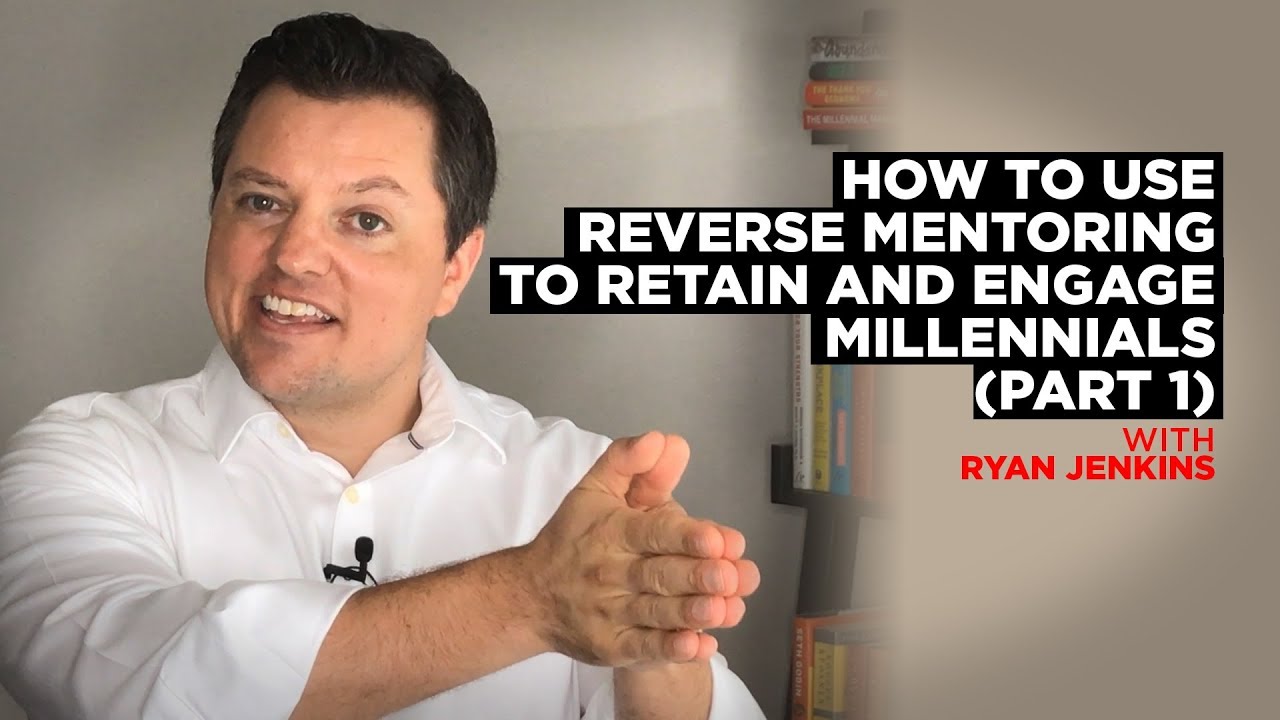
How to Use Reverse Mentoring to Retain and Engage Millennials (Part 1)
Автор: Ryan Jenkins, CSP
Загружено: 2017-12-16
Просмотров: 1978
Описание:
How to Use Reverse Mentoring to Retain and Engage Millennials (Part 1)
Learn what is reverse mentoring and how companies are benefiting from reverse mentoring.
Have Ryan speak to your organization or association: https://ryan-jenkins.com/speaker
Grab your copy of Ryan’s book, The Millennial Manual: The Complete How-To Guide to Manage, Develop, and Engage Millennials at Work: http://amzn.to/2oJUOF8
Ryan Jenkins is an internationally recognized Millennial and Generation Z speaker, generations expert, and Inc.com columnist who helps organizations better lead, engage, and sell to the emerging generations— Millennials and Generation Z. Ryan’s clients include Coca-Cola, John Deere, Delta Air Lines, Wells Fargo, and more. Find more of Ryan’s top-ranked generational and future of work insights at…
Inc.com Column: https://www.inc.com/author/ryan-jenkins
Website/Blog: https://ryan-jenkins.com
VIDEO TRANSCRIPT
In this video you will learn what is reverse mentoring and how companies are benefiting from reverse mentoring.
“It produced...an inversion of expertise because we had so many changes at the lower levels in technology and tactics and whatnot that suddenly the things we grew up doing weren’t what the force was doing anymore. So how does a leader stay credible and legitimate when you haven’t done what the people you’re leading are doing? It’s a brand-new leadership challenge, and it forced me to become a lot more transparent, a lot more willing to listen, and a lot more willing to be reversed-mentored.”
Retired four-star general, Stanley McChrystal, made this bold statement in his “Learn, listen…then lead” TED talk. Today’s exponential times and the rise of Millennials forced McChrystal into adopting a new perspective of mentorship, more specifically reverse mentoring.
Reverse mentoring has become a powerful strategy for leaders and organizations to close the generational gap at work and to retain and engage Millennials.
Millennials place a premium on mentorship. In fact, Millennials intending to stay with their organization for more than five years are twice as likely to have a mentor (68 percent) than not (32 percent). And over 90 percent of Millennials with mentors describe the quality of advice and the level of interest shown in their development as “good.” Having a company culture of mentorship will promote Millennial loyalty and, as we’ll see, reverse mentoring will engage Millennial talent.
What is Reverse Mentoring?
Reverse mentoring is a learning relationship where the mentor is younger than the mentee. Senior executives or veteran employees are paired with younger employees who then share their insights and perspective on various topics such as technology, social media, leadership, workplace trends, and more.
Unlike traditional mentoring, in which the mentor is always a senior individual who can pass on experience without much risk of pushback from the mentee, reverse mentoring provides an environment where information and insights can freely flow and where the organizational hierarchy is flattened.
Each generation brings with them strengths shaped by their unique circumstances. Today’s younger generations carry a very unique and high-demand skill set and knowledge that has not been possessed by previous generations at that age. In fact, 68 percent of hiring managers agree that Millennials have skills that previous generations don’t have.
Millennials are familiar and comfortable with reverse mentoring because they grew up doing it. Millennials were the “Household CTO” where they helped mom and dad troubleshoot computers, set-up Facebook, and embrace texting.
Who Uses Reverse Mentoring?
Jack Welch, while CEO at GE, was credited for being one of the first adopters of reverse mentoring. Welch selected a junior employee to mentor him and then encouraged 500 other organizational leaders to find a reverse mentor. Since then other companies including HP, The Hartford, Power Home Remodeling (a Fortune top 10 of the 100 Best Workplaces for Millennials), PayPal, Cisco, and Coca-Cola have initiated reverse mentoring programs.
According to Thomas Koulopoulos and Dan Keldsen, authors of “The Gen Z Effect: The Six Forces Shaping the Future of Business,” mentoring is used in 56 percent of a 600 company sample polled by Delphi Group. Yet of those 600 companies only 14 percent had a reverse mentoring program in place, even though 51 percent of those companies have cross-generational teams.
Reverse mentoring is underutilized and isn’t widely used because leaders are…
unaware of the benefits.
already engaged in peer-to-peer mentoring.
pressured to focus on tasks with clear ROI.
lacking time.
too prideful. Yet, reverse mentoring is becoming increasingly important to consider as more and more Millennials and Generation Z pour into the workplace...
Повторяем попытку...
Доступные форматы для скачивания:
Скачать видео
-
Информация по загрузке: