How to watch the 5 celestial planets shine in the dawn sky this month?
Автор: NASA Space News
Загружено: 2022-06-17
Просмотров: 4874
Описание:
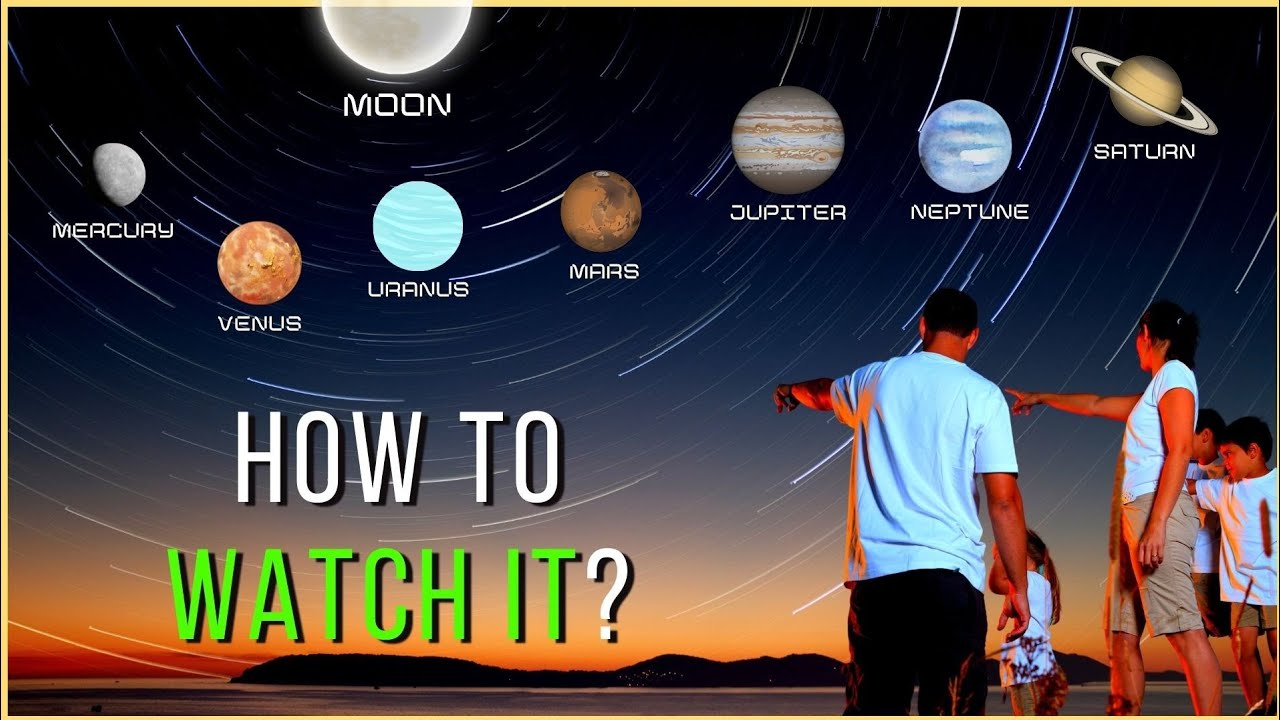
Throughout June, Earth's skies will witness a great cosmic homecoming. From June 17 to June 27, skywatchers will have a rare opportunity to observe all of our solar system's major planets clustered together—along with the moon.
Mercury, Venus, Mars, Jupiter, and Saturn are among the five planets visible with the naked eye in this unusual alignment. Each is visible even in the light-polluted city sky, with dazzling Venus being the brightest and Mercury being the faintest. Our nearest planets will emerge in the sky in the same order as their distance from the sun.
This planetary near encounters are referred to as conjunctions by astronomers. Two or three planets meeting is very uncommon, but the last time we observed conjunction amongst the five brightest planets was in December 2004.
Uranus and Neptune, which are farther distant, will also cluster in the same location, though the two ice giants will be more difficult to identify, necessitating the use of binoculars. Green-tinged Uranus may be observed in the sky between Venus and Mars, and blue Neptune can be found between Jupiter and Saturn.
The great majority of the world's population will be able to see this planetary alignment, although some will be better positioned than others. Mercury, the planet nearest to the sun, will be near the horizon and may be wiped out by the brightness of dawn for people in northern latitudes, above cities such as New York and London. The other planets will likewise hug the eastern horizon in similar places, making it difficult to view all of them.
The view will be especially stunning since the planets will seem packed together. If you miss this spectacular, you'll have to wait until 2040 to see it again.
Viewers simply need to glance at the brilliant crescent moon to find the planets. Our natural satellite will act as a guidepost, posing with each planet through day one beginning on June 17, when it will appear near Saturn.
The moon will be closest to Saturn on June 18 while Neptune will be closest to the moon on June 20. The moon will join Jupiter on June 21, and it will meet Mars on June 22. On June 24, the moon will align with Uranus, and skywatchers will remark that it will seem exactly halfway between Venus and Mars. On June 26, the moon will have an exciting near encounter with Venus, the brightest planet in the sky, before concluding its encounters with Mercury on June 27.
So; Get ready for this planetary party now, as it won't last long.
If you want to learn more about Space and stay on top of Astronomy news and updates, subscribe to the channel.
Join our channel to get access to perks:
/ @nspacenews
Tags:
#nasa #grandalliance #planets #meteor #asteriod #meteorshower #tauherculids #jwst #rockyworld #exoplanets #55Cancrie #jwstnews #jwstupdate #mars #saturn #cassini #saturnrings #saturnmoon #jameswebbspacetelescope #webbtelescope #jwst #universe #mysterioussignal #galaxy #webbtelescopeupdates #jwstimages #photons #firstgalaxy #webbtelescopeupdates #interstellar #webbselfie #webbtelescopeimage #alienlife #jwstasteroid #asteroidtracking #jameswebbspacetelescope #nasa #galaxy #star #spacenews #nasanews #webbtelscopenewimages #HD84406 #webbtelescopeupdates
Повторяем попытку...
Доступные форматы для скачивания:
Скачать видео
-
Информация по загрузке: