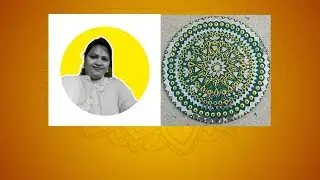
Mandala Art for beginner
Автор: Craft by Asha
Загружено: 2026-02-02
Просмотров: 112
Описание:
Mandala art is a sacred geometric design that originated in ancient India, characterized by intricate, symmetrical patterns that radiate from a single central point. Derived from the Sanskrit word for "circle," it traditionally represents the universe, wholeness, and the interconnectedness of all life.

Core Characteristics
Geometric Precision: Most mandalas are circles contained within a square, organized into sections around a central dot.
Radial Symmetry: Patterns emerge from the center and move outward in layers, creating a sense of balance and harmony.
Layers of Meaning: In spiritual traditions, a mandala is viewed as having three layers:
Outer: Represents the divine form of the universe.
Inner: Acts as a map to guide the mind toward enlightenment.
Secret: The personal relationship between the artist and the creation.
Symbolism and Motifs
Common symbols found within mandala art hold specific cultural or spiritual meanings:
Lotus Flower: Symbolizes purity, balance, and the soul's awakening as it reaches from "muddy water" toward the light.
Eight-Spoked Wheel: Represents the "perfect universe" and the Eightfold Path of Buddhism.
Triangle: Facing upward, it represents action and energy; facing downward, it represents creativity and knowledge.
Bell: Signifies the openness and "emptying" of the mind to receive wisdom.
Major Types of Mandalas
Sand Mandalas: Intricate designs made of colored sand by Tibetan monks. They are ceremonially destroyed upon completion to symbolize the impermanence of life.
Teaching Mandalas: Used as "mental maps" where every line, shape, and color represents a specific religious or philosophical teaching.
Healing Mandalas: More intuitive designs intended for meditation, designed to deliver wisdom and evoke feelings of calm and focus.
Yantras: Specifically used in Hinduism, these are often square-based geometric diagrams used for worship or invoking a particular deity.
Modern Uses
While rooted in spiritual traditions like Buddhism and Hinduism, mandala art is widely used today for:
Art Therapy: Psychology pioneer Carl Jung popularized mandalas in the West as a tool for self-discovery and "individuation".
Stress Relief: Coloring mandalas is a common mindfulness activity used to reduce anxiety and improve concentration.
Decorative Art: Mandala patterns are frequently found in tattoos, home decor (tapestries, rugs), and adult coloring books.

Повторяем попытку...

Доступные форматы для скачивания:
Скачать видео
-
Информация по загрузке: