Adding White Toner Printing to your DTG Business
Автор: ColDesi Inc
Загружено: 2020-07-29
Просмотров: 1970
Описание:
Adding White Toner Printing to your DTG Business
White toner printing vs direct to garment printing - that's the decision that most first time t-shirt printers struggle with. In this video we're going to walk you through the pros and cons. And maybe why BOTH is the answer you're looking for.
Transcript:
So, the first thing I want to do is show you the results of both.
Now, this is the result of Direct to Garment printing (https://dtgprintermachine.com/). You can see that it's pretty amazing. If you get right in and see the quality, you can see the feathers. This is the kind of thing that Direct to Garment printing is famous for, is this kind of resolution and detail.
And also, if you'll notice on the outside, how the feathers go off into black. So, that's unlike a transfer, or a vinyl printer, cutter printer because they can't do this, right? They can't feather because you have a transfer with either something there or something not. This is direct inkjet technology. Here's another great example of that.
Here's a video about printing a t-shirt with Direct to Garment Printing: • DTG G4 | Printing T-Shirt Start to Finish
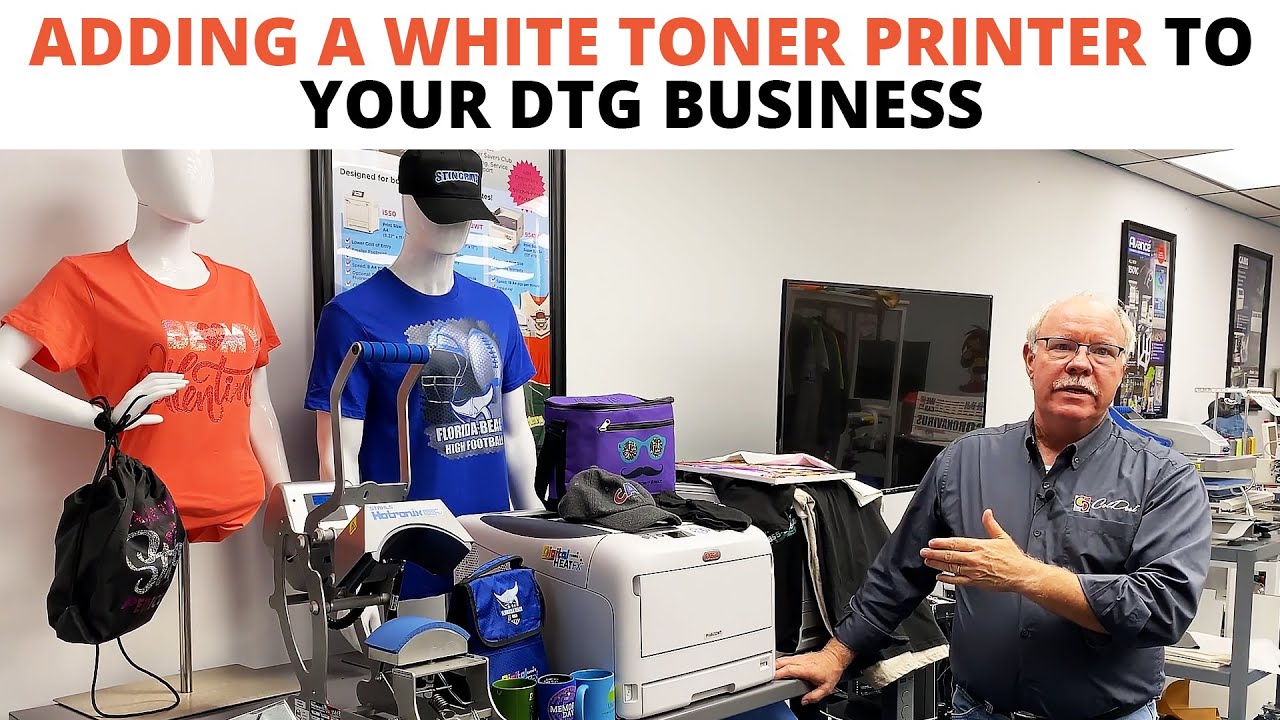
Now, what I'm going to show you next is another t-shirt that looks amazing that was done by Digital Heat FX (https://digitalheatfx.com/). Now the Direct to Garment printed shirt was a 100% ring spun cotton. This is a 100% polyester.
So the great benefit to using a white toner transfer printer from Digital Heat FX is that you can apply that transfer to almost anything, that includes this 100% polyester t-shirt. But if you get in close, you can also see that even though it's amazing looking, there is no feathering on the outside, right?
We saw there's no eagle feathers. It's not part of the graphic because when we do graphics with transfers, we design them differently than we do for Direct to Garment printing. Direct to Garment printing is amazing at photos. It feels great, and it'll give you outstanding details.
This I can put this transfer on just about any kind of fabric and get a terrific result. I'm just going to reach over and grab a couple more great examples of Digital Heat FX prints.
So you can also do the promotional products you see down below with Digital Heat FX white toner printer. It's one of the main strengths is that you can print on, or you can apply transfers to hard surfaces like tiles or glass.
You can more easily do hats.
You can do it on wood.
You can do it on backpacks or koozies.
There's a whole list on the website about things that you can do with a white toner printer, but there are a couple of advantages to DTG that kind of make up for that.
Here's a great video on make promotional products with a white toner printer • EZ Peel Hard Surface Transfer Paper | Digi...
First of all, if I feel DTG, especially a white shirt, it's almost not there. It's a very smooth, almost not there-feel, because a water based ink goes right into the shirt. So you're going to get a great quality image. If you were doing pictures on t-shirts for a living, or if you're doing high content graphics, then you're going to want Direct to Garment printing.
Okay now, because of the way Direct to Garment printing works, you have ink cartridges in the side and it's an inkjet printer, so the jets spray directly onto a shirt.
So when I put a shirt in here, it's only going to put ink where the design is. So there, if this was a Digital Heat FX or this was a transfer print, this whole area would be used as a transfer sheet.
Now this shirt probably cost under $2 in ink, where the same size print would have cost $4 in Digital Heat FX. A white shirt can get down to 17 or $0.18, where it's still going to be the same price with a white toner transfer. So there's a difference in upfront costs. You're going to pay more for this one upfront. You're going to pay less for supplies. You're going to get a great feeling print, as long as you use cotton or some kind of natural material.
For Digital Heat FX, you're going to get all kinds of versatility.
You can put those transfers on just about anything. You'll pay less upfront. You'll pay more for the supplies on an ongoing basis. So that's a quick differentiator for which one might be right for your business. You're going to have to look at your customers and what you want to do and decide. But I would say that a great solution is to do both, because there are things that Direct to Garment printing does really well, beautiful quality prints, very low cost prints, you might want to use for volume t-shirt printing.
Then the Digital Heat FX, which excels at small designs, labels and tags and printing on not only t-shirts, but you can print on 100% polyester. You can present on nylon. You can apply it to jackets or koozies or coasters. You've got a whole promotional products business. So that's it. The answer which is best is obvious between DTG and Digital Heat FX, and that's both. Let us know if you have any questions, visit http://coldesi.com for more information.
Повторяем попытку...
Доступные форматы для скачивания:
Скачать видео
-
Информация по загрузке:


