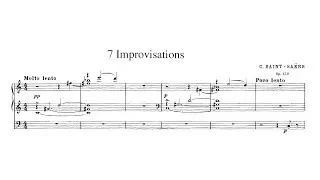
Camille Saint-Saens - 3 Rhapsodies Cantiques Bretons (Op.7)
Автор: Sohan Kalirai
Загружено: 2020-07-13
Просмотров: 4812
Описание:
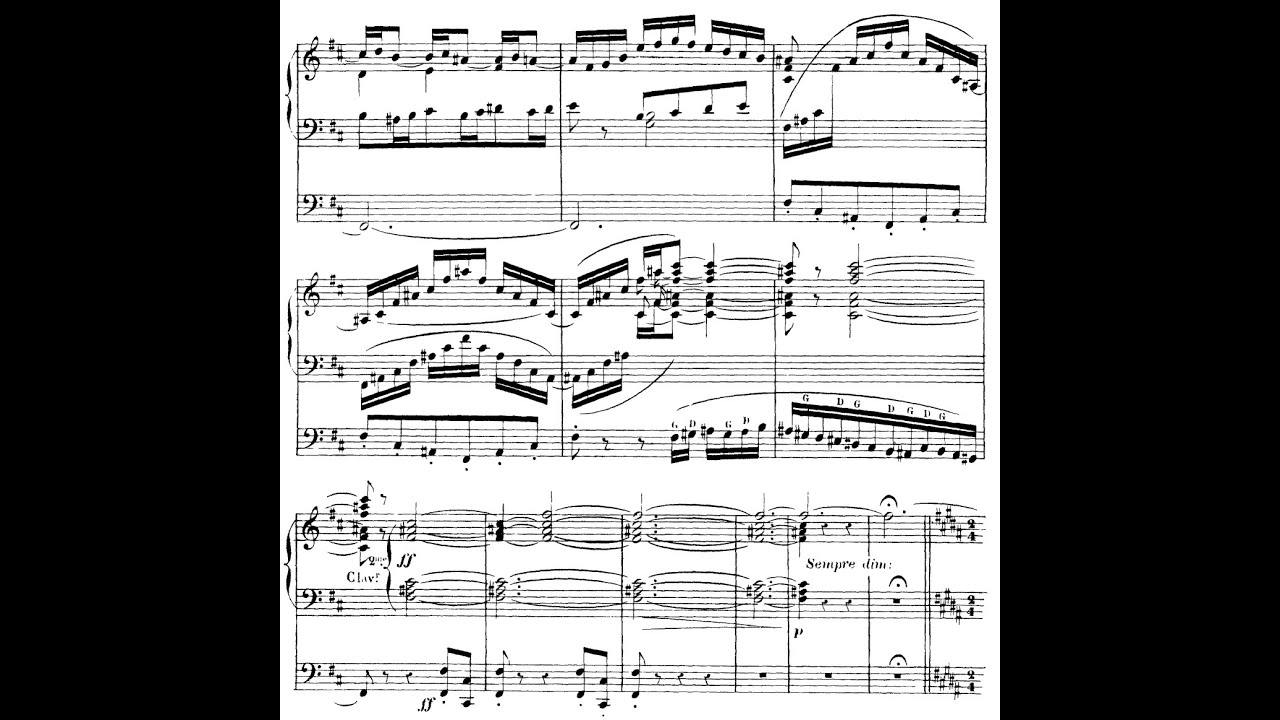
"The Three Rhapsodies on Breton Canticles, by Saint-Saens were written originally for organ in 1866, and subsequently two-thirds orchestrated in 1891 as Rhapsodie Bretonne. They represent, it’s said in Stephen Studd’s biography, the first examples of Saint-Saens directly taking traditional melodies as the basis for a composition (although he had written Eastern-style music in his opera Le Timbre D’Argent).
0:01 - I: Andantino con moto
4:52 - II: Allegro moderato e pomposo -- Andante -- Tempo 1
9:44 - III: Andantino -- Allegretto -- Allegro quasi presto -- Tempo 1 -- Allegretto
In the summer of 1866, Saint-Saens, along with some artist friends went to Rennes (main administrative centre of Brittany) to visit his protégé Gabriel Fauré, who had secured his first professional post at the cathedral there. Fauré was not particularly happy in what, compared to Paris, was a cultural backwater – so would have welcomed the visit from his mentor.
While staying in Brittany, Saint-Saens became enamoured of the simplicity of the local tunes, particularly some heard on a boat trip, and played on an oboe by the sea captain.
“During the trip he played the tunes of his country, those airs with a character at once so savage and so charming. They are such a welcome change from our too-refined music, and refresh the soul like a salty breeze”.
It’s a little uncertain whether it was these tunes that Saint-Saens used as the basis for these three Rhapsodies, or, as the longer title (Pilgrimage to the Pardon of St. Anne La Palud) suggests, some hymns (canticles) heard in Fauré’s church. Most likely both, since the pieces, mostly straightforward adaptations and embellishments of these melodies, veer around a bit in style from the gently monastic-sounding to the raucously folk-like. Either way, Saint-Saens clearly liked the tunes enough to jumble them together as three organ pieces dedicated as a gift for his former pupil, and then later in 1891 to orchestrate No.1 and No.3 as Rhapsodie Bretonne.
The first two rhapsodies are binary-form pieces and the first, in E major, is a very simple gentle 6/8 tune, pretty similar in feel to the recently completed Serenade.
In the first Rhapsody the arrangement later becomes a bit more interesting with some arpeggiations in the treble while the base-line takes the tune, and Saint-Saens makes full use (as he does in all three pieces) of the complete sound-world you can get out of an organ.
The second piece is described by one biographer (Stephen Studd) as a raucous drinking-song, but another (Brian Rees) as a devotional hymn. Perhaps it depends on the speed at which the organist takes it, particularly through the fugal treatment of the main theme. Saint-Saens, it is suspected, must have not thought as much of this movement as it was the movement he chose not to orchestrate subsequently.
The third rhapsody, however, can be considered the most interesting. Here we have a different form, with different tunes arranged in an A-B-C-A-B-C form, with the recapitulations of the three tunes being slightly shortened and intermingled. This segues to a clear folk tune (B), with the sound of bag-pipe like drones and then into rustic dance (C) which builds up to a slightly frenetic, but enjoyable climax – before we slip back to our simple elegy. This brings the listener around again to the main sad tune of this third movement.
Note: The tune in the third rhapsody is also used – in a different form, by Smetana in Die Moldau– the famous melody that is Vltava– based supposedly on a Czech folk tune, not Breton. The tune is also the Israeli National Anthem, with the melodic line, with one or two slightly embellishments, but the composer of that anthem (Samuel Cohen) claims to have based it on a Romanian folk song. In fact, according to the Wikipedia article on the Israeli National Anthem, the tune is originally Italian, but is also a traditional song in Poland, Ukraine and Slovenia. Mystery..."
Complete Works of Camille Saint-Saens
Performer: Hans Fagius
Повторяем попытку...
Доступные форматы для скачивания:
Скачать видео
-
Информация по загрузке: