How to Call a Function on a Pandas DataFrame with Multiple Arguments
Автор: vlogize
Загружено: 2025-09-08
Просмотров: 0
Описание:
Learn how to effectively call a function on a Pandas DataFrame by passing multiple arguments without hardcoding column names.
---
This video is based on the question https://stackoverflow.com/q/63339278/ asked by the user 'dg S' ( https://stackoverflow.com/u/10707797/ ) and on the answer https://stackoverflow.com/a/63339970/ provided by the user 'Håkan Svensson' ( https://stackoverflow.com/u/4396243/ ) at 'Stack Overflow' website. Thanks to these great users and Stackexchange community for their contributions.
Visit these links for original content and any more details, such as alternate solutions, latest updates/developments on topic, comments, revision history etc. For example, the original title of the Question was: How to call a function on pandas dataframe with multiple argument
Also, Content (except music) licensed under CC BY-SA https://meta.stackexchange.com/help/l...
The original Question post is licensed under the 'CC BY-SA 4.0' ( https://creativecommons.org/licenses/... ) license, and the original Answer post is licensed under the 'CC BY-SA 4.0' ( https://creativecommons.org/licenses/... ) license.
If anything seems off to you, please feel free to write me at vlogize [AT] gmail [DOT] com.
---
How to Call a Function on a Pandas DataFrame with Multiple Arguments
When working with Pandas DataFrames in Python, you may sometimes find yourself needing to apply a function to multiple columns without hard-coding their names in the function definition. This can be particularly useful when dealing with large datasets where column names might change or when you want your functions to be more flexible.
The Problem
Suppose you have a DataFrame and you want to create a function that applies an operation to several specified columns. You might initially try something like the code below:
[[See Video to Reveal this Text or Code Snippet]]
However, when you attempt to call this function with multiple column names, you encounter errors like:
[[See Video to Reveal this Text or Code Snippet]]
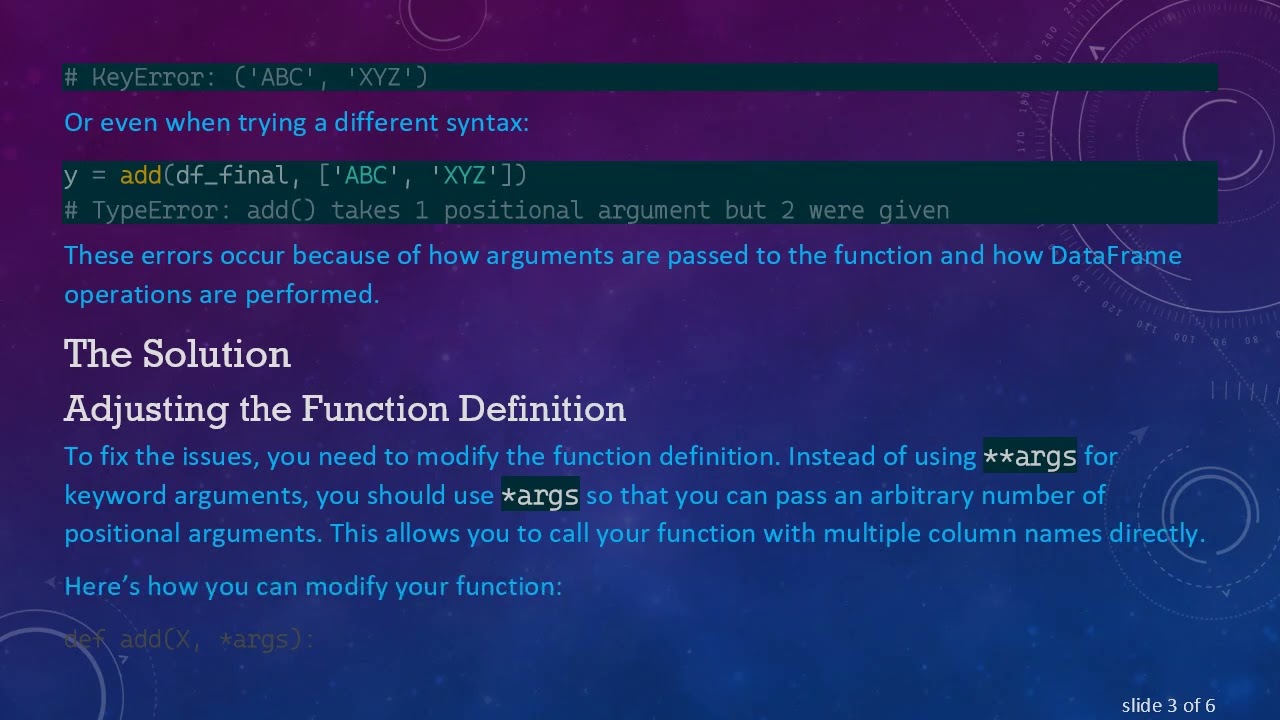
Or even when trying a different syntax:
[[See Video to Reveal this Text or Code Snippet]]
These errors occur because of how arguments are passed to the function and how DataFrame operations are performed.
The Solution
Adjusting the Function Definition
To fix the issues, you need to modify the function definition. Instead of using **args for keyword arguments, you should use *args so that you can pass an arbitrary number of positional arguments. This allows you to call your function with multiple column names directly.
Here’s how you can modify your function:
[[See Video to Reveal this Text or Code Snippet]]
Explanation of the Code
Defining the Function: The *args in the function header allows you to pass multiple column names.
Iterating Over Arguments: The for loop goes through each column name provided in args.
Applying the Lambda Function: Each column specified is updated in-place with the transformed values.
Example of Usage
Let’s see the modified function in action with an example DataFrame:
[[See Video to Reveal this Text or Code Snippet]]
After calling the function, the DataFrame will be updated as follows:
[[See Video to Reveal this Text or Code Snippet]]
Conclusion
By using *args instead of **args, you can define a function that efficiently applies transformations to multiple DataFrame columns without the need to hard-code their names into the function. This approach not only simplifies your coding process but also enhances the versatility of your functions when working with various DataFrames.
Feel free to incorporate similar patterns and adjust function definitions as needed in your own projects. Happy coding!
Повторяем попытку...
Доступные форматы для скачивания:
Скачать видео
-
Информация по загрузке: