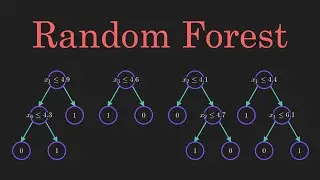
Decision Tree | AI/ML for Beginners #10 | Explained in Hindi
Автор: Prasoon Goyal
Загружено: 2022-11-02
Просмотров: 175
Описание:
Hi friends! In this video, we will discuss decision trees, which is another popular model used in artificial intelligence (AI) and machine learning (ML). Learn about the terminology (root node, internal node, decision node, leaf node), how rule-based AI can be represented using decision trees, how we learn decision trees in data-driven approaches (for classification and regression), how we do inference, and how we visualize them in the feature space.
===============
In our exploration of machine learning models, we’ve covered basic models like K Nearest Neighbors, Linear Regression, and Linear Classification. These models, while foundational, show limitations in handling datasets that are not linearly separable. To address more complex data patterns, we turn our attention to Decision Trees, which offer a versatile approach suitable for both rule-based and data-driven applications.
*Decision Trees for Rule-based Approaches*
Decision Trees serve as an effective tool for implementing rule-based systems. These systems operate on predefined rules, such as those used in spam email detection. In such a system, Decision Trees represent decisions and their possible outcomes in a tree-like structure comprising nodes: decision nodes dictate the path based on specific conditions, and leaf nodes represent the final outcomes or decisions. The process starts at the root node and follows through the decision nodes based on the input data’s attributes, culminating at a leaf node that gives the predicted outcome.
*Decision Trees for Data-driven Approaches*
In data-driven approaches, Decision Trees automate the process of identifying the best conditions for splitting the data at each node, aiming to group the data into as homogeneous subsets as possible. This is achieved by analyzing the labeled data points (e.g., emails marked as spam or not) and iteratively selecting the optimal feature at each node to split the dataset. The goal is to refine the dataset into subsets where a clear pattern or outcome can be observed. This involves a process of feature selection, condition setting based on those features, and partitioning the dataset accordingly, leading to a structured tree where each path from the root to a leaf node represents a set of conditions that predict a specific outcome.
*Decision Trees for Regression*
In regression tasks, Decision Trees apply a similar principle but aim to reduce variance within each group created by the splits. This approach ensures that the data points within each leaf node have similar continuous values, facilitating accurate predictions. The process involves selecting features and conditions for splits that result in groups with low variance in their target values, indicating that the data points in each group are similar to each other. This method allows for predictive modeling where the output is a continuous value, such as house prices or temperatures.
*Visualizing Decision Trees*
Visually, a Decision Tree can be represented in a feature space where each split made by a decision node is depicted as a line (in two-dimensional space) or a hyperplane (in higher dimensions). These splits organize the feature space into distinct regions, each corresponding to different predictions based on the path from the root to a leaf node. The visualization highlights how Decision Trees partition the feature space into areas of similar outcomes, making it easier to understand the decision-making process and the model’s predictions.
Through their flexible structure, Decision Trees adeptly model complex relationships in data, offering a robust solution for both classification and regression problems. Their intuitive representation also aids in understanding and explaining the model's decisions, making Decision Trees a valuable tool in the machine learning toolkit.
===============
Keywords: Machine Learning, Decision Trees, K Nearest Neighbors, Linear Regression, Linear Classification, Classification Task, Rule-based Approaches, Data-driven Approaches, Nodes, Leaf Nodes, Decision Nodes, Internal Nodes, Root Node, Binary Features, Feature Selection, Spam Email Detection, Dataset Splitting, Conditions, Predictive Modeling, Variance, Threshold, Feature Space, Continuous Labels, Homogeneous Subsets, Model Visualization, Email Labeling, True/False Conditions, Data Partitioning
Повторяем попытку...

Доступные форматы для скачивания:
Скачать видео
-
Информация по загрузке: