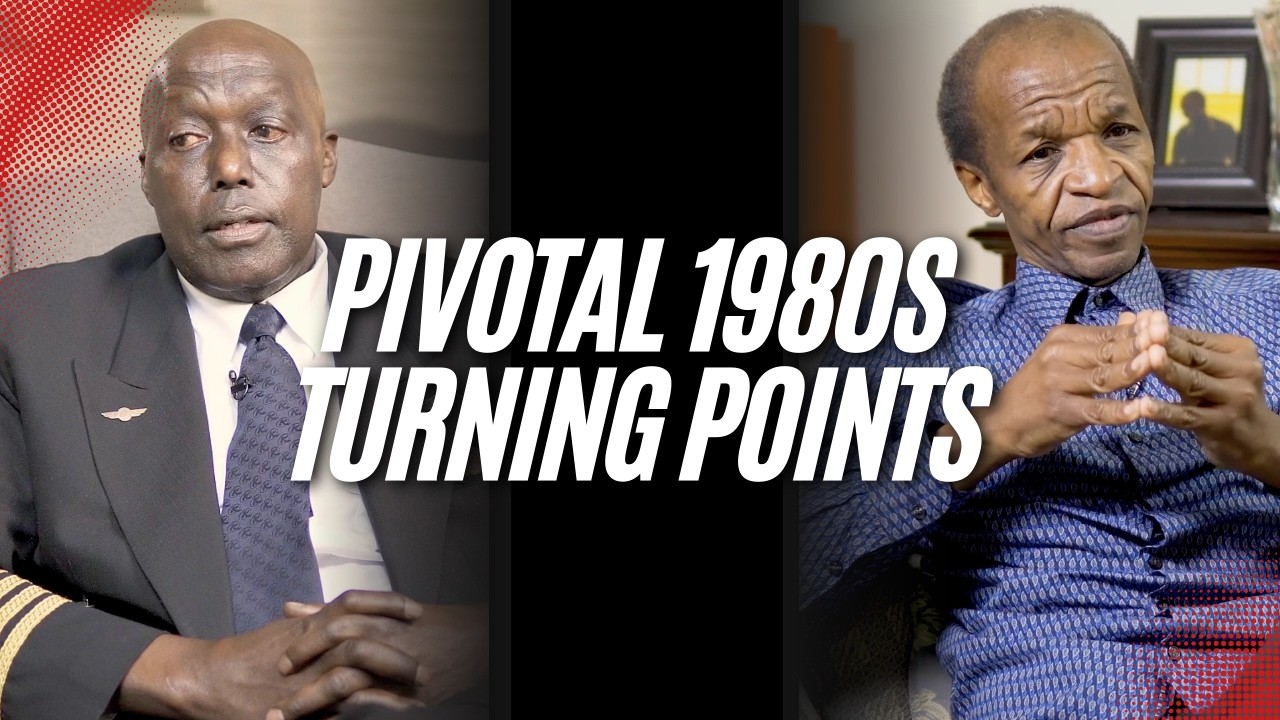
Pivotal 1980s Turning Points: Survival and Transformation in 1980s Kenya
Автор: CTA - Cleaning The Airwaves
Загружено: 2026-03-03
Просмотров: 35
Описание:
Missions and Melodies: Survival and Transformation in 1980s Kenya
Captain Chris Kariuki FULL CTA Podcast - • The Play House feat. Capt. Chris B. Kariuki
Jack Odongo FULL CTA Podcast - • 431. The Play House feat. Jack Odongo
The narratives of Capt. Chris B. Kariuki and Jack Odongo offer parallel yet contrasting lenses into a defining era of Kenyan history. One account unfolds within the volatility of military insurrection; the other within the disciplined creativity of advertising, music production, and spiritual awakening. Together, they illuminate how crisis and innovation shaped Kenya’s early 1980s.
Similarities: Pivotal 1980s Turning Points
1. A Shared Temporal Backdrop
Both narratives are rooted in the early 1980s, a period marked by structural and psychological shifts in the nation.
Kariuki’s story revolves around the attempted coup of 1982, which he characterizes as a decisive rupture in the institutional life of the Air Force. Odongo’s professional rebirth begins shortly after, in 1983, when he returned to Nairobi and entered the rapidly expanding world of advertising music. Though their arenas differed, both were operating in a Kenya undergoing recalibration.
2. The Architecture of Professional Rigor
Each man functioned within systems that demanded precision.
Kariuki, as a fighter pilot stationed in Wajir, operated within a strict military hierarchy, conducting high-risk exercises and serving as an air liaison officer guiding jets to designated targets. His world required procedural discipline and immediate decision-making under pressure.
Odongo, in contrast, navigated corporate creative structures, working under demanding creative directors such as Bharat Sachdev and Andrew White. Advertising composition required not artistic indulgence but adherence to product briefs, timelines, and commercial objectives. Excellence was not optional; it was contractual.
In both contexts, professionalism was survival.
3. Technical Mastery and Adaptation
Technological fluency defined their competence.
Kariuki mastered the operational systems of F5 fighter jets and coordinated tandem maneuvers during volatile circumstances. His domain was mechanical, strategic, and kinetic.
Odongo confronted a different technological revolution: the transition from live studio capture to MIDI and computerized production. The shift toward tapeless recording in the late 1970s and 1980s redefined musical workflows. His ability to adapt positioned him at the forefront of Kenya’s evolving soundscape.
Both men thrived by mastering tools that were reshaping their industries.
4. Critical Moments of Contingency
Each narrative hinges on a seemingly small decision with profound implications.
Kariuki’s choice to return his pistol to the armory the night before the coup insulated him from suspicion and likely imprisonment. What appears procedural became existential.
Odongo’s pivotal moment came in 1985, when he chose to seek spiritual clarity alone in his room. That decision catalyzed a personal conversion that redirected his vocational identity beyond commercial music toward worship leadership and theatrical production.
Both accounts underscore the disproportionate weight of singular choices.
Contrasts: Crisis and Creative Expansion
1. National Conflict vs. Corporate Growth
Kariuki’s experience was embedded in violent national upheaval. Junior officers seized armories. Pilots were coerced into flying missions at gunpoint. Nairobi bore visible scars of conflict.
Odongo operated within a booming advertising economy, composing jingles for brands such as Mclean’s, Princess Patra, and Crown Paints. His battlefield was market competition, not armed rebellion.
One confronted instability. The other leveraged opportunity.
2. Public Turmoil vs. Private Calling
Kariuki’s ordeal unfolded in the public sphere, amid fatalities, interrogations, and institutional purges. His survival required discretion and strategic invisibility.
Odongo’s transformation was internal. While advertising sustained him financially, his deeper calling matured within church spaces, eventually leading him to serve at the International Christian Center and nurture emerging artists through mentorship and album production.
Kariuki navigated state crisis. Odongo navigated vocational clarity.
3. Coercion vs. Collaboration
During the coup, pilots were compelled into aircraft under armed supervision. Authority was enforced through intimidation.
Odongo’s world, by contrast, was relational. He collaborated with Swedish engineer Carl Anderson at Valley Road and supported young talents such as Peter Odera and Reuben Kagame in recording foundational works.
One environment operated through force. The other through creative partnership.
Повторяем попытку...
Доступные форматы для скачивания:
Скачать видео
-
Информация по загрузке: