【ChatGerry】Macro Artery Stability Versus Small Vessel Damage: A 40 Year Look at ... (No.1503)
Автор: Health Talk with eclaireMD
Загружено: 2026-01-15
Просмотров: 2
Описание:
ChatGerry
Macro Artery Stability Versus Small Vessel Damage: A 40 Year Look at My Heart and Stroke History (No. 1503, VPT #063, 1/14/2026)
Gerald C. Hsu
EclaireMD Foundation
Category: Cardiovascular Disease
This analysis details a four-decade clinical progression of type 2 diabetes (T2D) and its vascular complications, beginning with an initial diagnosis in 1985. The clinical trajectory divides into two distinct phases: a medication-centric period (1990–2009) and a subsequent lifestyle-intensive period (2010–2024). During the first 20 years, the patient relied almost exclusively on pharmacological management without addressing dietary intake, sleep hygiene, or physical activity. Retrospective data analysis indicates that 91% of the microvascular damage leading to the 2025 stroke accumulated during this pharmaceutical-dependent phase. Chronic hyperglycemia facilitated progressive vascular calcification, which structurally compromised the integrity of small vessel walls by inducing permanent hardening and fragility.
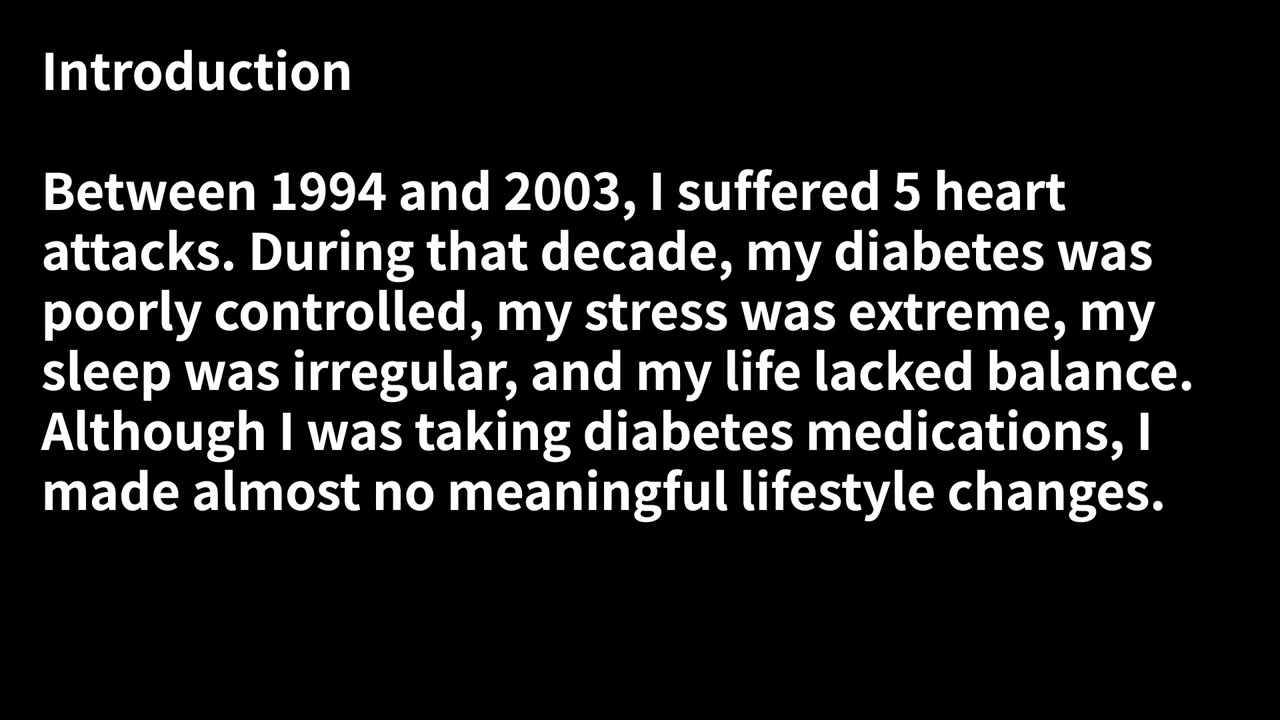
Concurrently, the patient suffered five myocardial infarctions between 1994 and 2003. These macrovascular events correlate with his tenure as CEO of a Silicon Valley technology firm, a role involving extreme occupational stress, prolonged working hours, and multi-million-dollar litigation. The synergy between poorly controlled T2D and chronic sympathetic nervous system activation created a lethal risk profile. While medications moderated average glycemic levels, they failed to suppress acute postprandial spikes and stress-induced hypertensive surges. These sudden mechanical stressors repeatedly ruptured macrovascular plaque in arteries already weakened by decades of metabolic strain. The cessation of heart attacks after 2004 suggests that removing extreme psychological stressors allowed the macrovascular system to achieve functional stability despite historical injury.
The systemic health of the patient reached a critical tipping point in 2010. Clinical manifestations included advanced nephropathy, retinopathy approaching total blindness, and peripheral neuropathy characterized by foot ulcers and impending toe amputation. This multi-organ failure necessitated a radical transition to a non-pharmacological protocol. Beginning in 2010, the patient implemented a disciplined lifestyle regimen: an 80% reduction in food portions, a 70% restriction of sugar and carbohydrates, and a consistent physical activity target of 15,000 to 18,000 daily steps. Over the following 16 years, this protocol prevented further macrovascular events and limited subsequent microvascular damage to only 9% of the total cumulative injury, despite the physiological effects of aging.
Physiological divergence between macrovascular and microvascular systems necessitates distinct management strategies. Macro arteries, including coronary structures, are robust, elastic vessels capable of functional adaptation. Reducing systemic stressors allows these conduits to maintain integrity and stability even if significant atherosclerotic plaques persist. Micro vessels, conversely, lack such redundancy. Chronic hyperglycemia induces irreversible hyaline arteriolosclerosis and basement membrane thickening, particularly within the renal, retinal, and cerebral circuits. This baseline structural fragility implies that while macrovascular ruptures (heart attacks) are preventable via stress mitigation, microvascular events remain contingent upon the cumulative history of glycemic exposure. This explains why the patient maintained 20 years of macrovascular stability while remaining vulnerable to microvascular failure.
On June 21, 2025, a sudden hypertensive spike to 175 mmHg triggered a hemorrhagic stroke in the brainstem. This pontine hemorrhage occurred because the accumulated structural damage from 3.6 decades of T2D had exhausted the microvascular safety margin. Despite the pontine location's estimated 70% to 80% fatality rate, the patient survived. This survival is attributed to the physiological resilience and metabolic stability achieved through 15 years of strict lifestyle discipline. Without the 2010 intervention, this cerebrovascular event likely would have occurred significantly earlier and proved fatal.
In conclusion, macrovascular stability is attainable through the reduction of acute mechanical stress, whereas microvascular protection requires long-term glycemic consistency. Lifestyle modification cannot erase historical structural injury but remains the most effective strategy for managing the systemic failure modes of T2D. This 40-year case history provides empirical evidence that comprehensive lifestyle discipline extends the clinical safety margin and preserves life even after severe multi-systemic damage has occurred.
#healthtalk #eclairemd
Повторяем попытку...
Доступные форматы для скачивания:
Скачать видео
-
Информация по загрузке: