ycliper

Популярное

Музыка Кино и Анимация Автомобили Животные Спорт Путешествия Игры Юмор

Интересные видео

2025 Сериалы Трейлеры Новости Как сделать Видеоуроки Diy своими руками

Топ запросов

смотреть а4 schoolboy runaway турецкий сериал смотреть мультфильмы эдисон
Скачать

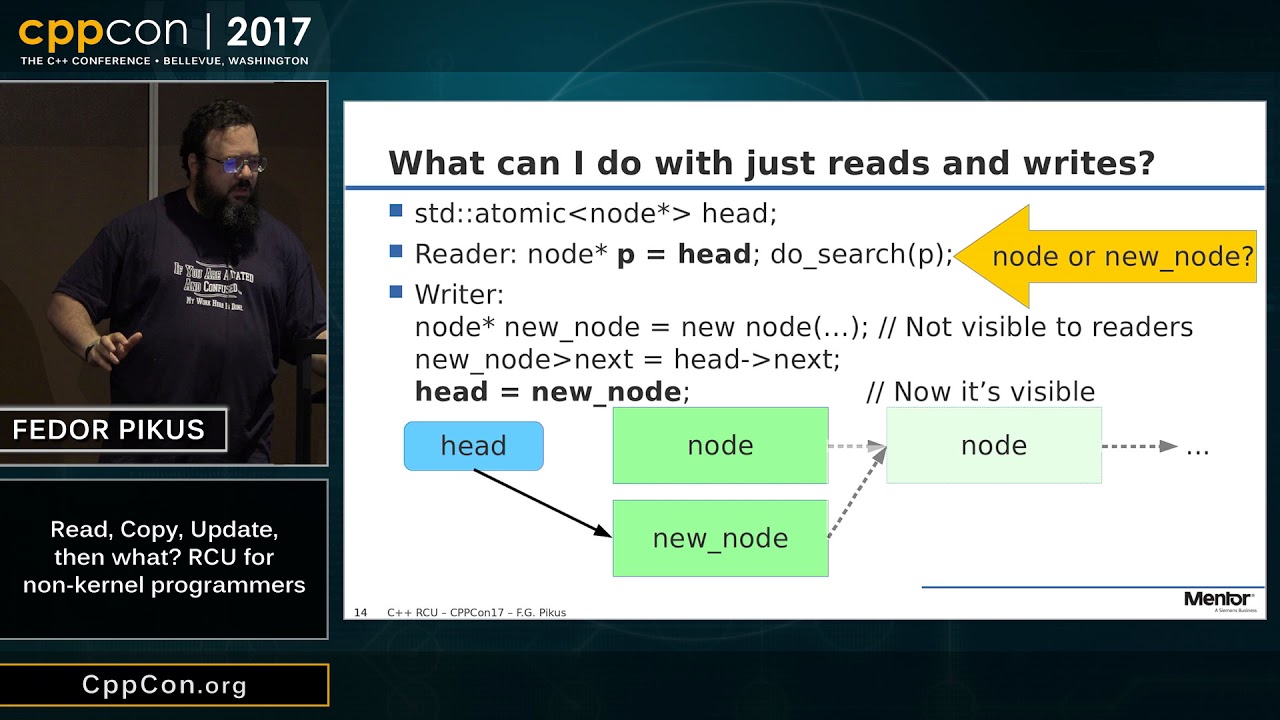
CppCon 2017: Fedor Pikus “Read, Copy, Update, then what? RCU for non-kernel programmers”

Автор: CppCon

Загружено: 2017-10-19

Просмотров: 39319

Описание: http://CppCon.org
—
Presentation Slides, PDFs, Source Code and other presenter materials are available at: https://github.com/CppCon/CppCon2017
—
RCU (Read, Copy, Update) is often the highest-performing way to implement concurrent data structures. The differences in performance between an RCU implementation and the next best alternative can be striking. And yet, RCU algorithms have received little attention outside of the world of kernel programming. Largely, this is because the most common drawback of RCU solution is complicated, and often wasteful, memory management. Kernel code has some advantages here, whereas a generic solution is much harder to design.

There are, however, cases when RCU is simple to use, offers very high performance, and the memory issues are easy to manage. In fact, you may already be using the RCU approach in your program without realizing it! Wouldn't that be cool? But careful now: you may be already using the RCU approach in your program in a subtly wrong way. I'm talking about the kind of way that makes your program pass every test you can throw at it and then crash in front of your most important customer (but only when they run their most critical job, not when you try to reproduce the problem).

In the more general case, we have to confront the problems of RCU memory management, but the reward of much higher performance can make it well worth the effort.

This talk will give you understanding of how RCU works, what makes it so efficient, and what are the conditions and restrictions for a valid application of an RCU algorithm. We focus on using RCU outside of kernel space, so we will have to deal with the problems of memory management... and yes, there will be garbage collection.
—
Fedor Pikus: Mentor Graphics - Siemens business, Chief Scientist

Fedor G Pikus is a Chief Engineering Scientist in the Design to Silicon division of Mentor Graphics Corp. His earlier positions included a Senior Software Engineer at Google and a Chief Software Architect for Calibre PERC, LVS, DFM at Mentor Graphics. He joined Mentor Graphics in 1998 when he made a switch from academic research in computational physics to software industry. His responsibilities as a Chief Scientist include planning long-term technical direction of Calibre products, directing and training the engineers who work on these products, design and architecture of the software, and research in new design and software technologies. Fedor has over 25 patents and over 90 papers and conference presentations on physics, EDA, software design, and C++ language.
—
Videos Filmed & Edited by Bash Films: http://www.BashFilms.com

Work at Hudson River Trading (HRT): https://tinyurl.com/safxfctf
---

Videos Filmed & Edited by Bash Films: http://www.BashFilms.com

Не удается загрузить Youtube-плеер. Проверьте блокировку Youtube в вашей сети.
Повторяем попытку...
CppCon 2017: Fedor Pikus “Read, Copy, Update, then what? RCU for non-kernel programmers”

Поделиться в:

Доступные форматы для скачивания:

Скачать видео

  • Информация по загрузке:
Скачать аудио

Похожие видео

12. Очередь Майкла-Скотта. RCU

12. Очередь Майкла-Скотта. RCU

Concurrency in C++: A Programmer’s Overview (part 1 of 2) - Fedor Pikus - CppNow 2022

Concurrency in C++: A Programmer’s Overview (part 1 of 2) - Fedor Pikus - CppNow 2022

Ядро Linux переходит на современный язык программирования C! Почему? Давайте изучим исходный код ...

Ядро Linux переходит на современный язык программирования C! Почему? Давайте изучим исходный код ...

CppCon 2016: Fedor Pikus “The speed of concurrency (is lock-free faster?)

CppCon 2016: Fedor Pikus “The speed of concurrency (is lock-free faster?)"

More Speed & Simplicity: Practical Data-Oriented Design in C++ - Vittorio Romeo - CppCon 2025

More Speed & Simplicity: Practical Data-Oriented Design in C++ - Vittorio Romeo - CppCon 2025

CppCon 2018: Fedor Pikus “Design for Performance”

CppCon 2018: Fedor Pikus “Design for Performance”

Thread Synchronisation in Real-Time Audio Processing With RCU (Read-Copy-Update) - Timur Doumler ADC

Thread Synchronisation in Real-Time Audio Processing With RCU (Read-Copy-Update) - Timur Doumler ADC

CppCon 2017: Fedor Pikus “C++ atomics, from basic to advanced.  What do they really do?”

CppCon 2017: Fedor Pikus “C++ atomics, from basic to advanced. What do they really do?”

Branchless Programming in C++ - Fedor Pikus - CppCon 2021

Branchless Programming in C++ - Fedor Pikus - CppCon 2021

IRQs: the Hard, the Soft, the Threaded and the Preemptible

IRQs: the Hard, the Soft, the Threaded and the Preemptible

CppCon 2017: John Regehr “Undefined Behavior in 2017 (part 1 of 2)”

CppCon 2017: John Regehr “Undefined Behavior in 2017 (part 1 of 2)”

Introduction to Wait-free Algorithms in C++ Programming - Daniel Anderson - CppCon 2024

Introduction to Wait-free Algorithms in C++ Programming - Daniel Anderson - CppCon 2024

CppCon 2017: John Lakos “Local ('Arena') Memory Allocators (part 1 of 2)”

CppCon 2017: John Lakos “Local ('Arena') Memory Allocators (part 1 of 2)”

understanding mmap, the workhorse behind keeping memory access efficient in linux

understanding mmap, the workhorse behind keeping memory access efficient in linux

Linux-Kernel Memory Ordering: Help Arrives At Last!

Linux-Kernel Memory Ordering: Help Arrives At Last!

12 what is RCU 2013 Paul McKenny at IISc

12 what is RCU 2013 Paul McKenny at IISc

Mentorship Session: Unraveling RCU-Usage Mysteries (Fundamentals)

Mentorship Session: Unraveling RCU-Usage Mysteries (Fundamentals)

CppCon 2017: Matt Kulukundis “Designing a Fast, Efficient, Cache-friendly Hash Table, Step by Step”

CppCon 2017: Matt Kulukundis “Designing a Fast, Efficient, Cache-friendly Hash Table, Step by Step”

Let's read the Linux socket source code

Let's read the Linux socket source code

НА ЧТО МЫ МОЖЕМ НАДЕЯТЬСЯ?

НА ЧТО МЫ МОЖЕМ НАДЕЯТЬСЯ?

© 2025 ycliper. Все права защищены.


  • Контакты
  • О нас
  • Политика конфиденциальности


Контакты для правообладателей: [email protected]