Field of vision - Introduction
Автор: Adel Abdelshafik
Загружено: 2011-04-29
Просмотров: 44100
Описание:
Field of vision - Introduction
Overview
The segment introduces the concept of the field of vision, explaining its typical angular extent and the two primary methods used for examination: kinetic and static perimetry. Kinetic perimetry tests a patient's field of vision by moving a target from the periphery towards the center, recording when it becomes visible to define the limits of their visual field. Additionally, the Bjerum Screen is presented as a historical method for assessing the central part of the visual field, with a detailed description of its setup and procedure.
Timeline
00:00:00 - 00:02:39 Field of Vision Introduction
00:00:06
The field of vision extends approximately 100 degrees temporally, 60 degrees nasally, 60 degrees up, and 75 degrees down, though these measurements can vary between individuals.
00:00:50
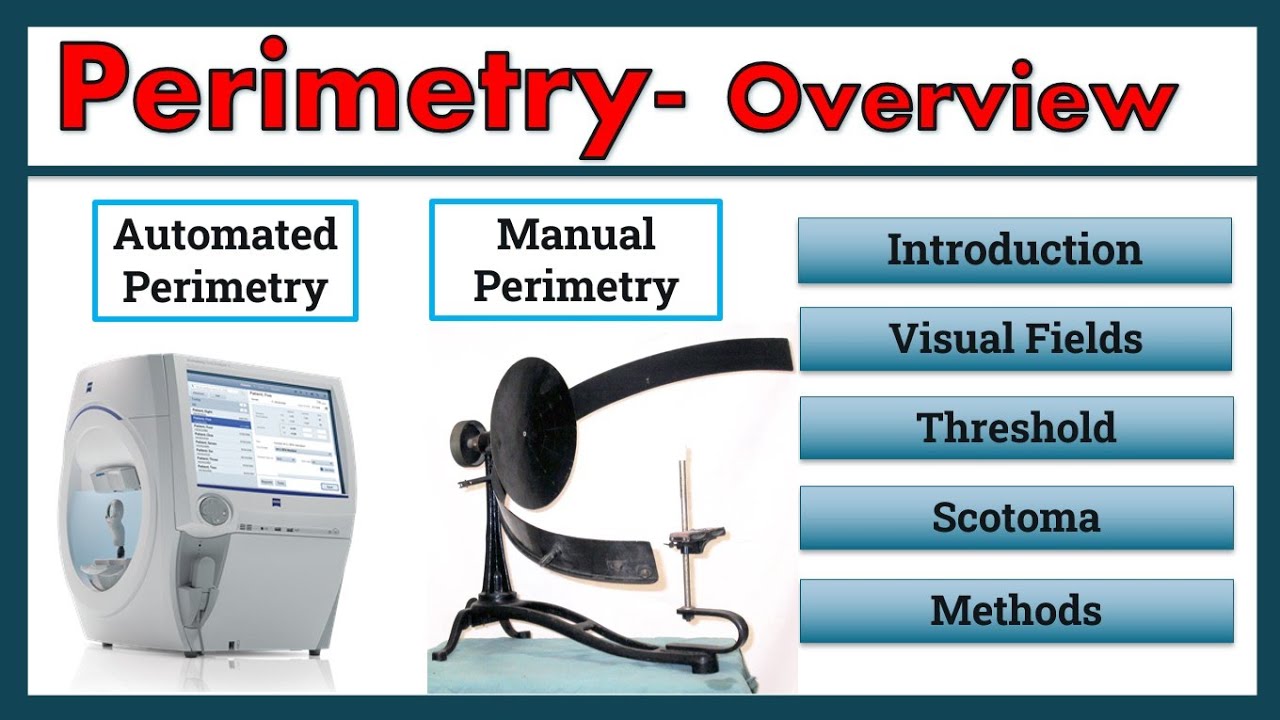
The field of vision can be examined using two methods: kinetic perimetry, which involves moving a target from the periphery towards the center, and static perimetry, which presents stimuli of varying intensity at a fixed location.
00:01:53
Static perimetry determines the sensitivity of a specific location by varying stimulus intensity, whereas kinetic perimetry identifies the location where a moving target becomes visible.
00:02:21
Kinetic perimetry is considered more efficient and flexible for evaluating the peripheral field, particularly in neurology and pediatric conditions, but not for glaucoma.
00:02:39 - 00:06:36 Kinetic Perimetry
00:02:41
The field of vision is determined by moving a target from the periphery inward along different meridians, and the points where the patient sees the target are joined to form an Isopter or contour line.
00:03:09
The Isopter varies depending on the size and color of the target used, meaning different target parameters will yield different visual field limits for the same person.
00:04:41
This variation in the visual field is a physiological phenomenon, and it is crucial to use the same isopter for follow-up examinations to ensure comparable results.
00:04:57
The anatomical arrangement of receptors, bipolar cells, and ganglion cells in the retina, which varies from the periphery to the fovea, explains why a stimulus of a certain size might be seen centrally but not peripherally.
00:06:36 - 00:07:59 Introduction to Jerem Screen
00:06:36
The Jerem Screen is a meter-by-meter screen used for checking the central visual field, with the patient positioned 1 or 2 meters away from the screen's center fixation point.
00:06:57
The screen features rings at 5°, 10°, 20°, and 30° from the central fixation point, used to map the patient's field of vision.
00:07:13
During the test, the doctor moves targets of different colors and sizes from the periphery towards the center, asking the patient if they see the target while one eye is covered.
00:07:39
If a patient misses seeing the target in a specific sector, it indicates a defect in that area of their visual field.
00:07:59 - 00:09:01 Scotoma: Types and Awareness
00:08:00
Scotoma is defined as an island of blindness within the field of vision, which can be classified as relative or absolute, and positive or negative.
00:08:11
Absolute scotoma refers to an area that is defective for all sizes and colors, while relative scotoma is an area blind to specific sizes or colors, as seen in conditions like optic neuritis or papilledema.
00:08:42
Positive scotoma means the patient is aware of the visual field defect, such as with corneal opacity or cataracts.
00:08:53
Negative scotoma indicates that a defect exists, but the patient is unaware of it.
00:09:01 - 00:12:29 Static Perimetry
00:09:01
Static perimetry offers several advantages, including repeatability, detection of shallow scotomas, and numerical data for statistical analysis.
00:10:08
The patient places their chin on a rest, and a camera tracks their cornea while they fixate on a central point, with tiny light spots appearing from different locations to test retinal sensitivity.
00:11:11
Static perimetry typically uses a special size, usually number three, but a larger size is needed for advanced glaucoma, distinguishing between central and peripheral fields.
00:11:54
The central field, representing 25 to 30 degrees, is highly sensitive and crucial because it accounts for about 83% of the occipital cortex's representation, where most pathological lesions appear.
Повторяем попытку...

Доступные форматы для скачивания:
Скачать видео
-
Информация по загрузке: