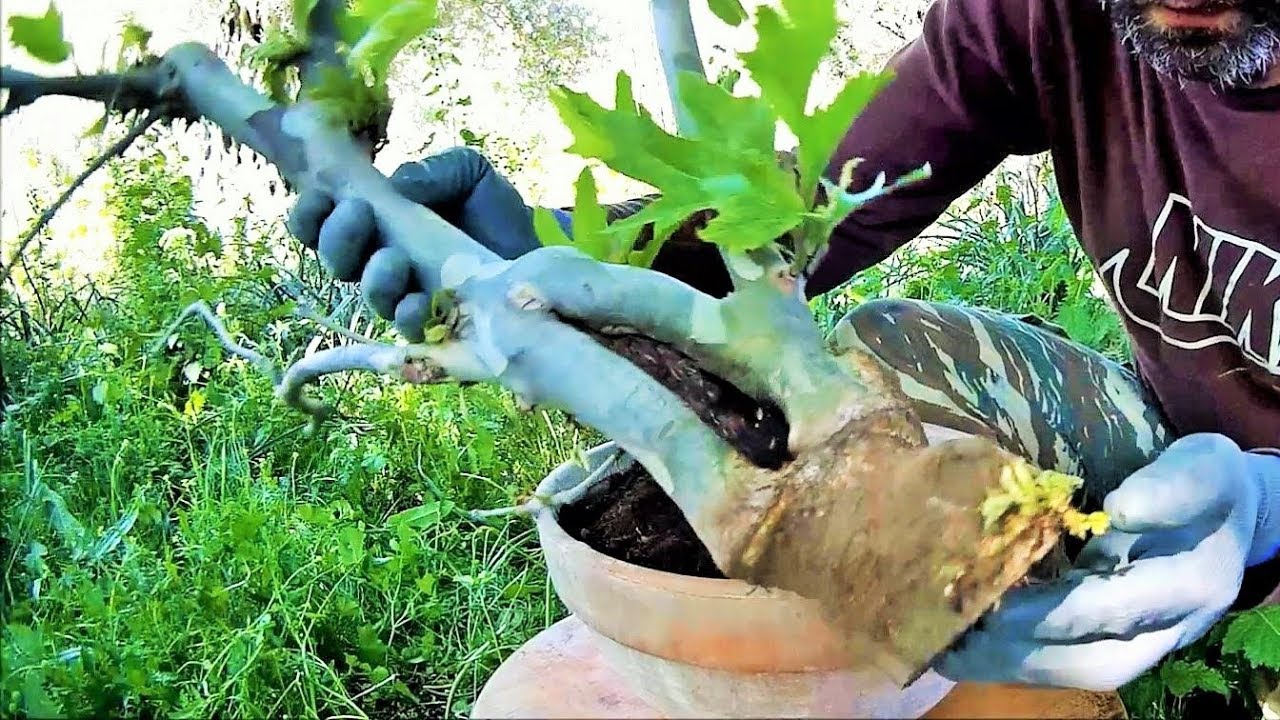
How To Collect Material For Bonsai: Collecting Platanus With Hollow Air Layering After 14 Weeks!
Автор: Mediterranean Bonsai
Загружено: 2019-05-01
Просмотров: 8462
Описание:
In episode 16 of Mediterranean Bonsai we are going in the field and we collect the platanus with hollow air layering we did 14 weeks ago for bonsai!
MAKE YOURS A BONSAI TREE OR A BONSAI POT TODAY BY SUPPORTING MEDITERRANEAN BONSAI ON PATREON :
https://www.patreon.com/bePatron?u=15...
FOLLOW US ON FACEBOOK: / mediterranean-bonsai-2191968524425062
CHECK OUT HERE THE PLAYLIST OF THE PLATANUS WITH HOLLOW: • How To Collect Material For Bonsai: Platan...
Please Subscribe & Share To Support Our Channel !!!
Platanus is a genus consisting of a small number of tree species native to the Northern Hemisphere. They are the sole living members of the family Platanaceae.
All members of Platanus are tall, reaching 30–50 m (98–164 ft) in height. All except for P. kerrii are deciduous, and most are found in riparian or other wetland habitats in the wild, though proving drought-tolerant in cultivation. The hybrid London plane has proved particularly tolerant of urban conditions.
They are often known in English as planes or plane trees. Some North American species are called sycamores (especially Platanus occidentalis, although the term sycamore also refers to the fig Ficus sycomorus, the plant originally so named, and to the Sycamore Maple Acer pseudoplatanus.
The flowers are reduced and are borne in balls 3–7 hairy sepals may be fused at the base, and the petals are 3–7 and are spatulate. Male and female flowers are separate, but borne on the same plant (monoecious). The number of heads in one cluster (inflorescence) is indicative of the species. The male flower has 3–8 stamens; the female has a superior ovary with 3–7 carpels. Plane trees are wind-pollinated. Male flower-heads fall off after shedding their pollen.
After being pollinated, the female flowers become achenes that form an aggregate ball. The fruit is a multiple of achenes. Typically, the core of the ball is 1 cm in diameter and is covered with a net of mesh 1 mm, which can be peeled off. The ball is 2.5–4 cm in diameter and contains several hundred achenes, each of which has a single seed and is conical, with the point attached downward to the net at the surface of the ball. There is also a tuft of many thin stiff yellow-green bristle fibers attached to the base of each achene. These bristles help in wind dispersion of the fruits as in the dandelion.
The leaves are simple and alternate. In the subgenus Platanus they have a palmate outline. The base of the leaf stalk (petiole) is enlarged and completely wraps around the young stem bud in its axil. The axillary bud is exposed only after the leaf falls off.
The mature bark peels off or exfoliates easily in irregularly shaped patches, producing a mottled, scaly appearance. On old trunks, bark may not flake off, but thickens and cracks instead.
Styles:
Formal upright, Informal Upright, Slanting, Cascade, Semi-cascade, Broom, Rock-over-root, Clasped-to-rock, Twin-trunk, Clump, Group planting, Saikei.
Location:
Outdoor
Position:
Place the tree where it will receive morning or evening sun but will not be in direct sunlight at the height of summer, and do not water in direct sun. The delicate foliage can "burn" if exposed to direct summer sun. Water well in early morning or late afternoon to prevent the soil from drying out.
Watering:
Water regularly keep soil moist not wet as root tend to suffer easily from root rot. Ensure soil is well drained.
Feeding:
Between early spring and late summer feed biweekly with a balanced low yield fertiliser. Slow release fertilisers are best applied in early spring as new growth appears.
Leaf and Branch Pruning:
Heavy pruning is best done in early spring before new growth appears. New growth pruning can be done in late spring early summer when 5-6 leaf nodes have grown on a stem. Cut back to leave the last two leaf node. In more mature/established specimens apex nodes are pinched off before they start to grow to encourage lateral shoots and finer branching.
Re-potting & Growing Medium:
Repot in spring every year for younger trees and every 2 to 3 years for older trees, shortening the roots by up to a third of their length. Remove dead or damaged roots to avoid root rot.
Wiring:
Younger branches may be wired sparingly and with care, in spring. Check wire frequently and remove after a few months. Older more stubborn branches will need to be pulled in to position with a wire tourniquet slowly and gradually.
Camera: SJCAM - SJ5000 Action Camera
Please Subscribe & Share To Support Our Channel !!!
Повторяем попытку...
Доступные форматы для скачивания:
Скачать видео
-
Информация по загрузке:


