Setting the stopper (cork) of a flute correctly
Автор: Jemtheflute
Загружено: 2019-01-29
Просмотров: 8158
Описание:
"How to" demonstration of the method to set the stopper (cork) in the head of a flute correctly. This video deals specifically with a "simple system" flute head with a cylindrical bore, but also mentions the similar method needed on a Böhm tapered head.
I should probably have emphasised in my (off-the-cuff, unplanned) spiel that a measured setting is by no means necessarily "correct" or going to be ideal. You must always check the actual intonation and adjust to optimise it. Then you must also consider that having the stopper farther in facilitates the upper (3rd) register at the expense of the fundamental (but makes it tend sharp relative to the lower registers) whilst pulling it farther out will make the low end stronger and richer and the 3rd register harder to access and less sweet. Compromises, compromises!
On any type or size of flute the default placement of one bore diameter from the embouchure centre is only a starting point, not a definitely "correct" one. The correct placement is the one which gives the particular player (with their unique embouchure/blowing style) accurate octave intonation at the tuning slide setting that player requires in the conditions prevailing at the time to be in tune at the required reference pitch. Just putting a simple system stopper to 19mm or a Böhm stopper to 17.3mm or whatever and pronouncing that "correct" is not doing the whole job properly. It's what a technician should do in setting a flute up, but the player should then check and (if necessary) adjust regularly, especially if needing to make significant tuning slide changes for extreme conditions or a different reference pitch.
The method shown, taking a head bore diameter onto a rod, can be used for any cylindrical head flute from piccolo upwards in size without the need to take an actual bore measurement. For a Böhm tapered head you have to measure 17mm from the end of your rod. Many commercial swab rods are already marked thus, but check it! Don't use a Böhm marking for a cylindrical head! For a cylindrical head with no projecting tuning slide you will need to measure the internal diameter of the head at the crown end and measure that onto your rod.
If your flute has no screw-adjuster connecting the crown to the stopper then you will have to remove the crown and use a broader piece of dowel than a swab rod to push the stopper in or out until positioned as you wish. It is in any case wise (especially if the stopper hasn't been moved recently) to use a broad dowel to push an adjustable stopper, or to unscrew the crown a little and push the stopper inwards with it, before trying to withdraw the stopper with the crown screw, in case it is seized in place.
For further information, visit these pages of the brilliant University of New South Wales website: http://newt.phys.unsw.edu.au/jw/flute...
http://newt.phys.unsw.edu.au/jw/flute...
http://newt.phys.unsw.edu.au/jw/tunin... (scroll to the very bottom for flute stopper info)
See also:
http://www.mcgee-flutes.com/Stopper.html
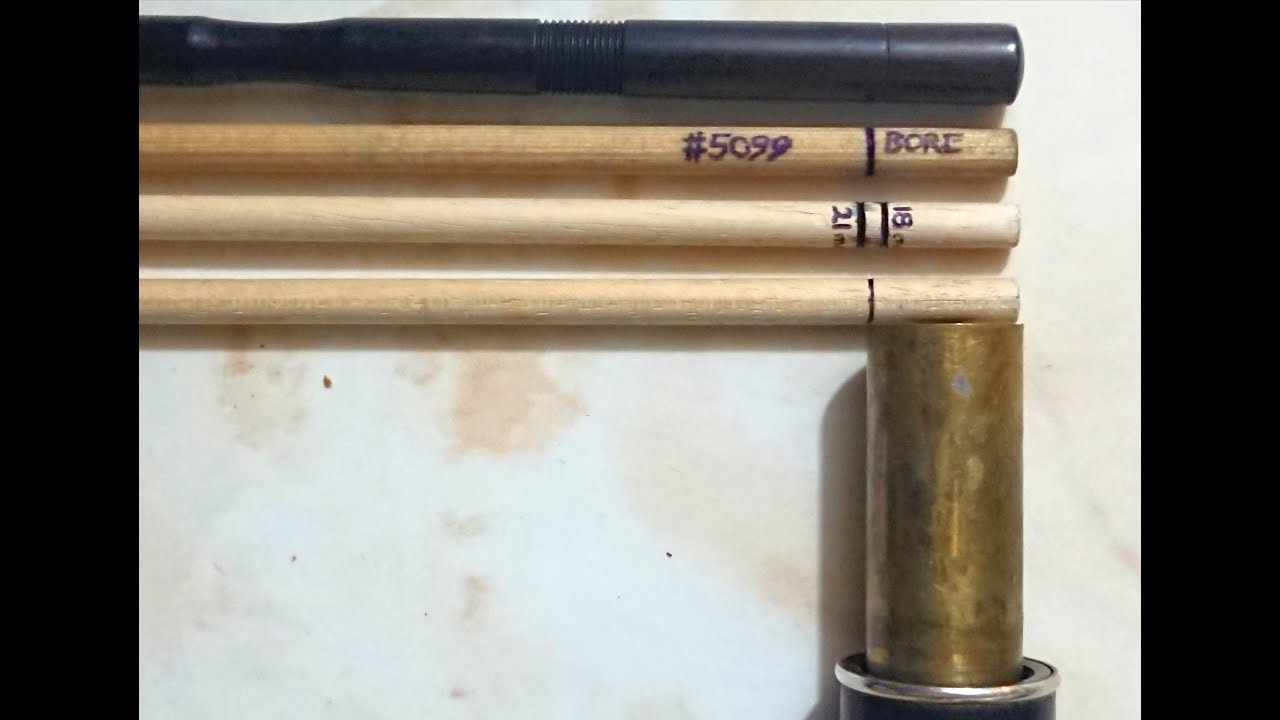
The cover photo shows the tuning slide and rod used in the video, plus two other rods I have made/marked up, one with measured marks, one with the bore of a specific flute made as per the video demonstration, and a Rudall Carte cocuswood rod marked for a Böhm taper head.
Повторяем попытку...
Доступные форматы для скачивания:
Скачать видео
-
Информация по загрузке:


