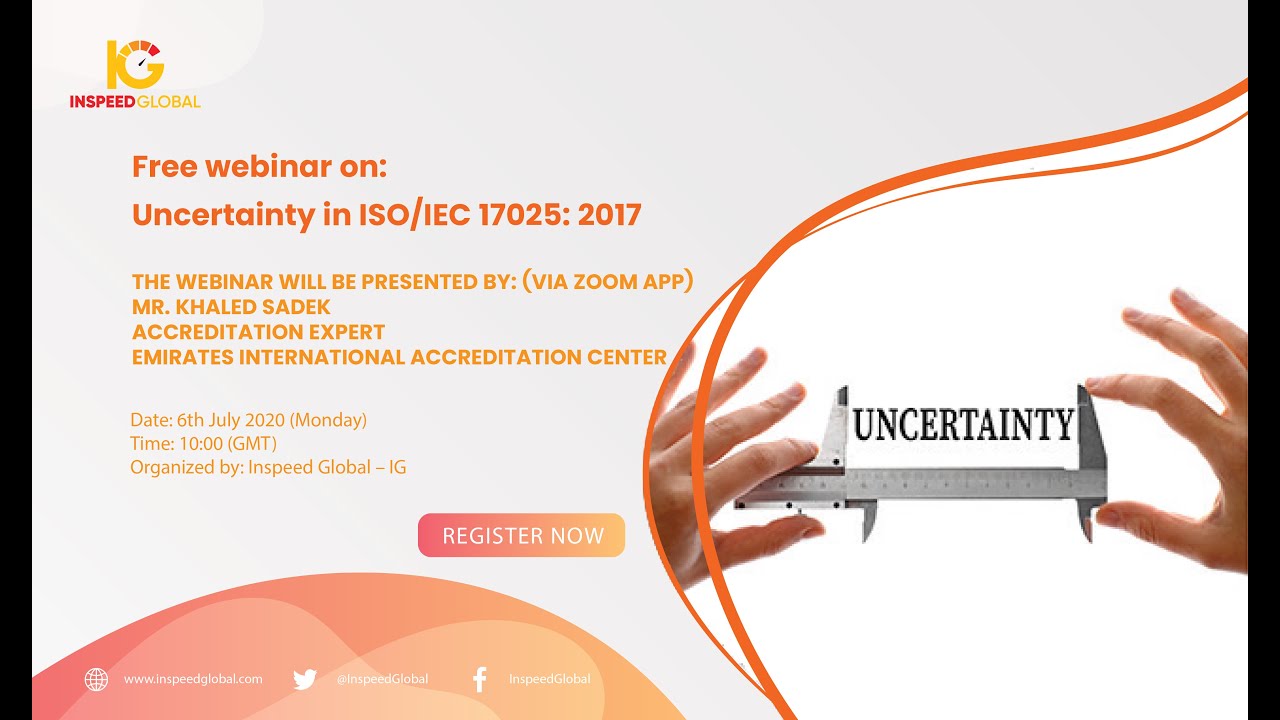
Uncertainty in ISO/IEC 17025: 2017
Автор: Inspeed Global
Загружено: 2020-07-06
Просмотров: 22882
Описание:
How your laboratory can comply with the uncertainty requirements in the new standard ISO/IEC 17025: 2017, what are the types of uncertainty and how to report the uncertainty?
WHAT IS MEASUREMENT UNCERTAINTY?
Measurement uncertainty refers to the doubt or lack of knowledge about the true value of a physical quantity being measured. It is an inherent characteristic of any measurement process due to various factors such as limitations of the measuring instrument, environmental conditions, human error, and the variability of the quantity being measured itself. Measurement uncertainty is usually expressed as a range of values within which the true value is expected to lie with a certain level of confidence. Accurately estimating and reporting the uncertainty associated with a measurement is crucial in determining the reliability and validity of experimental results and ensuring their proper interpretation and use.
WHY KNOWING MEASUREMENT UNCERTAINTY IS IMPORTANT?
Measurement uncertainty has an impact on all measurements, and for critical measurements, uncertainty can mean the difference between a pass or fail decision. Accurate measurements are critical in industries such as oil and gas, where miscalculated measurements may result in environmental harm, financial loss, damage to reputation, or even loss of life. Identifying sources of uncertainty in the measurement and test equipment for a given product may be difficult and time-consuming.
HOW TO MEASURE MEASUREMENT UNCERTAINTY?
Measuring measurement uncertainty can be a difficult task, especially when identifying the sources of uncertainty that affect a given product or set of measurement and test equipment. However, there are several factors that can contribute to uncertainty, such as;
Calculating total measurement uncertainty involves several components, with standard deviation being a crucial one. Simply taking one measurement is not enough, and repeating the measurement multiple times can help determine the normal difference between measurements. This process can provide information on the A-type uncertainty components, which are calculated using standard deviation. It is essential to keep the standard deviation in mind during the calibration process as it is a significant part of total uncertainty. Another significant source of uncertainty comes from the reference standard or calibrator used in the measurement or calibration. Selecting an appropriate reference standard and paying attention to the total uncertainty documented by the laboratory for the reference standard can help mitigate this uncertainty. Other components, including those mentioned earlier, contribute to measurement uncertainty and are classified as type B uncertainty components.
REPORT MEASUREMENT UNCERTAINTY
Reporting measurement uncertainty must provide accurate, clear, unambiguous, and objective results and include all information necessary for the interpretation of the results. Calibration laboratories must always include the measurement uncertainty on calibration certificates. However, for testing laboratories, they have a choice. The uncertainty must be included on the report when it is necessary for the interpretation of the results and when the measurement uncertainty is relevant to the validity or application of the test results, when the customer’s instruction requires it, or when the measurement uncertainty affects conformity to a specification limit.
MEASUREMENT UNCERTAINTY IN ISO/IEC 17025:2017
ISO/IEC 17025:2017 is the international standard for testing and calibration laboratories. It sets out the requirements for the competence, impartiality, and consistent operation of these laboratories. One of the key requirements of this standard is that laboratories must be able to demonstrate that they have a well-established measurement uncertainty (MU) estimation process for all of their measurements. This means that laboratories must have a comprehensive understanding of the sources of uncertainty that affect their measurements, and they must be able to estimate the size of these uncertainties using appropriate statistical methods. The ISO/IEC 17025:2017 standard provides guidance on how to carry out MU estimation, and it requires laboratories to report their measurement results with associated uncertainty values. By complying with this standard, laboratories can provide their clients with greater confidence in the accuracy and reliability of their test and calibration results.
00:00 Introduction
05:57 Definition of uncertainty
06:24 Example of uncertainty
10:52 Uncertainty vs Error
33:47 Restorative
37:35 How to report
34:48 Conclusion
#uncertainty
Contact us on:
E-Mail: [email protected]
Int. Marketing & Customer Relations:
+44 793 084 0449 (Call & What Sapp) +90 553 775 1648 (Calls)
English and Arabic conversations are available.
Contact info:
Website : https://inspeedglobal.com/
Facebook : / inspeedglobal
Повторяем попытку...
Доступные форматы для скачивания:
Скачать видео
-
Информация по загрузке: