Didcot Power Station firing up, and some information from memory of the tri fuel burner layout
Автор: The Inspiring Engineer - Scrapbook
Загружено: 2015-03-14
Просмотров: 3737
Описание:
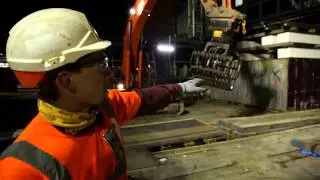
Didcot Power Station memories - Unit 3 warming up. sorry for being in a hurry and swinging the camera about, was trying to not run out of video, Enjoy! :) Alas the old girl made the national news big time when botched preparations for demolition, led to the collapse of two of the four boilers and the loss of four experienced professional demolition men. The thumbnail shows a view of 'my office' (as well as my own workshop) down one of four burner galleries per boiler - each gallery had 2 groups of 6 burners - jet engine sized monsters, giving 48 in total per boiler.
Top row (gallery) burners - 'G' and 'E' group - burners E1 E2 E3 G4 G5 G6 G7 G7 G9 E10 E11 E12
Second row burners - burners 'B' and 'C' group B13 B14 B15 C16 C17 C18 C19 C20 C21 B22 B23 B24
Third row from top - burners 'A' and 'F' group A25 A26 A27 F28 F29 F30 F32 F32 F33 A34 A35 A36
Forth from top , bottom row - 'H' and 'D' group H37 H38 H39 D40 D41 D42 D42 D44 D45 H46 H47 H48 - ten years on, I can still remember all the burner numbers! :)
Notice that one group of six burners is in the middle and the other group split in two with three burners at one and and three at the other - this is because it was six burners to a 'mill' (ground up the coal - see 2:15) so each mill would provide heat across the whole boiler - not just one side - effectively the burner groups of three mirrored each other across the vertical centerline of the boiler with each mill feeding two groups of three - the burners would be put in burning oil, then the mill would be started and as the ground up coal dust came through to the six burners and producing a stable flame, the oil burners would then be dropped out and the burners continue burning on ground up coal - which we would call simply 'PF' for 'pulverised fuel' from the pulverisers on the ground floor - the coal would be ground until the particles were small enough to be swept up is an airstream and carried to the burners, this airstream would be provided by a large fan (called?) but this would be only a small part of the total air feed - the bulk of which would come in the air intakes at the top of the building (to recycle waste heat from the boiler house), then passed through rotating heat exchangers to transfer heat from the exhaust to further preheat the air, then some of it would be diverted to the mills, the rest of it would pass through two huge ducts either side of the boiler, each as large as a double decker bus with a single decker bus on top, these would feed air to the burners via ducting the ran under or over the burner galleries - the angled yellow pipes you can see in the thumbnail is the gas piping, to feed gas to the burners as the burners could burn oil (for lighting up), coal or gas - the oil burners were not powerful enough to maintain full load as they were just for lighting up, the coal and gas burners could. However, before my time there, during the 1980's miners strike, the oil burners were retrofitted with high flow burner jets to increase the available heat from the oil burners to save coal. I remember this from a documentary I saw years before called "The men who kept the lights on" - I wish I could see this documentary again if anyone knows where I could find a copy. In 1995, the burners were changed on units 1, 3, and 4 to one that could also burn gas, to further protect the nation from possibly again being held to ransom by the miners, Unit 2 was never converted as it was difficult to get the gas line in, and the sentiment at the time is that it would be cannibalised as spares for the other three units, a common practice for old stations was to take a unit out of service and use it for spares - but, it remained in service right up until the end. Fawley oil station (that I visited as a child on a school trip), had only two units running with the other two being used for spares, when it stopped generating the same time Didcot 'A' station did, Fawley was built to take heavy 'bunker' oil from a nearby oil refinery, this oil is like tar that needs to be heated up to 160 degrees C and pressured to 300 bar like it did at Didcot 'A' station (from memory - please correct if wrong) to get it to atomize in the burner jets to a spray assisted by a 'core air fan' (the orange fans you can see on the burners) Fawley too has now being demolished and replaced by a wind farm, talking of which, I helped in the construction of the wind farm you could see from the top of the boiler house - Westmill Wind Farm near Watchfield on the a420. Didcot 'A' station could consume a ton of coal every 6,5 seconds and produce 10,000 tonnes of CO2 per day - this was a motivator for my involvement in the UK's first and worlds largest community build energy project. Over its lifetime, Westmill wind and solar will off set around six months of emissions from Didcot 'A' station - a proud achievement :) Please feel free to correct me or all further details if you so wish in the comments, and I will add them here..... ;)
Повторяем попытку...

Доступные форматы для скачивания:
Скачать видео
-
Информация по загрузке: